Write your resume in 15 minutes
Our collection of expertly designed resume templates will help you stand out from the crowd and get one step closer to your dream job.


Whether you're applying in London, New York, Sydney, Toronto… hiring managers share one habit: they spend ten seconds on a professional resume in English before deciding if it's worth their time. A well-written one DOES something in those ten seconds: it creates a voice, a presence.
Then suddenly there's a person on the page, not just a list of roles. That's when 10 seconds become a closer read… and a closer read becomes a phone call.
Why English shifts the way you write
English, especially in professional contexts, leans on action and impact. Recruiters often skim dozens of CVs in minutes, so your words need to pull them in immediately.
Short, punchy sentences with strong verbs like “led,” “rolled out,” or “optimized” immediately signal competence. Numbers, percentages, or concrete outcomes make your CV memorable without sounding boastful.
Mini example:
- Before: Responsible for managing a social media team.
- After: Led a team of 5 to redesign content strategy, increasing engagement by 40% in six months.
Do you see the difference? One line and your contribution comes alive !
Take the time to read our full guide to writing a professional CV in English
How ATS systems read your resume in English
Before a hiring manager reads your CV, something else does. A lot of modern companies in English-speaking job markets run applications through an Applicant Tracking System (ATS), filtering, ranking, and sometimes eliminating CVs before a human eye gets involved.
This emerging practice tends to be a principle. That's not a reason to panic, but reason to understand how this contemporary system works.
Use keywords so your resume passes ATS filters
ATS systems don't read your CV the way a person does. They scan for specific terms, and they're often literal about it. If a job description says "Adobe Creative Suite" and your CV says "Adobe Creative Cloud," you may not surface at all, despite having the exact skill.
The move is simple: read the job description carefully, note the exact language used for skills, tools, and responsibilities, and mirror it. Not stuffed in awkwardly, woven into bullets where they naturally belong.
Newer ATS tools (the ones rolled out across larger companies in these last years) use AI to read context, not just keywords. Which means keyword stuffing now works against you. A CV that repeats "project management" seven times reads as low-quality to the system, not thorough.
The current standard is natural writing that mirrors job description language. Writing for a machine and writing well have converged, which, if you're already doing the latter, is good news.
Why you should have two resume versions (ATS and PDF)
The practical standard now is to maintain two versions of the same document:
- The ATS version : a clean .docx file. No columns, no text boxes, no icons, no tables. Standard section headings ("Work Experience," not "Where I've Been"). Fonts that parse cleanly. This one goes through the upload portal.
- The human version : your polished PDF. Same content, better presentation. This one you send directly, or attach when the format is your choice.
Same story. Two formats. The content must match exactly.
Writing the English CV itself
Some points need your full attention when you write an English CV or résumé both for ATS and human.
Professional summary: making your first ten seconds matter
The top of your CV is the only part most recruiters will actually read. Think of your professional summary or profile (the About me section) as a compressed argument: who you are, what you do, and what you've delivered. Not a list of qualities. A narrative.
Here's what that looks like for a digital marketer:

Best CV in English : focus on achievements, not responsibilities
Most CVs read like job descriptions. English-speaking recruiters aren't looking for what you were hired to do. They want to know what actually happened when you showed up.
Avoid Using “I” in an English Resume
One habit that flags non-native writers immediately: using "I" in a CV. It's not really necessary. The document already belongs to you, and it often reads as unprofessional across all English-speaking markets. Most of the time, every bullet starts with a verb, not a pronoun.
 Not:
Not: But:
But:Standard structure of a professional resume in English
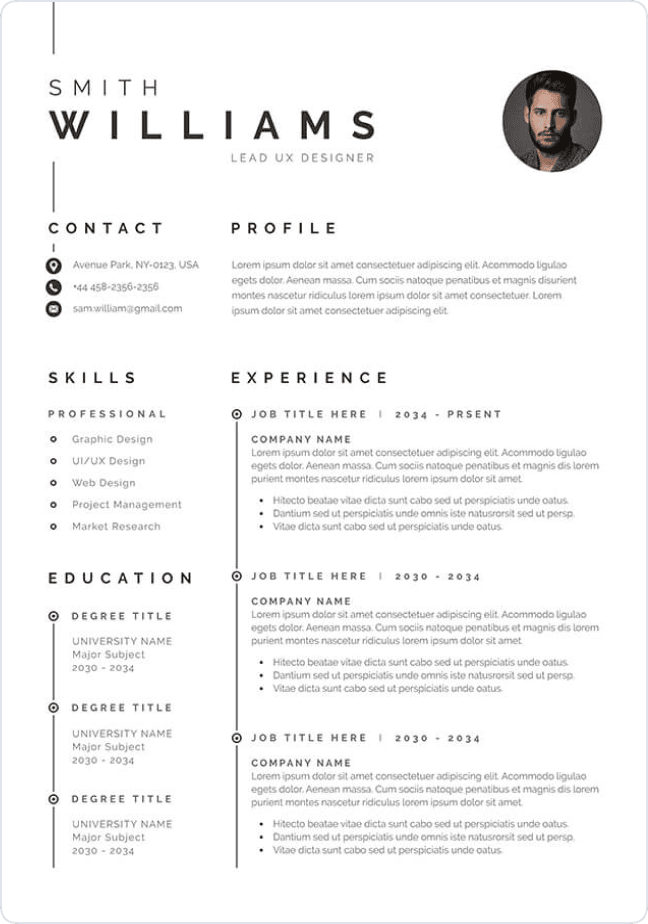
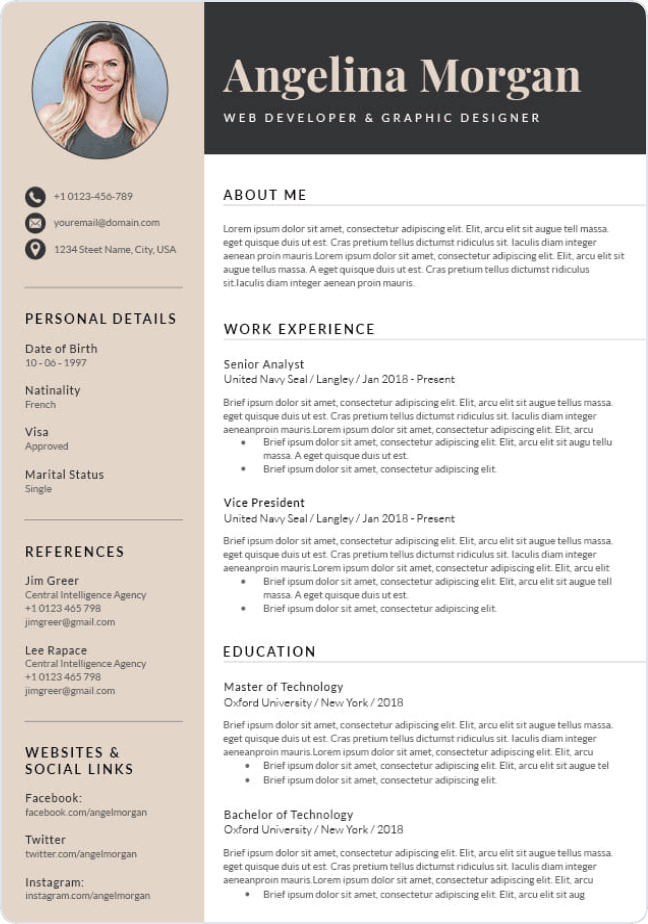
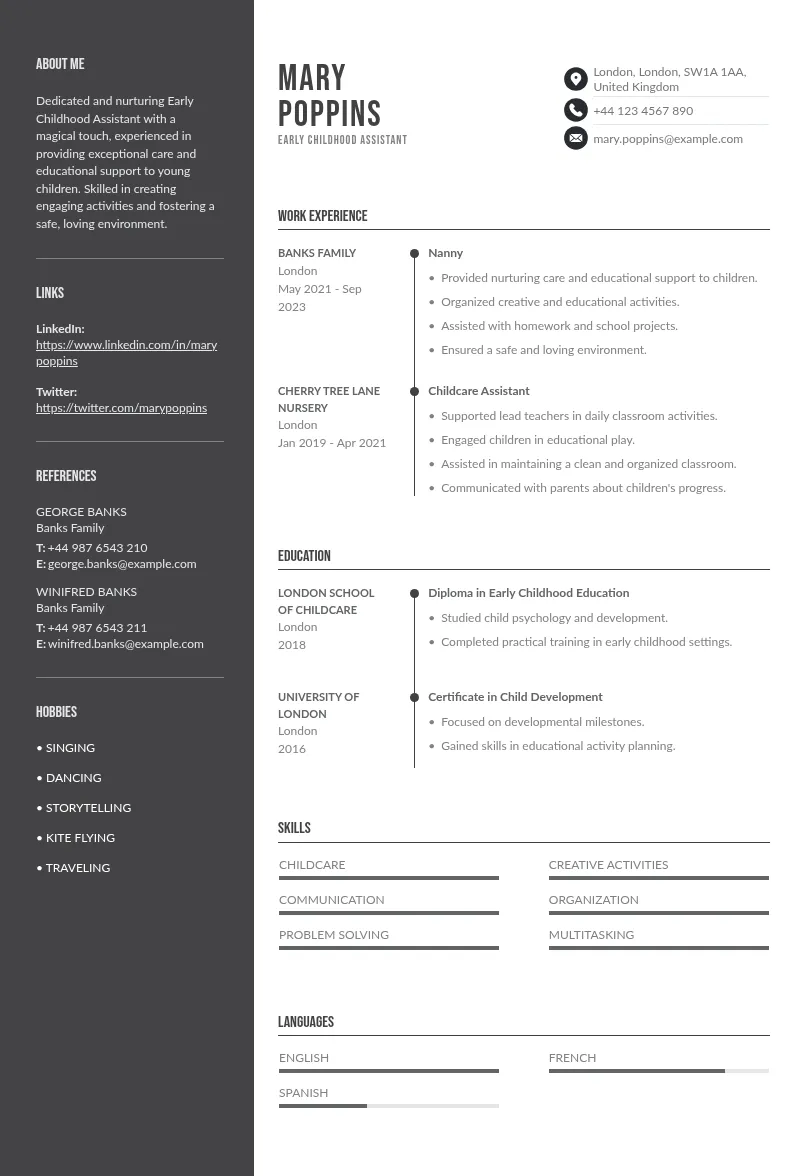
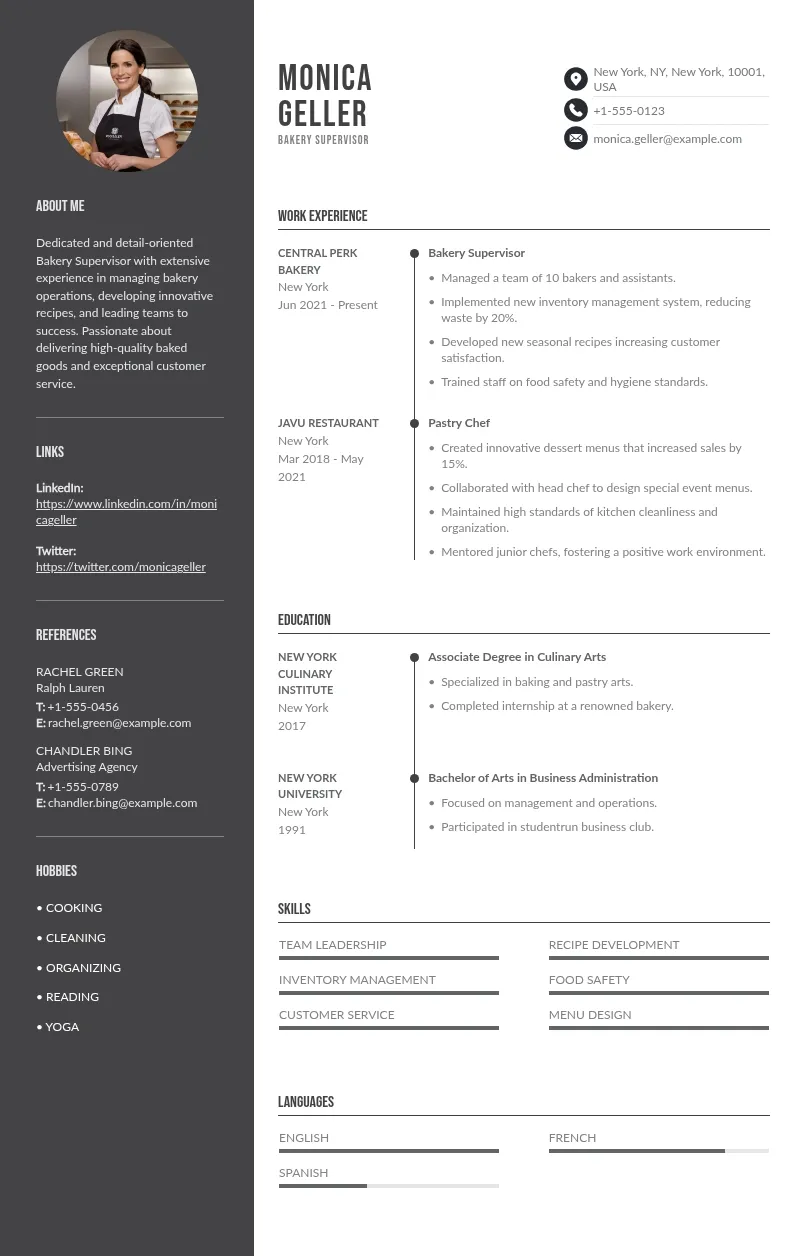
When applying to English-speaking markets, your resume needs to be clear and well-structured. It should highlight your achievements in a way that’s immediately understandable. Use organized headings and a dedicated skills section. This ensures your resume works for both ATS systems and human recruiters.
Using well-designed ATS-friendly resume templates can also help ensure your resume is properly formatted and easy for hiring software to read. Every element should clearly communicate your value… no fluff, no guesswork.
Example of an ATS-friendly, internationally formatted English resume
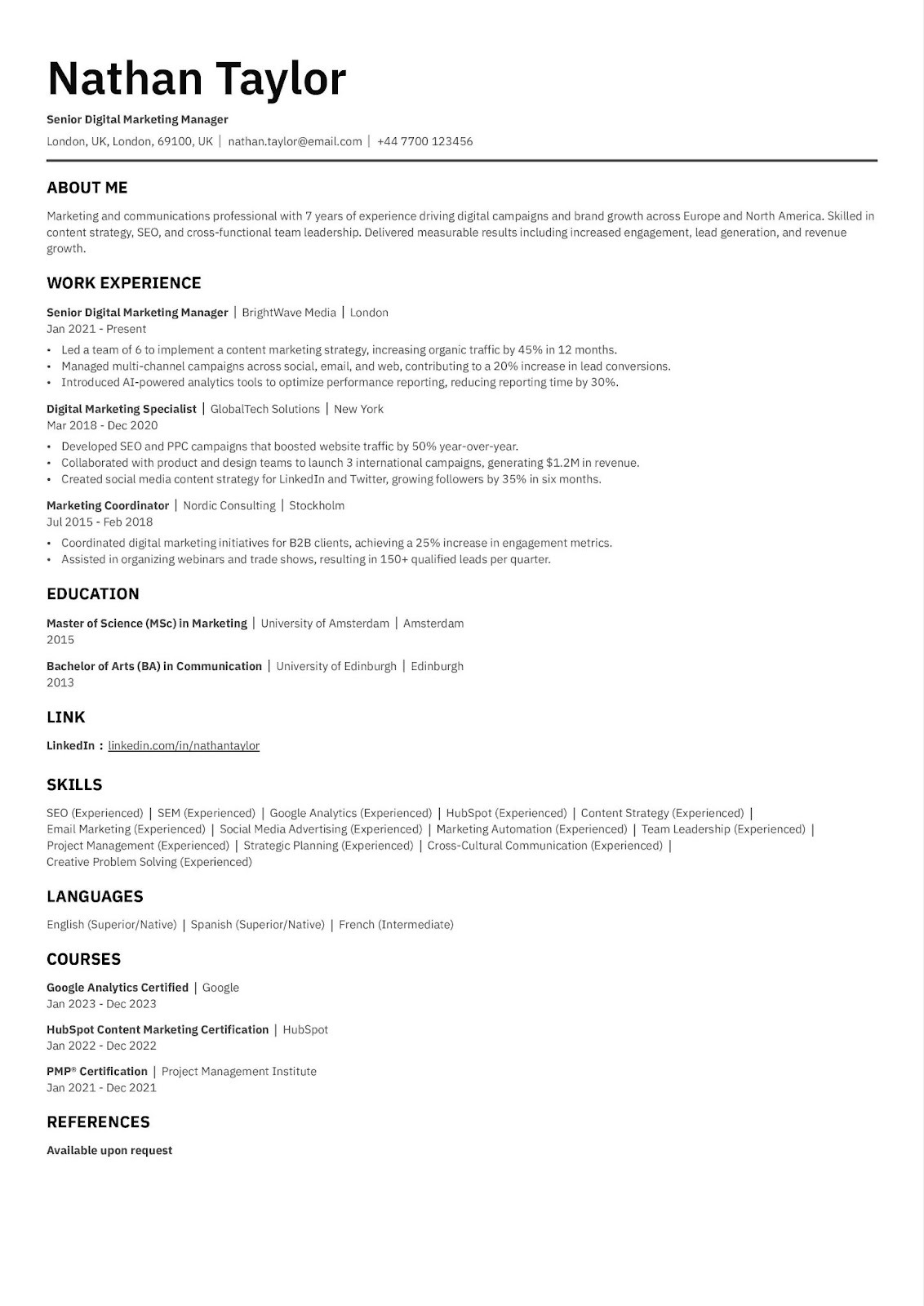
Recommended layout for resume in English-speaking job markets
A professional resume or CV in English doesn't try to impress with density. It's clean, structured, and readable at a glance.
- Header with Name, email, phone, LinkedIn
- Professional Summary : 3 to 5 lines, achievement-focused
- Work Experience in reverse chronological, with bullet points: action + result
- Education : showing degree, institution, dates, relevant coursework
- Skills section with hard and soft ones (clearly separated, ideally)
- References : "Available upon request" or its absence is the standard in both the UK and US
Skills: show both sides
Technical skills get you past the filter. Interpersonal ones close the gap.
- Hard skills: Tools, software, methodologies — SEO, SQL, HubSpot, Agile.
- Soft skills: Don't just list "leadership." Show it — "Worked across three departments to deliver a product launch on a compressed timeline."
This is also where your keywords live. The skills section isn't just a list for the recruiter: it's the index the machine searches first. Keep it clean, accurate, and aligned with the language of the roles you're targeting.
UK CV and US resume: More than a style difference
In the United States, "CV" and "resume" are not interchangeable. A CV in the US context is an academic document, long-form, exhaustive… used for research or faculty positions. When applying to a US company, you submit a resume. Getting that wrong signals unfamiliarity with the market (before anyone's read a word).
In the UK, Australia, Canada, and most of Europe, CV and resume in english refer to the same thing. A few structural differences are also common:
- In the US, resumes typically include a Professional Summary, and bullet points tend to be short and highly results-focused.
- In the UK, Canada and Australia, CVs often include a Profile, with slightly fuller sentences and sometimes professional memberships.
Neither format is better. What matters is using the conventions expected in the market where you apply.
One framework, Several fluencies
The rules hold across every English-speaking market and every professional field. What changes is how you apply them. Different industries have different definitions of proof — a number that lands well with a marketing director means nothing to a CFO. A deployment metric that excites a CTO falls flat in a consulting pitch.
The framework stays the same. The vocabulary you borrow from each field is what changes.
Tech and IT
Speed and specificity. Recruiters in this space filter fast, and vague language is the first thing cut. "Contributed to" and "worked on" describe presence, not impact.
Lead with delivery. What shipped, what improved, what scale it touched.
If you worked in a team (in tech), own your slice of it precisely. "Owned front-end architecture for a three-person squad" lands differently than "collaborated on development."
Marketing and Sales
Numbers carry the most weight here, and their absence is the most noticed. Conversion rates, audience growth, pipeline value, ROI. If something moved, say by how much and over what timeframe.
The tone can carry slightly more personality than other fields without losing its footing. Phrasal verbs work well here ("came up with," "built out," "ran with"…) because the field values commercial instinct alongside execution.
Example:
Finance and Consulting
Precision over personality. Exact, not dense. Long sentences with multiple clauses are as much a liability here as they are anywhere else.
What this audience reads as credibility: process improvement, error reduction, decision-making under pressure, and scale.
One thing specific to consulting: context matters as much as outcome. Who the client was (by sector if not by name), what the brief was, what changed as a result. That's the narrative structure consultants recognise.
Creative industries : design, editorial, media
Creative CVs sit in an awkward position. The field rewards originality, but the document that gets you in the room still needs to be readable, structured, and ATS-compatible. The temptation to let the CV itself be the creative work usually backfires.
The same clean structure applies, but the language shifts. Where a finance CV leads with scale and rigour, a creative CV leads with the brief, the constraint, and what came out of it. Process is part of the proof here in a way it isn't elsewhere.
Example:
Here a few other things specific to creative roles:
- Portfolio link in the header. Not buried, not optional. It's the primary document. The CV is the context around it.
- Soft skills read differently here. "Collaborated with stakeholders" is weak in any field. In creative industries, what matters is how you held a creative vision through feedback, budget cuts, and shifting briefs. Show that instead.
- ATS still applies. Especially in media and larger agencies. A beautifully designed CV in a non-standard format may never be read. Keep the ATS version plain; let the portfolio carry the aesthetic weight.
Reading the job description differently
Verb, context, result. the structure stays fixed. What shifts by field is the weight of each element:
- In tech, result and scale.
- In marketing, result and the method that produced it.
- In finance, result and the rigour behind it.
- In creative, the brief, the constraint, and what came out of it.
Read the job description not just for keywords, but for what it treats as evidence. The language a company uses to describe the role tells you what they'll read as proof.
A professional CV in English isn't a record of where you've been. It's a case for where you're going. Every bullet, every metric, every verb should be doing a job building a picture of someone worth meeting. And before that picture reaches a human, it passes through a machine.
Create your resume with the best templates