You moved to Canada, or you are about to, and your old resume probably will not cut it. Canadian employers follow specific conventions. Get them right and your application reaches a recruiter. Get them wrong and an ATS or any HR system filters you out.


This guide covers the exact Canadian resume format: what to include, what to leave out, how it differs from an American resume, and the small details like spelling and date formats that trip up most newcomers. Five downloadable templates are included so you can build yours today.
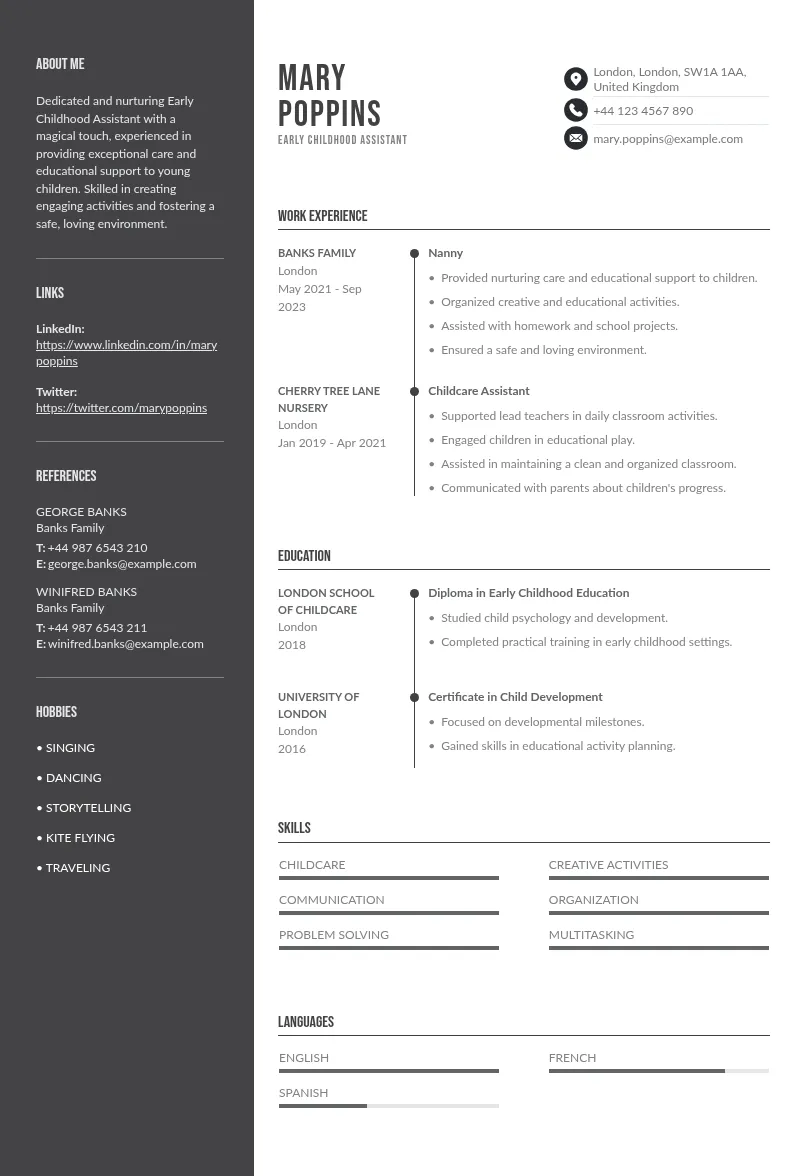
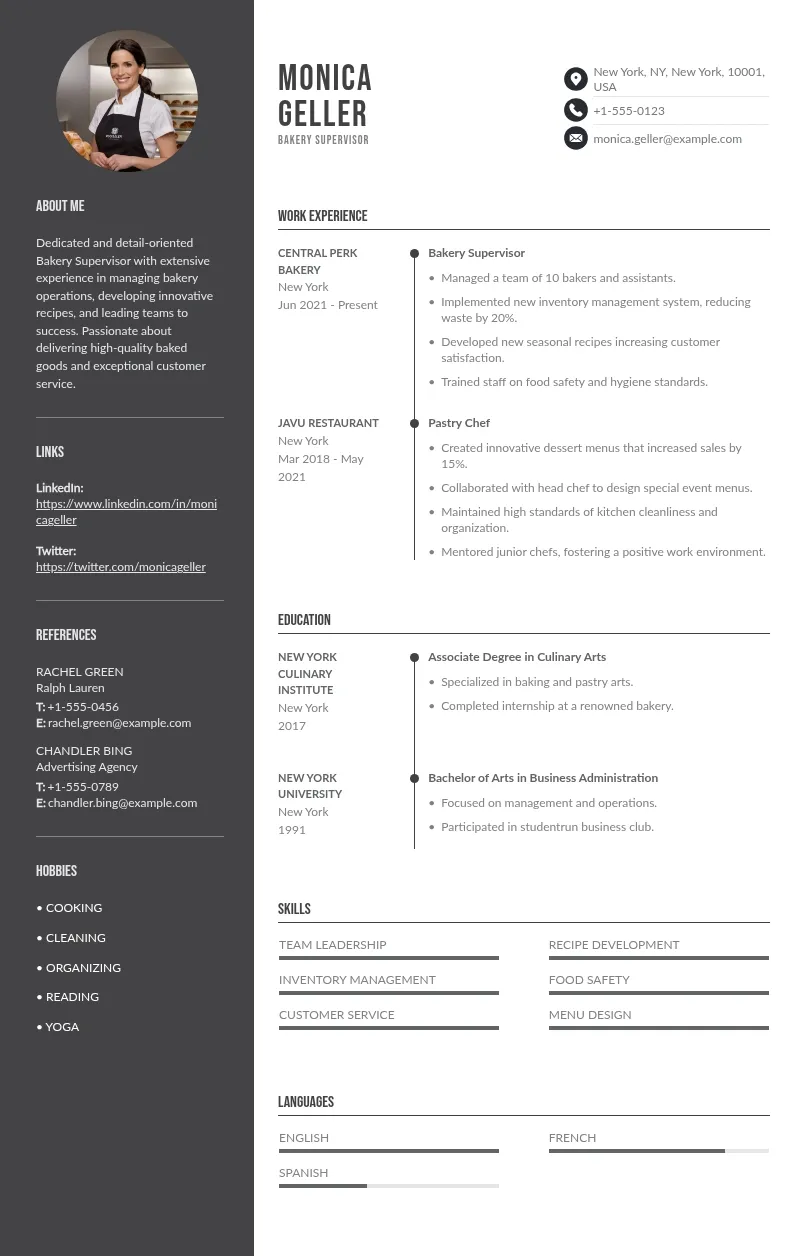
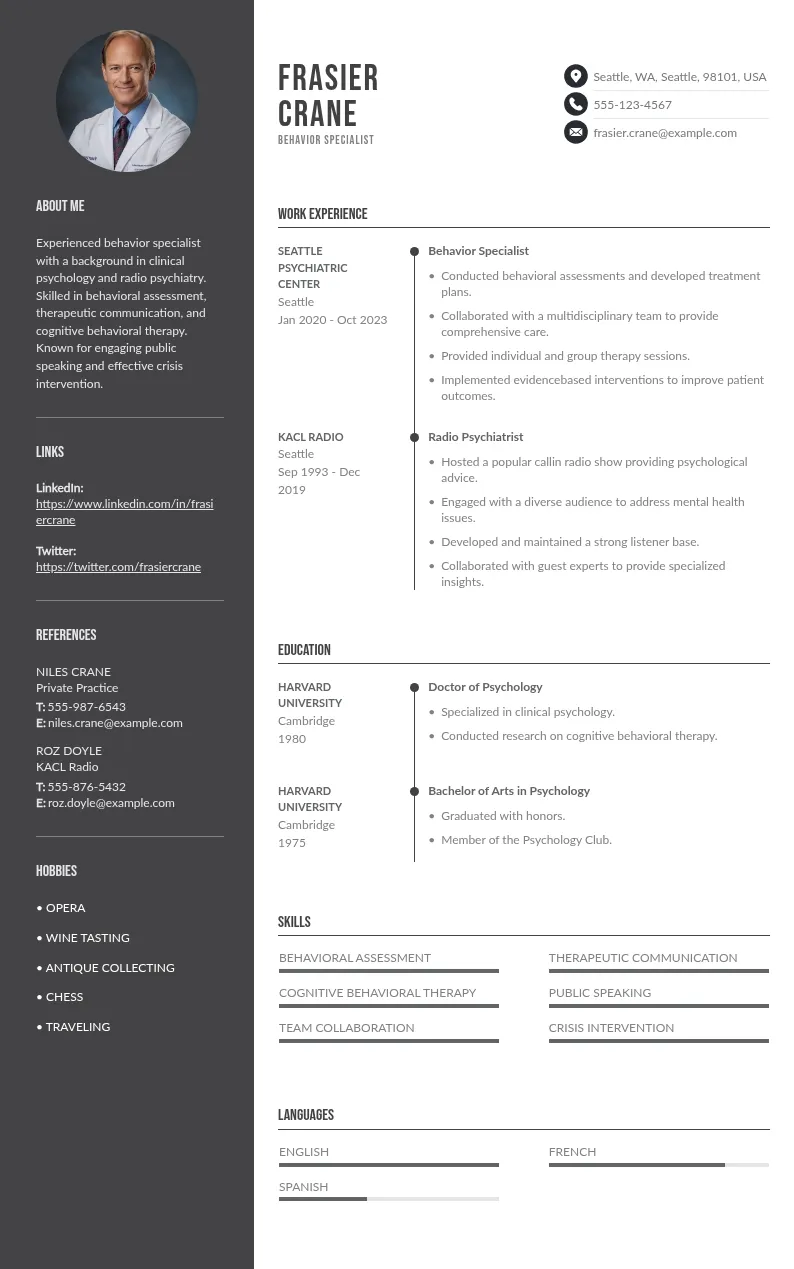
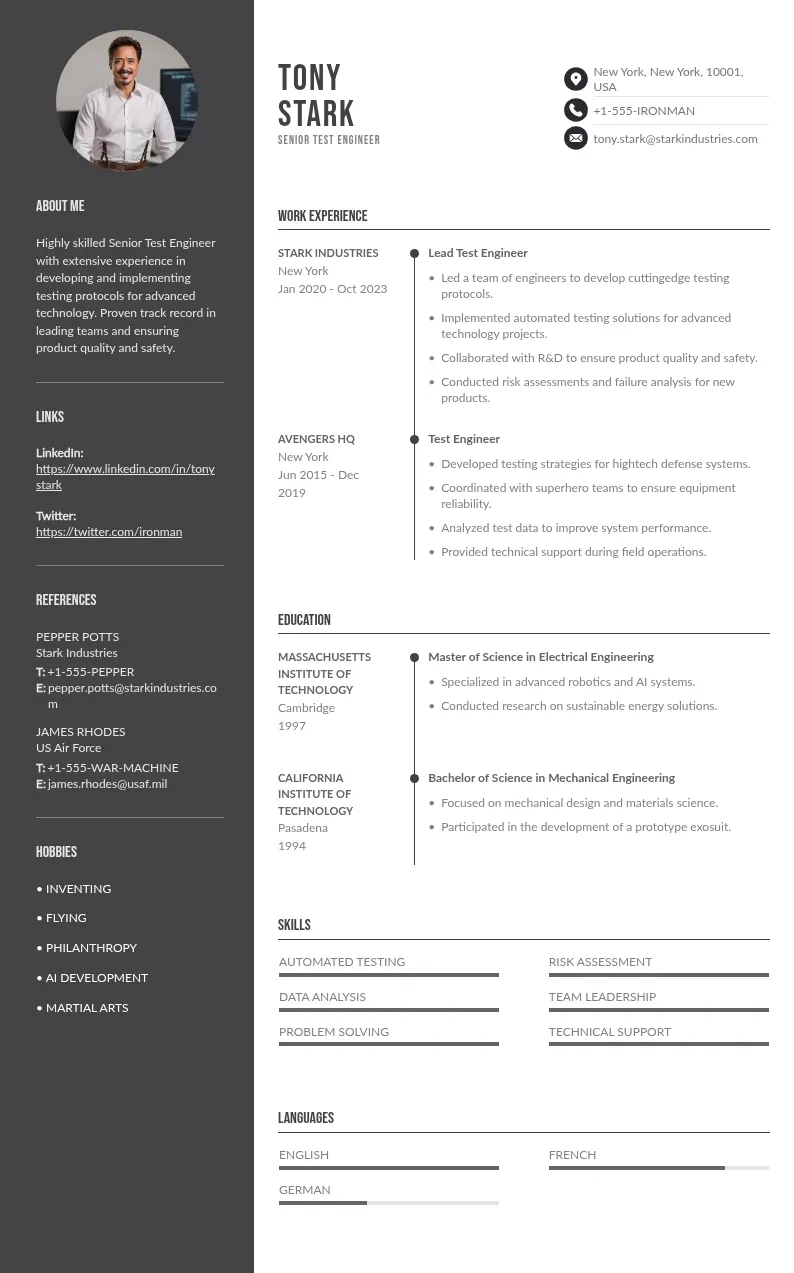
The five examples below show what a finished resume format in Canada looks like across marketing, media, hospitality, healthcare, and security. Each one is built to pass ATS systems used by Canadian employers and to satisfy a human recruiter in under ten seconds.
Use them as structural references, then adapt the content to your own background.
If you are writing a marketing director resume in Canada for a corporate role in Toronto or Montreal, the core challenge is compression: you need to communicate executive-level P&L scope, team leadership, and measurable commercial outcomes within two tight pages.
Canadian hiring committees in competitive markets do not reward long summaries or dense duty lists. They respond to specificity. The example below shows the resume format for Canada that works at the senior marketing level: a brief but numbers-anchored summary, experience bullets that open with a result rather than a task, and a skills block aligned to the job posting's language.

ALEX TEXAS
Marketing and Sales Director
Toronto, ON | 555-674-5678 | alextexas6@yahoo.com | linkedin.com/in/alextexas
Professional Summary
Results-driven marketing and sales leader with 12+ years driving revenue growth across B2B and B2C markets in Canada and the US. Proven record of building high-performance teams, launching multi-channel campaigns, and delivering measurable ROI. Seeking a senior leadership role to apply strategic marketing expertise and data-driven decision-making in the Canadian job market.
Work Experience
Ruby Motors Company, Saskatoon, SK
Marketing Coordinator | 2015 to 2018
Volunteer Work
Zetech Company, Saskatoon, SK
Sales Representative | 2014 to 2015
Education
Bachelor of Arts, Marketing | University of Tampa, Tampa, FL | July 2022 | GPA 3.7
Certifications
Health and Safety | First Aid and CPR
Key Skills
Strategic planning | P&L management | Team leadership | Digital marketing | CRM systems | Data analysis | Cross-functional collaboration | Bilingual communication
A broadcast journalism resume for the Canadian job market lives or dies on verifiable market credentials and editorial credibility. Newsroom hiring managers at CBC, CTV, Global, or City TV assess candidates against the size of the markets they have worked in, their behaviour during breaking news events, and their digital presence.
The resume format in Canada for senior broadcast roles works best with a clean two-column layout: personal branding and supporting details on one side, core career narrative on the other. Promotional language is a red flag in this sector. The tone should read like a well-constructed lead paragraph: specific, factual, and economical with words…
SARAH CHEN
Senior News Anchor | Broadcast Journalist
Vancouver, BC | 604-555-0192 | sarah.chen@email.com | linkedin.com/in/sarahchenbc
Professional Summary
Senior news anchor and broadcast journalist with 14 years of live on-air experience across major Canadian markets. Recognised for composure during breaking news events and for growing audience share consistently. Fluent in English and Mandarin. Experienced covering business, politics, and public affairs for the Canadian job market.
Work Experience
CBC Vancouver, Vancouver, BC
Senior News Anchor | 2018 to present
CTV News Toronto, Toronto, ON
News Reporter | 2012 to 2018
Education
Bachelor of Journalism | Toronto Metropolitan University (formerly Ryerson), Toronto, ON | 2011
Key Skills
Live broadcasting | Editorial judgment | Breaking news | Digital storytelling | Audience development | Bilingual: English and Mandarin | Social media | Crisis communications
Writing a business owner resume for jobs in Canada requires a deliberate reframing. Ownership and self-employment must be presented as executive-level leadership, not as a gap or an alternative to traditional employment.
Canadian executive recruiters in hospitality hubs like Calgary and Montreal respond to transformation narratives: what the property looked like when you took over, what it looked like after, and the operational decisions that drove the change, etc.
The structural rule for this Canadian resume format is simple: treat your own business exactly as you would any other employer, complete with a formal title, dated employment, and quantified outcomes. Entrepreneurial scope that is not quantified is invisible on a resume in Canada.
MARCO BELLINI
Hotelier | Entrepreneur | General Manager
Montreal, QC | 514-555-0248 | marco.bellini@email.com | linkedin.com/in/marcobellini
Professional Summary
Hospitality entrepreneur with 16 years founding, rebuilding, and operating independent hotels across Quebec and Ontario. Track record of turning around underperforming properties, growing RevPAR by an average of 28%, and building bilingual teams that consistently achieve 4.5+ guest ratings. Seeking a GM or VP Operations role with a Canadian hotel group.
Work Experience
Bellini Group, Montreal, QC
Founder and Managing Director | 2010 to present
Fairmont Hotels and Resorts, Toronto, ON
Front Office Manager | 2007 to 2010
Education
Diplome en gestion hoteliere | Institut de tourisme et d'hotellerie du Quebec | 2006
Languages
French (native) | English (professional working proficiency) | Italian (conversational)
Key Skills
P&L management | Revenue management | Team development | OTA and channel management | Brand positioning | Crisis management | Bilingual operations | Contract negotiation
A medical resume in Canada follows stricter conventions than almost any other sector. Hospital hiring committees screen first against licensure, then against clinical scope, then against institutional affiliation.
The resume format for Canada in regulated healthcare demands that your provincial licence number, Royal College certification (FRCPC or FRCSC), and active status appear near the top of the document, in a dedicated credentials block. Promotional language is actively unwelcome; factual and restrained is the correct register.
For internationally trained physicians writing a resume for Canada, MCCQE results, WES assessments, and your IMG pathway (CARMS or CAPER) should be noted clearly, as Canadian employers screen on regulatory compliance before reviewing clinical experience.
DR. PRIYA NAIR, MD, FRCPC
Cardiologist | Internal Medicine | Interventional Cardiology
Ottawa, ON | 613-555-0371 | priya.nair.md@email.com | linkedin.com/in/priyanairmd
Professional Profile
Board-certified cardiologist (FRCPC) with 11 years of post-residency experience in interventional and preventive cardiology at academic and community hospitals in Ontario. Areas of clinical focus: coronary artery disease, cardiac imaging, and heart failure management. Active member of the Canadian Cardiovascular Society.
Licensure and Credentials
College of Physicians and Surgeons of Ontario (CPSO): Active, #12345 | FRCPC, Internal Medicine and Cardiology (Royal College of Canada) | ACLS, BLS: current
Clinical Experience
Ottawa Heart Institute, Ottawa, ON
Staff Cardiologist | 2017 to present
Education and Training
Fellowship in Cardiology | University of Ottawa Heart Institute | 2016
Residency, Internal Medicine | The Ottawa Hospital | 2014
MD | University of Toronto | 2010 | Dean's List
Professional Affiliations
Canadian Cardiovascular Society | Canadian Medical Association | Heart and Stroke Foundation (volunteer)
Writing a security officer resume in Canada requires precision above everything else. In Canada's regulated security and investigative sectors, across operational hubs like Vancouver, Toronto, and Ottawa, recruiters filter on provincial licence compliance before reading a single bullet point.
A candidate without his or her Security Licence number clearly displayed will often be screened out automatically by ATS systems used by Canadian employers.
Beyond the licence, the resume format for Canada in this field demands factual, controlled language: every line should read like a concise incident report rather than a self-promotional statement. Covert, investigative, or federal bilingual roles also reward French proficiency, which functions as a competitive differentiator for positions adjacent to RCMP or Government of Canada contracts.
JAMES OKAFOR
Field Agent | Senior Security Investigator
Ottawa, ON | 613-555-0284 | j.okafor@email.com | linkedin.com/in/jamesokafor
Professional Profile
Experienced field agent and senior investigator with 9 years in corporate security, covert surveillance, and fraud investigation across Ontario and British Columbia. Maintained a 91% case resolution rate across all assigned investigations. Fluent in English and French. Holds current Ontario Security Licence and active CSIS security clearance.
Licences and Certifications
Ontario Security Licence: Active, #ON-8823441 | Basic Security Training (BST): Completed | Use of Force Certificate: Level 2 | First Aid and CPR: Current | WHMIS 2015
Field Experience
Paramount Investigations, Ottawa, ON
Senior Field Agent | 2019 to present
Paladin Security, Vancouver, BC
Security Supervisor | 2015 to 2019
Education
Diploma in Law and Security Administration | Algonquin College, Ottawa, ON | 2014
Languages
English (native) | French (professional working proficiency, TEF C1)
Key Skills
Covert surveillance | Fraud investigation | Evidence handling | Incident reporting | Use of force | Court-ready documentation | Cross-agency collaboration | Bilingual field operations
Choose your template and start writing
If you are still working out how to format a resume in Canada, you’d need to explore the proper templates.
A Canadian resume is a one-to-two-page document that summarises your work experience, skills, and education for a specific job. It follows a clean reverse-chronological format, uses Canadian English spelling, and, unlike resumes in many other countries, never includes a photo, birth date, or marital status.
Most Canadian employers expect a resume, not a CV. The two documents are not the same thing here (more on that below).
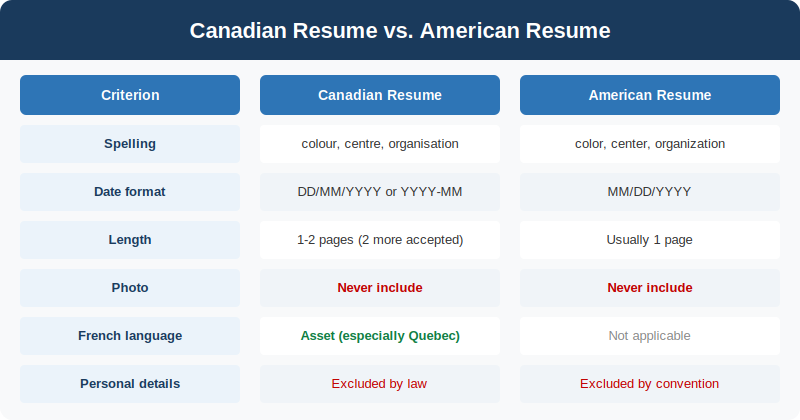
The honest answer: they are very similar, with same structure, same one-to-two-page length, same reverse-chronological order… If you have written a US resume before, you are most of the way there. The differences are real but narrow.
A Canadian recruiter reading "organizing" or "center" will read the American spellings as typos. Set your spellchecker to Canadian English before you submit anything. Words to watch: colour, centre, organisation, behaviour, neighbour, programme.
In Canada, a resume and a CV (Curriculum Vitae) are two different documents, not interchangeable terms.
If the job posting does not specifically ask for a CV, send a resume. Submitting a multi-page CV for a corporate role signals unfamiliarity with Canadian hiring norms. For more on the global difference, see our CV vs. resume guide.
Quebec exception: In Quebec, the terms "résumé" and "CV" are sometimes used interchangeably to describe a standard 1-to-2-page document. For Quebec positions, write in French unless the posting specifies otherwise.

Place your header at the very top of the page. Include your full name (larger font, bold), professional title, city and province (not your full street address), phone number, professional email, and LinkedIn URL. That is everything.
Two to four sentences. That is your entire budget for this section. If you have work experience, write a resume summary: a quick snapshot of your background and strongest results. Example: "Bilingual marketing manager with 8 years of experience driving B2B demand generation in Toronto's fintech sector. Reduced customer acquisition cost by 34% across three product lines."
If you are new to the workforce, changing careers, or recently arrived in Canada, write a resume objective instead: focus on what you bring to the role and where you are headed.
Cut anything that could apply to any candidate. "Hardworking professional seeking new opportunities" says nothing.
This section carries the most weight. Use reverse chronological order. For each position, include company name and location, your job title, employment dates (YYYY-MM or Month YYYY), and 3 to 6 bullet points.
The key: show results, not duties. "Managed social media accounts" is forgettable. "Grew Instagram following from 2,000 to 15,000 in eight months, generating 220 qualified leads" is not. Start every bullet with a strong action verb: led, built, increased, reduced, launched, negotiated, delivered. Add numbers wherever possible.
International experience is not a disadvantage if you present it clearly. Briefly mention the company size or industry. Focus on transferable skills such as leadership, project management, and communication. Numbers are universal; company recognition is not.
List degrees in reverse chronological order: degree name, institution, graduation date. Include GPA only if it is 3.5 or higher and you graduated recently. If you are more than a few years into your career, keep this section brief.
International degrees: list them normally for most positions. If you work in a regulated profession (nursing, engineering, accounting, teaching), you may need a formal credential assessment. Check with the relevant provincial regulatory body.
List 8 to 12 skills. Split them between hard skills (Python, QuickBooks, AutoCAD, Salesforce) and soft skills (cross-functional leadership, bilingual communication, project coordination). Tailor this list to each application. If the job posting mentions a specific tool or methodology and you have it, include it. For a comprehensive list, see our guide on hard skills for resumes.
These are optional but can significantly strengthen an application, particularly if you are building your Canadian work history:
If a section does not directly strengthen your application for this specific role, leave it out.
Getting this wrong can get your resume rejected before anyone reads it. The following table lists the most common mistakes and explains exactly why each one hurts you.
The test: does this help me get an interview? If the answer is not a clear yes, cut it. For more resume mistakes to avoid, see our bad resume examples guide.
Canada welcomed over 470,000 new permanent residents in 2024. Many of them need to adapt their resume to Canadian standards before their first job application. The good news: an international background is not a disadvantage if you present it clearly.
For authoritative guidance on working in Canada, refer to the Government of Canada Job Bank and Settlement.Org's resume guide for newcomers.
The core rules apply everywhere in Canada. Knowing these nuances can give you an edge when targeting a specific province.
Ontario, especially Toronto, is formal and traditional. Recruiters here favour the classic chronological format and want measurable results front and centre. The job market in finance, tech, and healthcare is competitive.
BC, particularly Vancouver, skews slightly more relaxed and values-driven. Creativity, flexibility, and cultural fit matter more here than in most other provinces. Volunteer work, sustainability involvement, and community engagement carry real weight. Hybrid and functional resume formats are more accepted, especially for career changers.
Write your resume in French for any role where the job posting is in French. This is not optional: Quebec's Charter of the French Language (Bill 101) requires French as the language of work in most Quebec workplaces with 25 or more employees. For bilingual roles, a French-English resume is standard. Our Quebec French resume guide covers the specific conventions for this market.
A Canadian resume is not complicated, but the details matter. Use Canadian English. Drop the photo. Lead every bullet point with a result, not a duty. Tailor the keywords to the job posting.
If you are a newcomer, contextualise your international experience and show Canadian context where you can. Even volunteer work or a recent certification counts.
Use our five templates as your starting point. Adapt the content to your background, and you will have something that meets Canadian employer expectations from the first read.
Our collection of expertly designed cover letter templates will help you stand out from the crowd and get one step closer to your dream job.