You've spent hours perfecting your resume for the U.S. market. Now you're applying to jobs in Germany, and none of the usual rules seem to apply.
German employers expect something different. The document they want is called a Lebenslauf – not just a translated version of your American resume. It includes details you'd never put on a U.S. application. A professional photo. Your marital status. Sometimes even your nationality.
This isn't about being intrusive. German companies operate under strict labor laws that make firing employees difficult. Hiring decisions carry more weight. Recruiters need detailed information before they commit.
The cultural difference goes beyond what information you include. German resumes are factual documents, not sales pitches. You won't write about "leveraging synergies" or "driving results." You'll state what you did, where you worked, and what you learned.
That's harder than it sounds if you're used to American resume conventions.
This guide breaks down the Lebenslauf format from header to signature. We'll cover personal details, work experience structure, education placement, and the additional sections German recruiters scan for. The templates and formats we recommend work across German-speaking markets –- Germany, Austria, Switzerland, Belgium.
No guesswork. Just the exact structure that gets you through initial screening.


Ben Stroke
Direktionsassistent
https://www.linkedin.com/in/benst
Persönliche Daten
Ändern : 28
Geschlecht männlich
Beziehungsstatus: Verheiratet
E-Mail: benstrocke@gmail.com
Telefon: 0211 4535961
Bildung
Master in Strategischem Marketing, 2018-2019
Columbia University, New York
Bachelorstudium Betriebswirtschaftslehre, 2014-2018
Columbia University, New York
Arbeitsgeschichte
K-Mart Supermarkt
Stellvertretender Filialleiter
August 2017 bis heute
New York City
Erobern Sie Restaurants
Stellvertretender Restaurantleiter
Juni 2014 bis August 2017
New York City
Fähigkeiten
Fähigkeitszertifizierungen
Interessen
One exception: multinationals operating in Germany sometimes accept American-style resumes, especially for international roles. Smaller German companies? They expect the traditional Lebenslauf.
Check the job posting. If it doesn't specify resume style, go with German format. You won't lose points for following local conventions.
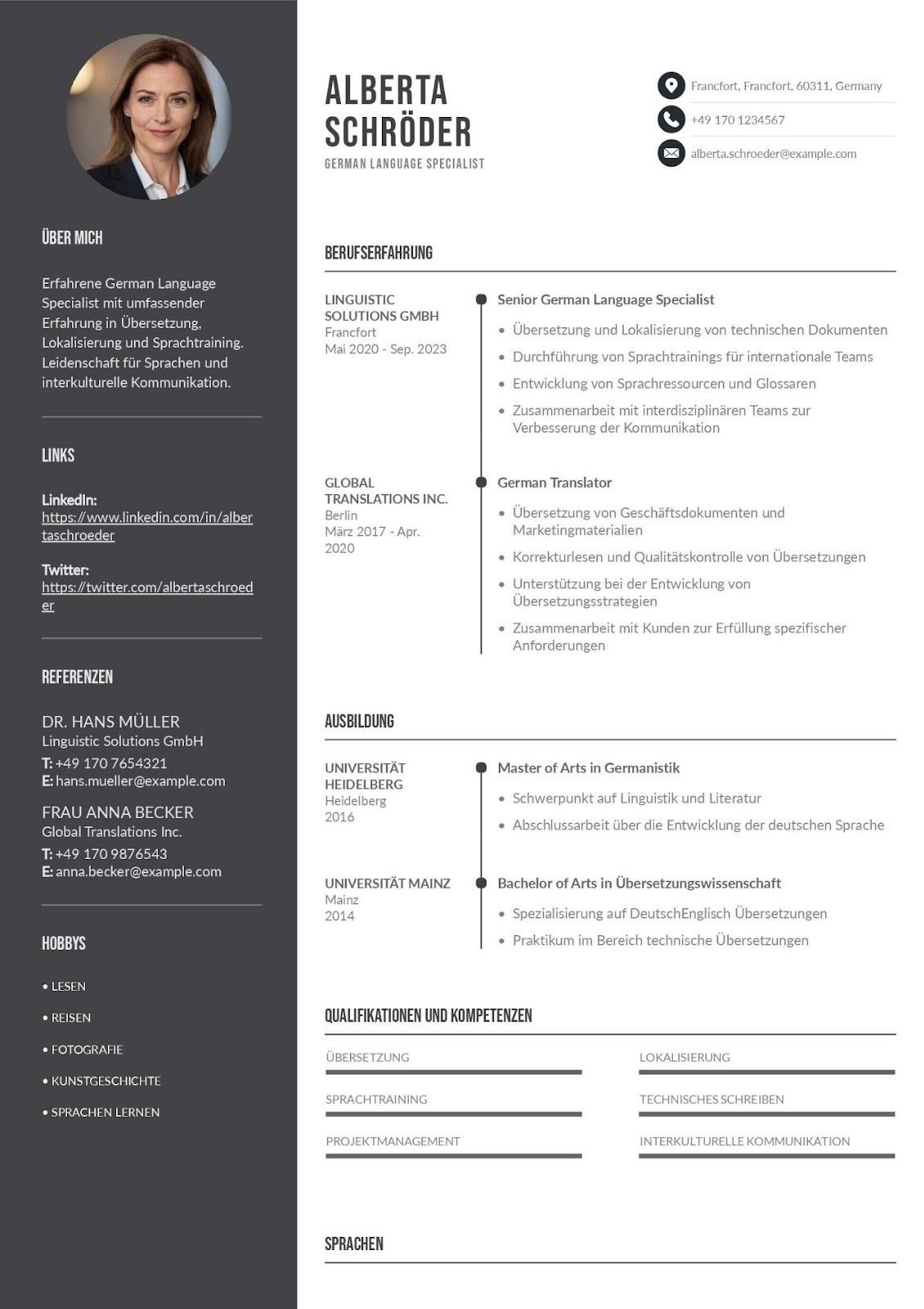
This resume sample is designed specifically for language instruction professionals targeting the German job market and educational institutions.
It follows the expectations of German schools, universities, and language training centers by emphasizing qualifications, language expertise, and pedagogical credentials without excessive personal branding.
The two-column layout separates professional details and supporting information (such as certifications and language proficiency indicators) from core work history. This clear structure is designed for quick scanning by German hiring managers and academic coordinators, allowing them to assess both professional qualifications and teaching expertise efficiently.
The main column prioritizes work experience, education, and language skills, using clear, concise formatting to detail career progression and instructional competencies. This format effectively emphasizes the language proficiency, teaching methodology knowledge, and educational background that resonates with German employers.
It is ideal for language specialists seeking positions in schools, universities, corporate training programs, or dedicated language institutes across Germany.
Additional Tips:
This resume works for language instruction and translation jobs across Germany. Erik Lehnsherr teaches German and translates business documents. He's based in Berlin and uses a two-column format that looks current without breaking the rules German employers expect.
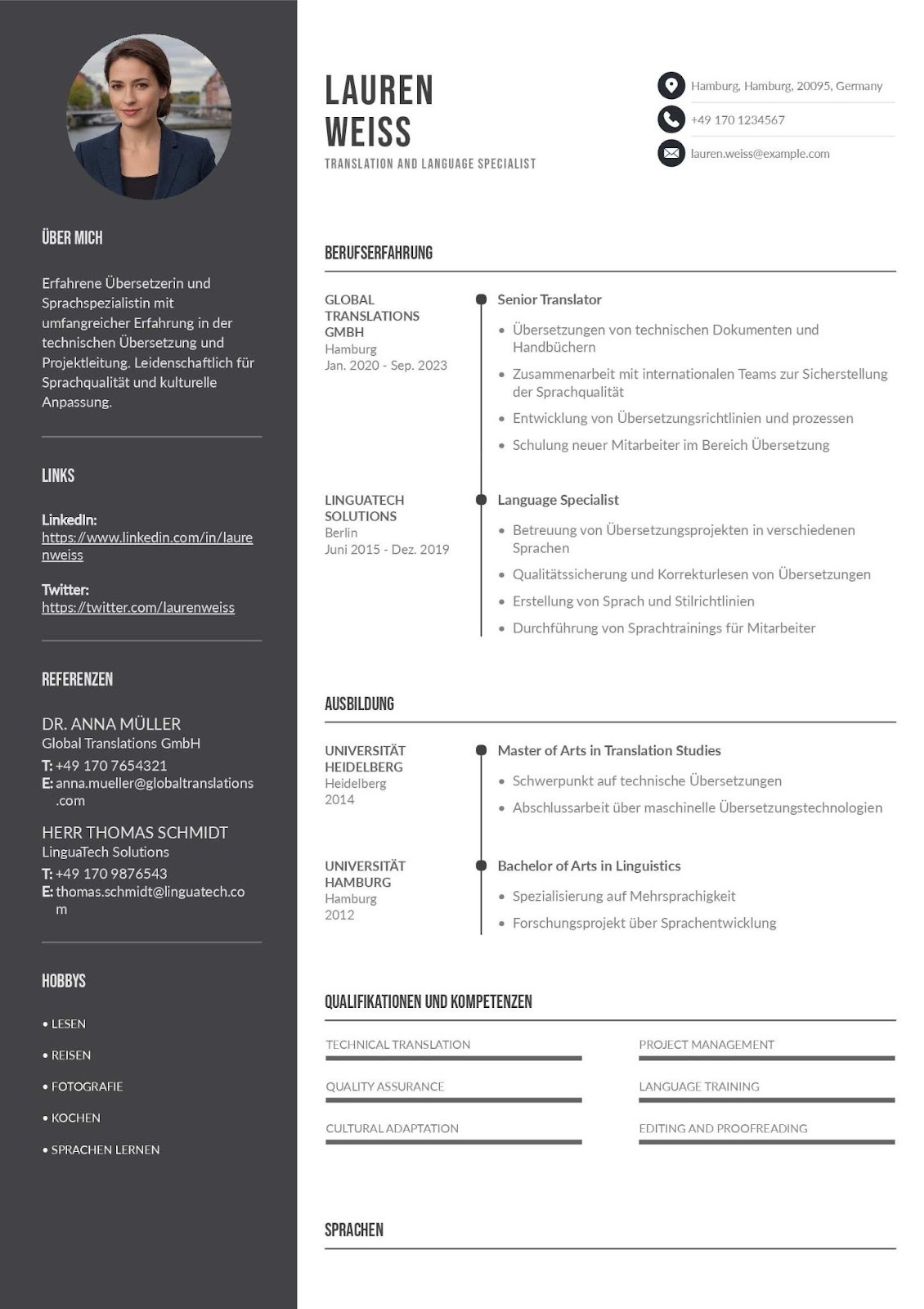
Professionals bridging language and document expertise face unique hiring requirements in Germany’s translation and linguistic services sector.
This resume example targets roles in translation agencies, multinational corporations, and specialized language service providers seeking candidates with both instructional and translation competencies.
The document prioritizes bilingual or trilingual credibility and professional accomplishments before diving into formal credentials. Rather than burying language skills in a bottom section, this layout puts language proficiency and translation expertise front and center where German recruiters expect to find them.
The supporting sidebar reinforces professional credibility through certifications, specialized language knowledge, and relevant business credentials—details that matter when hiring for translation-focused positions.
Its structure supports quick evaluation of translation quality indicators and teaching methodology combined. German employers in the language services industry benefit from seeing how candidates balance commercial translation work with language instruction experience, making this format especially effective for hybrid roles in Berlin, Munich, and Frankfurt’s thriving translation hubs.
Additional Tips:
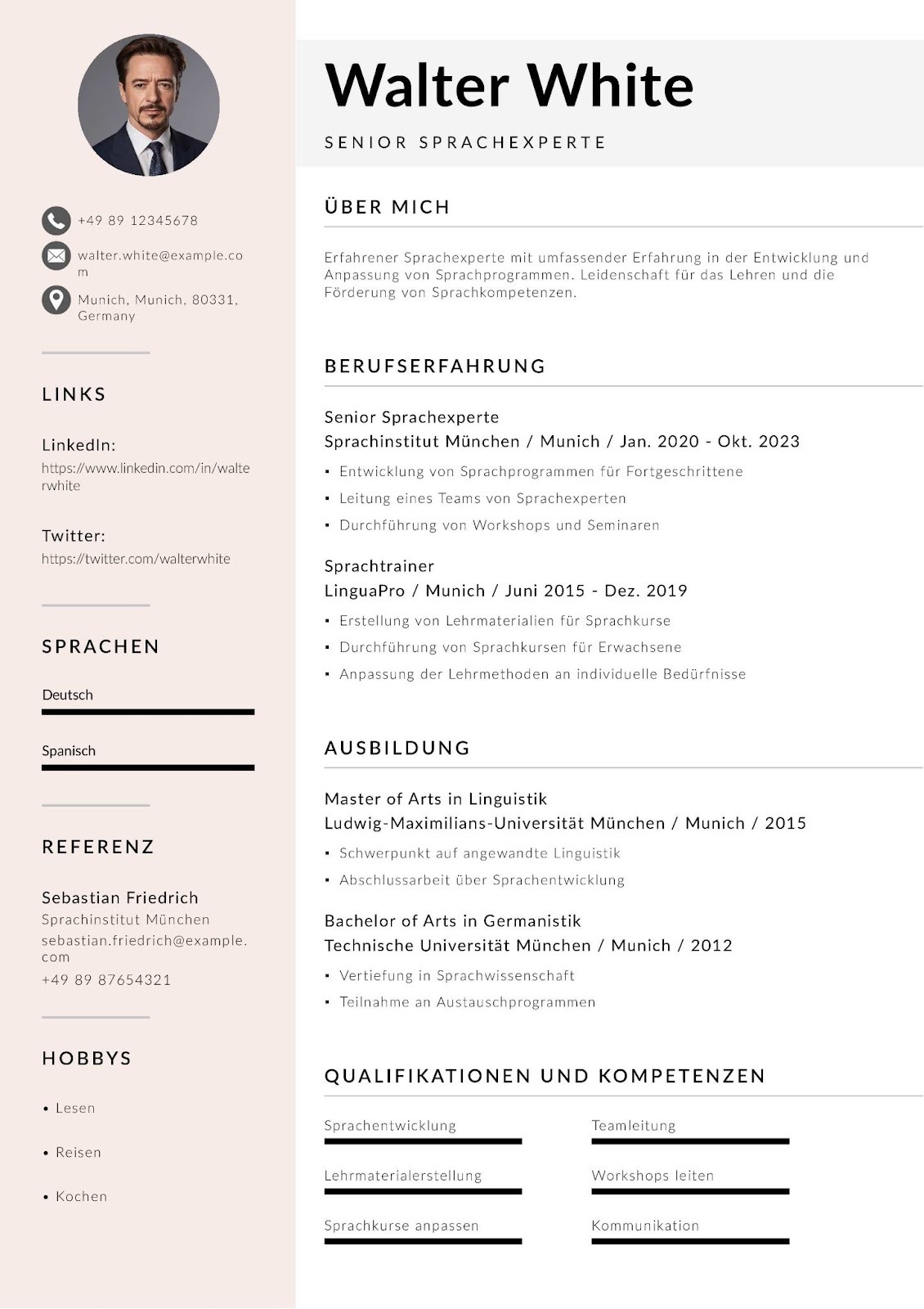
At the senior level, language professionals in Germany must demonstrate management expertise alongside technical fluency. This format is built for positions requiring both strategic oversight and advanced linguistic competency—roles where German employers value evidence of career progression alongside proven language mastery.
Leadership-focused content takes priority in the main column, with academic credentials and language certifications appearing in the supporting sidebar.
The highlighted columns approach emphasizes accomplishments and responsibility escalation, allowing German hiring managers to quickly understand seniority level, scope of past projects, and readiness for executive-track roles. This structure works particularly well for candidates with 8+ years of professional language services experience.
German companies seeking senior talent look for proof that candidates have successfully managed teams, developed programs, and shaped company direction—not just delivered language services.
The format clearly distinguishes between hands-on work and leadership achievement, making it ideal for positions at language service firms, multinational organizations, and corporate training departments across German-speaking regions.
Additional Tips:
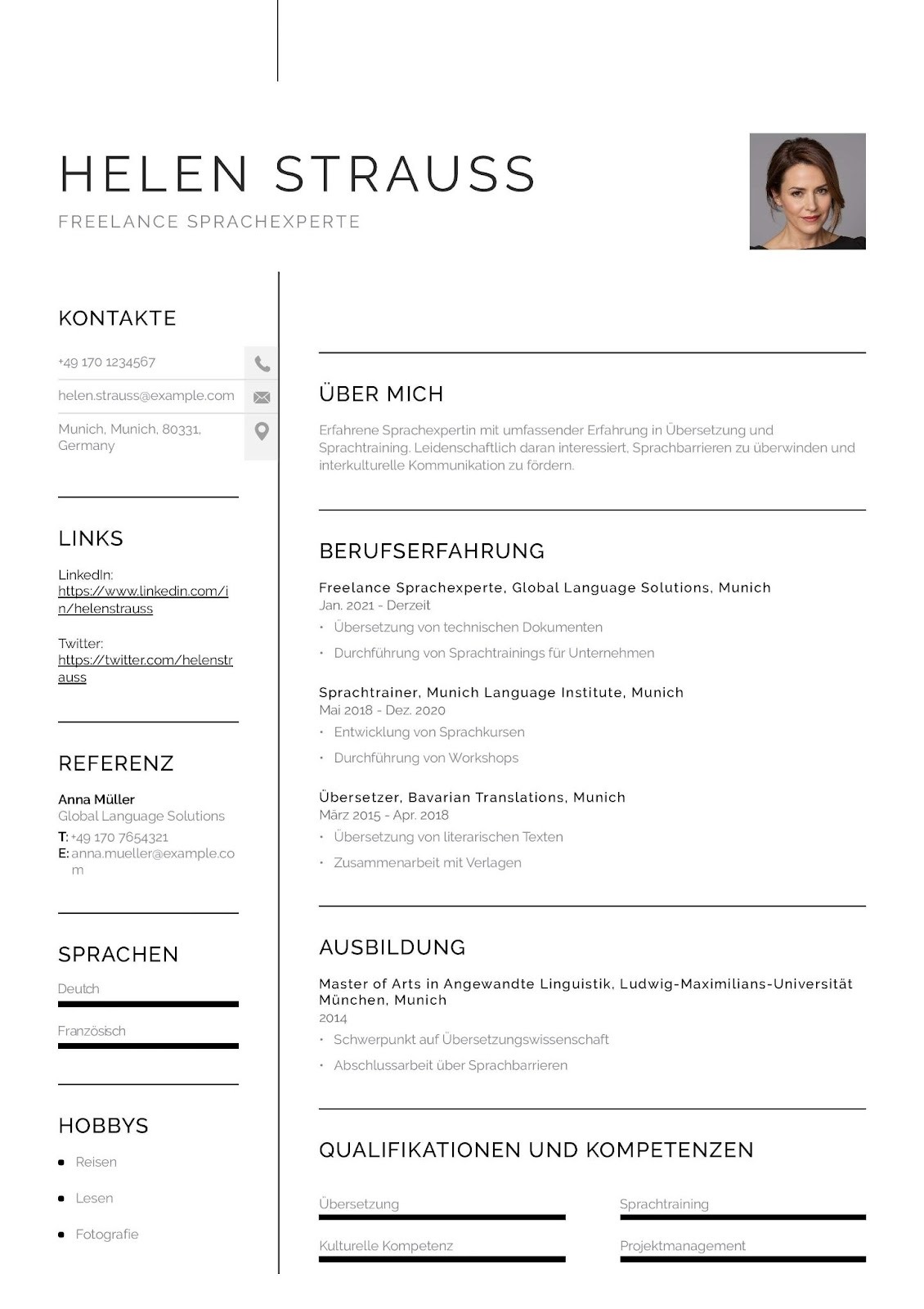
Freelance professionals operating in Germany’s language services market face distinct positioning challenges—they must showcase client experience, project scope, and independent track record without institutional backing.
This resume example serves translators, interpreters, and self-employed language consultants seeking direct contracts with companies and agencies.
Portfolio visibility takes center stage in the layout, with a centered-name design that emphasizes the individual as brand. The sidebar holds credentials and certifications, while the main content showcases diverse client engagements and specialized project experience.
Rather than hierarchical career progression, the format highlights range—multiple language pairs, industry sectors, and service types completed successfully for different organizations.
German businesses hiring freelancers look for documentation of stability and professional judgment. They want proof of completed projects, client retention, and ability to work independently within their constraints.
The format positions candidates as experienced service providers with proven business relationships, making it effective for consultants, contractors, and self-employed specialists across Germany’s major business hubs.ugh because that's what German clients and employers expect, even for freelance roles.
Additional Tips:
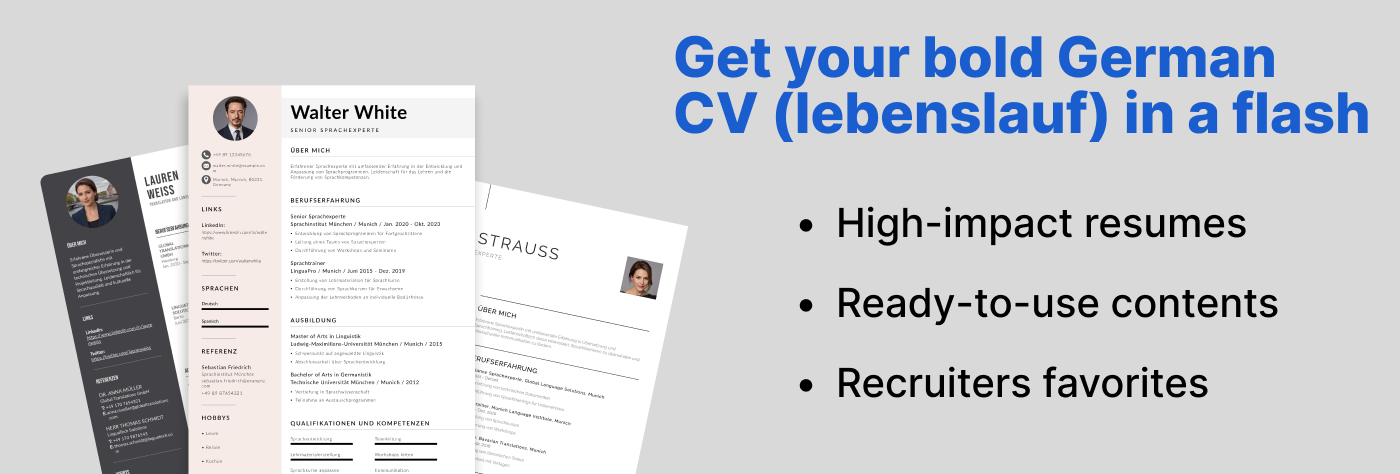
Start with the foundation: layout, format, and template selection.
These three elements shape how recruiters read your resume. Get them right and the content that follows will land better. Get them wrong and even strong qualifications won't save you.
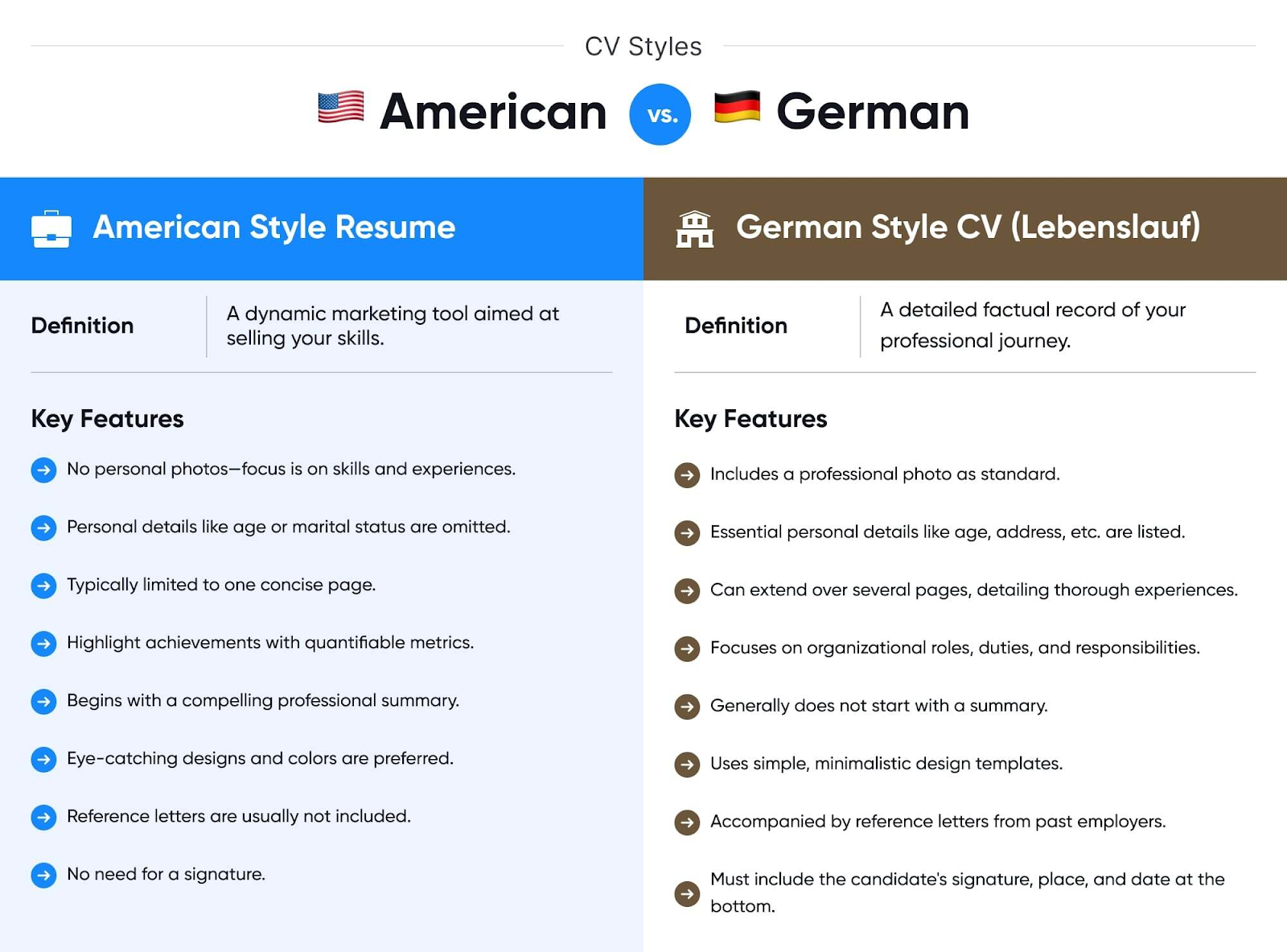
German resumes differ significantly from American resumes due to Germany’s strict labor laws, hiring practices, and corporate culture. German employers require detailed, factual documentation of your qualifications rather than a marketing-focused pitch. This fundamental difference shapes everything from format and length to required personal information and structure.
The graphic below shows the key differences between American-style resumes and German CVs (Lebenslauf). Understanding these distinctions is essential for successfully applying to jobs in Germany.
Germany pays well compared to most of Europe. The average salary sits around 42,500 Euros per year—solid wages, though not the highest on the continent. Switzerland, Luxembourg, and Iceland lead with higher annual averages. Still, Germany attracts English-speaking professionals for good reasons beyond salary. The job market is stable. Career opportunities span multiple industries. The quality of life is high.
For English-speaking professionals who want to work in Europe, Germany delivers on multiple fronts—good pay, stable employment, and room to grow.
Stay factual. German resumes document credentials, they don’t sell you.
Include personal details in your header. Name, contact information, age, marital status, nationality.
Skip the professional summary. No sales pitch needed.
Keep experience descriptions short and factual. State your responsibilities and the work you performed. Don’t highlight achievements or quantify results.
List your education with key learnings. Show what you studied under each degree or qualification.
Mix soft and hard skills. Prioritize the hard skills since German recruiters value technical abilities.
Add relevant additional sections. Languages, certifications, publications, interests—but only if they strengthen your application.
Sign and date your resume. This goes at the bottom of the document.
German resumes follow a predictable structure. Recruiters expect to find information in specific places.
Here's the standard layout:
Notice what's missing? There's no professional summary. No objective statement.
American resumes open with a pitch about why you're the perfect candidate. German resumes don't work that way. The Lebenslauf is a factual record of your background. You present your credentials and let them speak for themselves.
This feels strange if you're used to selling yourself on paper. But German hiring managers aren't looking for marketing copy. This feels strange if you're used to selling yourself on paper. German hiring managers want facts they can verify. Not marketing language.
Your cover letter is where you make the pitch. The resume? Just the credentials.
You have three ways to organize your work experience.
German recruiters prefer reverse chronological. Always.
They want to see your career as a timeline, not a skills portfolio. What are you doing right now? What did you do before that? The progression matters.
Grouping similar work across different time periods makes it harder for them to verify employment dates and spot gaps. German hiring managers don't like that. They need a clear chronological record they can cross-reference.
Save the functional format for other markets. Here, recent experience comes first.
Your template choice says something about you before recruiters read a single word.
German resumes aren't creative portfolios. Save the bold colors and multiple fonts for other markets. Recruiters here want clean layouts they can scan fast.
Black text on white background? Perfect. One accent color like navy or dark gray? Fine, as long as it's subtle. Multiple fonts or contrasting color blocks? No.
This isn't about being boring. It's about making your credentials easy to read. German employers value order and precision. Your template needs to show you get that.
One critical feature: make sure there's space for a photo. American templates don't include this. German resumes require it.
The content matters more than the design. Pick a resume template that gets out of the way and lets your qualifications speak.
The header is where German and American resumes diverge most dramatically.
American headers are minimal: your name and contact information. German headers go further. You'll include personal and contact information (persönliches und kontaktinformationen) details that would be considered inappropriate (or even illegal to request) in the U.S., UK, Canada, or Australia.
German recruiters expect biographical information upfront. This helps them assess candidate fit before making hiring decisions that are difficult to reverse.
Here's what goes in this section:
You can choose to omit some of these details. Not every candidate includes all of them.
It's worth noting: German law prohibits companies from rejecting or selecting candidates based on personal information like age, marital status, or nationality. But the practice of including these details remains standard in German corporate culture.
The contradiction exists. You're not required to share everything, but most German resumes do.
Your contact information section should include:
Make sure your email address sounds professional. If you're still using that high school email, now's the time to create a new one with your actual name.
Double-check that any links you include work correctly. Test them in both PDF and Word formats. A broken LinkedIn link wastes an opportunity for recruiters to learn more about you.
 CORRECT
Stefan Müller
+49 30 5567 8934
stefan.mueller@gmail.com
linkedin.com/in/stefanmueller
Berlin, Germany
 INCORRECT
Hans Schmidt
hans.schmidt1987@hotmail.com
0176-8844-5521
+49 (0) 211 / 456-7890
Hauptstraße 45, 60311 Frankfurt am Main, Hessen, Germany
Example
Levi Dough
Lehrer
https://www.linkedin.com/in/levid
Persönliche Angaben
Alter: 31
Geschlecht: Männlich
Familienstand: Ledig
Kontakt
E-Mail: levid@gmail.com
Telefon: 0211 3465978
The layout keeps everything scannable. Recruiters can find what they need in seconds.
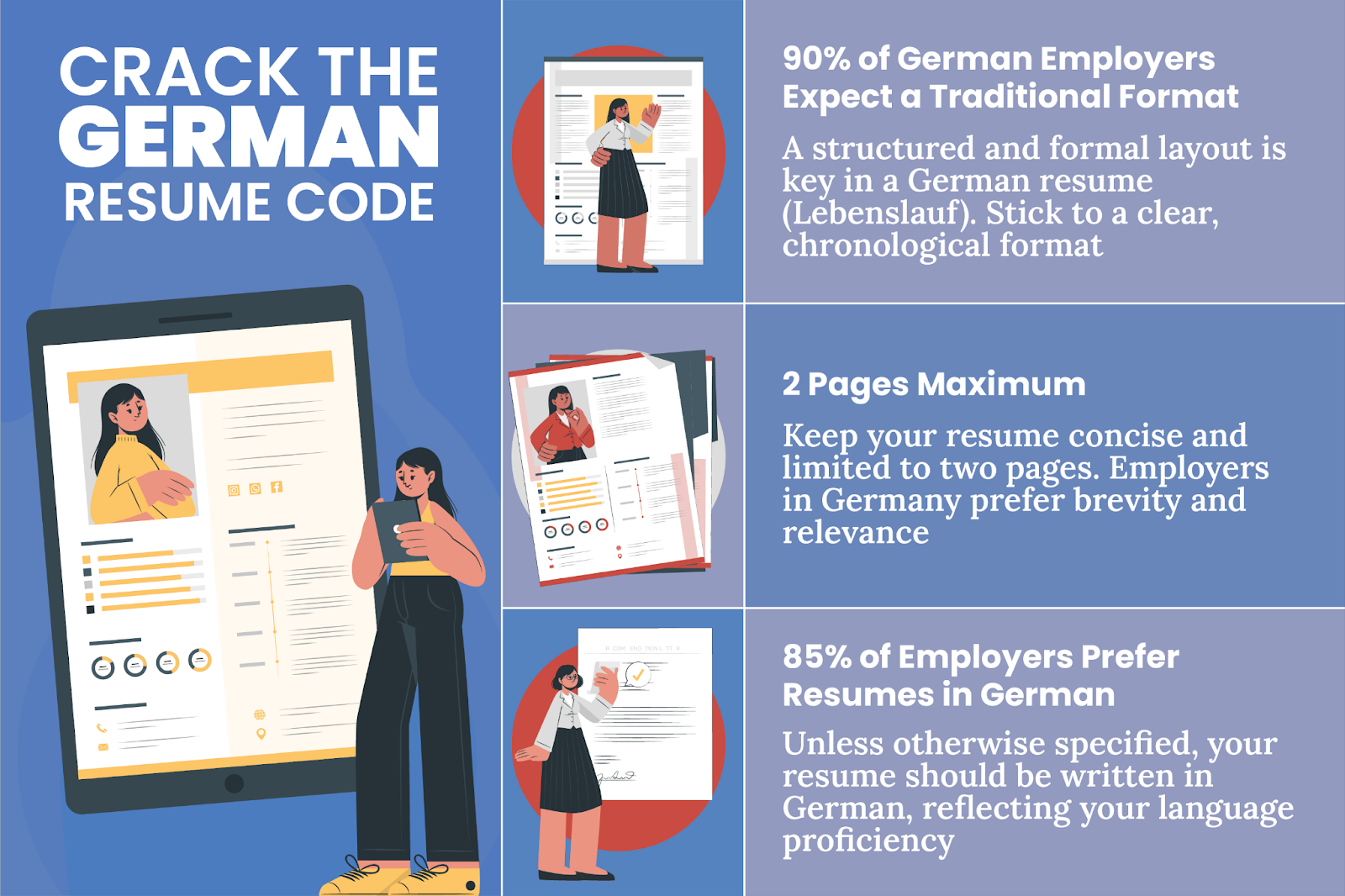
German resumes require a professional photo of you.
This practice is standard across Germany, Austria, and Switzerland. In the U.S., Canada, the UK, and Australia, including a photo on your resume could get it immediately rejected. Different markets, different rules.
When you're selecting a template, make sure it has dedicated space for a headshot. Most American templates don't include this feature.
Photo Guidelines:
Do this:Don't do this:Start with your most recent job and work backward through your career history.
The structure looks similar to American resumes. The content is where things change.
Include these elements for every job:
This is where German resumes break from American conventions.
Don't write about skills you used on the job. Don't highlight achievements or quantify results. Don't mention how you "increased efficiency by 30%" or "led a team of 12."
Just state what you did.
Your description should be factual and straightforward. What were your responsibilities? What type of work did you carry out? Nothing more.
Got jobs that don't relate to the position you want? Swap them out for internships or volunteer work that's more relevant. German recruiters care about applicable experience, not a complete employment history.
Example:
Berufserfahrung University of Massachusetts Boston
Sprachlehrer
Aug 2018 to May 2021
Boston
Notice how this lists duties without celebrating accomplishments? That's how German resumes work.
Fresh Graduate Work Experience - CORRECT
Praktikant Softwareentwicklung
SAP SE,
Walldorf
Juni 2023 - Dezember 2023
Unterstützte Senior-Entwickler bei der Entwicklung cloudbasierter ERP-Module. Erstellte Unit-Tests in Java für Funktionen im Kundenmanagement. Nahm an täglichen Stand-up-Meetings mit bereichsübergreifenden Teams teil. Dokumentierte technische Spezifikationen für Datenbank Integrationsprojekte. Sammelte Erfahrung mit agiler Entwicklungsmethodik und der SAP HANA-Plattform.
Fresh Graduate Work Experience - CORRECT (Alternative)
Marketing-Praktikant
Siemens AG, München
Januar 2024 - August 2024
Unterstützte das B2B-Marketing-Team bei der Kampagnen Koordination für Industrieautomatisierungsprodukte. Erstellte Inhalte für LinkedIn und Unternehmensblog Beiträge. Pflegte die Kundendatenbank in Salesforce CRM. Unterstützte bei der Vorbereitung der Messepräsenz für die Hannover Messe. Führte Marktforschung zur Wettbewerbspositionierung in europäischen Märkten durch.
Mid-Career Professional - CORRECT
Maschinenbauingenieur
Volkswagen AG, Wolfsburg
März 2019 - Heute
Entwicklung und Erprobung von Fahrwerkskomponenten für Elektrofahrzeug Plattformen. Erstellung technischer Zeichnungen mit der Software CATIA V5. Zusammenarbeit mit Zulieferern zu Komponenten Spezifikationen und Qualitätsanforderungen. Durchführung von Finite-Elemente-Analysen (FEA) für Belastungstests. Sicherstellung der Einhaltung deutscher Automobilnormen (VDA, DIN).
INCORRECT (Too achievement-focused)Senior Projektmanager
BMW Group, München
2018 - Heute
Transformierte den gesamten Projektabwicklungsprozess und steigerte die Teameffizienz um 40%! Leitete ein leistungsstarkes Team von 15 talentierten Fachkräften, um Quartal für Quartal herausragende Ergebnisse zu erzielen. Als „Mitarbeiter des Jahres" für außergewöhnliche Führungsqualitäten und die Förderung von Innovationen in mehreren strategischen Initiativen ausgezeichnet.
German resumes usually place education before work experience.
This reflects what German hiring managers value. Your academic background and technical skills matter more than your list of achievements. Education demonstrates your foundation and qualifications in a way that's easy to verify.
You can adjust this order based on your profile. If your academic credentials are stronger than your work history, lead with education. If you have extensive relevant experience, you can flip the sections.
Use reverse chronological format. List your most recent degree first, then work backward.
What to Include:
Both your secondary education and higher education belong on a German resume. Don't skip your earlier qualifications just because you have advanced degrees.
Skip your GPA.
The German grading scale runs opposite to the American system. Germany uses 5 (lowest) to 1 (highest). The U.S. uses 0 (lowest) to 4 (highest). Including your GPA without context will confuse German recruiters.
If you earned strong grades you want to mention, find a way to communicate that without using numbers. Mention academic honors or scholarships if you earned them. That communicates strong performance without the numbers.
For each degree or qualification, briefly state what you learned. Focus on the key areas of study or skills you developed.
CORRECT
Master of Science in Maschinenbau, 2020-2022
Technische Universität München (TUM)
Bachelor of Engineering, 2016-2020 RWTH Aachen
CORRECT (Business/Economics)
Master of Business Administration, 2021-2023
Frankfurt School of Finance & Management
Bachelor of Economics, 2017-2021 Universität Mannheim
Here's what that looks like:
Bildung
Bachelorstudium Betriebswirtschaftslehre, 2013-2016
Australische Nationaluniversität
Höheres Nationales Diplom in Informationstechnologie, 2018-2019
Institut für Informatik, Melbourne
Clean format. Key learnings listed under each degree.
The skills section on a German resume stays factual. You're listing capabilities, not marketing yourself.
Include a mix of soft skills and hard skills. Prioritize the hard skills.
These describe how you work with others and handle different situations. They're harder to prove and more generic across industries.
Examples:
These come from your recent job or education. They're technical and industry-specific.
Examples:
CORRECT
Technical Skills:
Soft Skills:
INCORRECTSkills:
German recruiters care more about these than soft skills. Hard skills are concrete. You either know Python or you don't. Leadership? Harder to measure.
Check the job description for the position you're applying to. It'll tell you which skills the company values most. Match your list to what they're looking for.
Five to seven skills in bullet points works well. More than that and you dilute the important ones.
This is where American and German resumes differ most in philosophy.
American resumes open with a professional summary. It's a sales pitch. You highlight your best skills, biggest achievements, and explain why the company should hire you. The goal is to hook the hiring manager in three sentences.
German resumes skip this entirely.
The Lebenslauf is a factual document. You're presenting credentials, not making a case for yourself. German recruiters don't expect (or want) marketing language at the top of your resume.
Save that for your cover letter.
Professional objectives work similarly—they’re designed for people with less experience. Students use them. So do candidates changing careers. Still, the same reasoning applies: German resumes are factual documents, not personal statements. Whether you’re a seasoned professional or just starting out, the format stays the same.
Your education, internships, and volunteer work will show where you’re headed. You don’t need to spell out your career goals in the resume itself. Skip this section entirely.
Examples
If you're applying to a multinational company in Germany with foreign management, you might include a professional summary. International companies sometimes expect American-style elements.
Check the job posting. If it doesn't specify, leave the summary out.
If you decide to add one, it needs to be strong. Look at these two versions:
INCORRECTCORRECT
CORRECT (Alternative - Engineering)
If you're going to break from German convention and add a summary, make it this specific.
Additional sections let you share factual information that might tip a hiring decision in your favor.
Not every section belongs on every resume. Look at what we cover below and only add the ones that strengthen your specific profile. Irrelevant sections just add clutter.
Language skills matter to German recruiters, especially if you're coming from another country.
If you're an expat looking for work in Germany, having some German proficiency helps. Even basic conversational skills show you're committed to integrating. Fluency is better, but not always required depending on the role.
English proficiency is expected for many positions, particularly at international companies. Other EU languages give you an edge too.
When you list languages, reference the Common European Framework of Reference (CEFR). It's the standard system recruiters understand.
Examples for Education on German Resume
Example:
CORRECT
Languages:
Using CEFR levels (Common European Framework) - this is what German recruiters expect.
INCORRECTLanguages:
Keep it simple. State the language and your level. Don't overcomplicate it with detailed explanations of what each level means.
Also, take a look at our ready-to-fill resume templates, where you’ll find a wide range of German-style designs with simple, effective features to showcase your language skills and other key sections.
If you've completed courses in computer science, programming, or information technology, list them here.
Basic computer literacy matters for most jobs in Germany. German companies run a lot of their operations through computer-based systems. Even non-technical roles often require comfort with software and digital tools.
Some positions require specific certifications. Check the job posting carefully.
For example, if the role involves driving a company vehicle, you'll need a valid EU driving license. Don't wait until after you apply to get this sorted. If you don't have the required certification, you're wasting everyone's time.
The same goes for technical certifications in your field. Project management credentials, safety certifications, industry-specific licenses – include anything that's relevant and current.
Out-of-date certifications don't help. If your credential expired three years ago, either renew it or leave it off.
If you're a student or applying for academic positions, list your research papers and publications here.
Include anything published under your name. Journal articles, conference papers, book chapters, research contributions – they all count.
German recruiters give weight to academic credentials. More than many other markets. If you have published work, it strengthens your profile in ways that work experience sometimes can't.
An additional section dedicated to publications gives this information the visibility it deserves. Don't bury it in your education section or mention it casually in your cover letter.
Format it clearly. Title of the publication, where it was published, date, and your role (author, co-author, contributor).
German resumes allow personal interests. American resumes typically don't.
But there's a catch: your interests need to relate to the job you're applying for.
This is the one section in a factual document where you can show some personality. Use it to demonstrate how you'd fit into the company culture. The interests you list should add value to your application, not just fill space.
Don't list generic hobbies you do in your free time. Recruiters don't care that you read books or watch football.
Show interests that connect to professional skills or demonstrate relevant qualities.
INCORRECTInterests:
These say nothing about you as a candidate. They're activities millions of people do.
CORRECTInterests:
CORRECT (Alternative - Engineering)Interests:
These demonstrate communication skills, public speaking ability, and subject matter expertise. They're relevant. They tell the recruiter something useful about who you are.
Pick two or three interests that strengthen your candidacy. Leave the rest off.
German resumes end with your signature and the date.
This practice disappeared from American resumes decades ago, but it's still standard in Germany. The signature confirms the information you've provided is accurate.
Since German resumes can run two to three pages, you'll have room at the bottom for this. Just add the date and your signature below your last section.
Don't create a separate heading that says "Candidate Signature." That's unnecessary. Simply leave space at the bottom of the final page.
An e-signature works fine if you're submitting digitally. Most applications go through email or online portals anyway.
Your cover letter is where personality and persuasion live.
The German resume sticks to facts. The cover letter lets you explain why you want this specific job at this specific company.
This is where you write about achievements. How your work helped your previous employer. What you learned from past roles. Why your background makes you a strong fit for what they need.
German recruiters expect a cover letter with your application. The resume shows you're qualified. The cover letter shows you're interested and engaged.
Don't repeat what's already in your resume. Use the letter to add context and motivation that a factual document can't provide.
Check out our cover letter templates to help you craft a strong cover letter for German recruiters.
Our collection of expertly designed cover letter templates will help you stand out from the crowd and get one step closer to your dream job.