College Graduate Resume: Complete Guide for Jobs, Grad School & Scholarships (2026)
Your college diploma unlocks multiple paths beyond employment. Yet most graduates make a critical mistake: using the same resume for every application. What impresses corporate recruiters can undermine graduate school admission. What wins scholarships might confuse tech hiring managers. How to strategically adapt your college graduate resume for any goal: jobs, academic programs, scholarships, or international opportunities?
Graduating from college opens doors: but which door matters most right now? Landing your first professional job? Pursuing a Master's or PhD? Securing scholarship funding? Teaching abroad? The answer determines everything about how you present yourself.
Nearly half of graduates go on to further study and most seek funding, yet resume advice still assumes everyone is chasing a job. That’s the disconnect. In reality, each path values different things: research potential, leadership, cultural awareness, or measurable results… So a single resume can’t effectively speak to them all.
This guide teaches you how to strategically adapt your college graduate resume for primary paths:
Professional resumes for corporate jobs, startups, and entry-level positions
Academic CVs for graduate school applications (Master's, PhD, professional programs)
Scholarship resumes that emphasize service, leadership, and impact
International program applications including Fulbright, Peace Corps, and teaching positions
Types of college graduate resumes: professional vs academic vs scholarship
Before writing anything, understand this fundamental truth: employers, graduate schools, and scholarship committees evaluate candidates using completely different criteria. Each audience cares about different accomplishments and interprets the same experiences through different lenses.
The critical difference most college graduates miss
Sending a job-focused resume to a PhD program signals you don't understand academic priorities. Submitting an academic CV to a startup suggests you can't communicate concisely. Using a corporate resume for scholarships misses the emphasis on service and leadership that selection committees prioritize.
The solution isn't creating three entirely different documents from scratch. Instead, you'll learn to strategically emphasize different aspects of the same core experiences. Think of it as translating rather than rewriting: the facts remain constant, but the presentation changes based on what each audience values most.
Quick comparison: Resume types at a glance
Element
Professional Resume
Academic CV
Scholarship Resume
Length
1 page strict
2-4 pages
1-2 pages
Primary Focus
Skills + quantified results
Research + publications
Community impact + service
Education Placement
After experience (if 2+ years)
Always first
Always first
GPA Display
Only if ≥3.5
Include if ≥3.3
Include always
Volunteer Work
Brief mention if relevant
Only if research-related
Major dedicated section
ATS Optimization
Critical
Less important
Varies by organization
Resume vs CV: what every college graduate must know
In the United States, "resume" and "CV" (curriculum vitae) are not interchangeable terms. Using the wrong one signals unfamiliarity with professional norms. Here's the critical distinction:
Resume for college graduate:
One page document (strictly enforced for graduates)
Focuses on skills, experience, and measurable achievements
Used for: Jobs, internships, most corporate opportunities
Tailored specifically for each application
Results-oriented language with action verbs
CURRICULUM VITAE (CV):
2-10+ pages (grows throughout academic career)
Comprehensive academic and research history
Used for: Graduate school, academic positions, research fellowships
Includes: Publications, presentations, teaching experience, grants, research
Chronological and complete (nothing omitted)
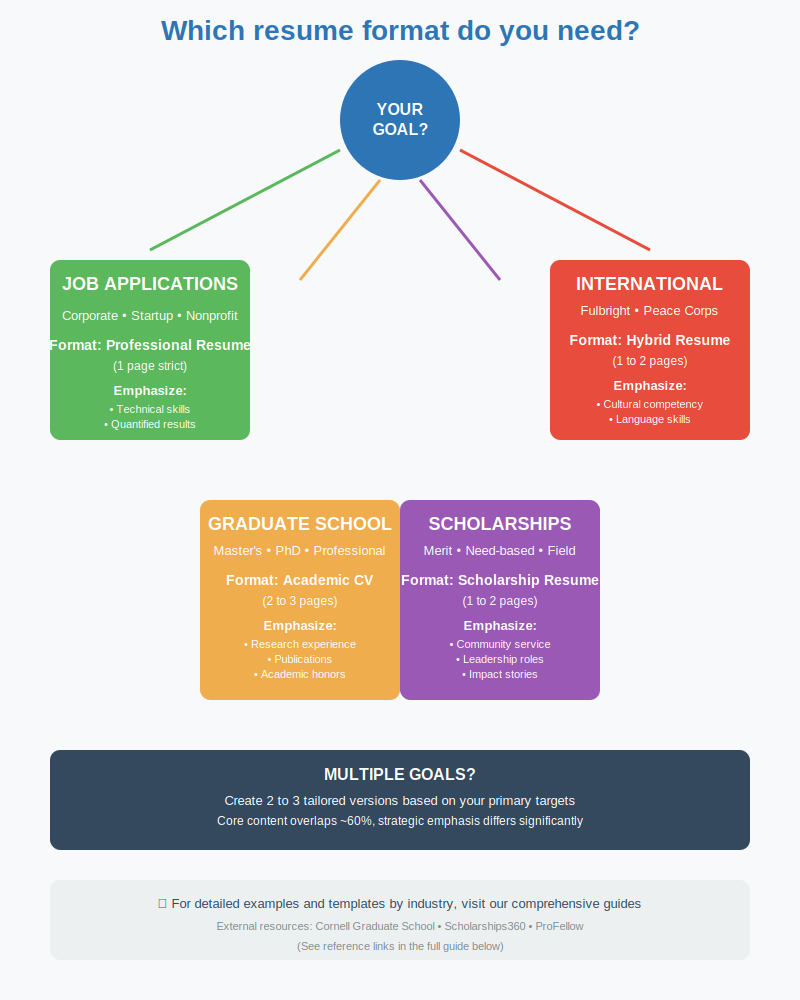
Decision framework: which resume format do you need?
Use this visual guide to determine which format matches your immediate goal. Each path has different requirements and expectations, so choosing the right format from the start saves time and increases your success rate.
Additional guidance for specific paths:
Job seekers: Review our industry-specific templates covering IT, marketing, finance, engineering, and healthcare with ATS-optimized formatting
Graduate school applicants: Cornell's Graduate School provides comprehensive CV guidelines specifically designed for academic applications, including sections on research experience and publications
Scholarship applicants: Scholarships360 offers a detailed scholarship resume writing guide that explains how selection committees evaluate applications and what makes candidates stand out
Fellowship candidates: ProFellow's fellowship application guide covers international programs like Fulbright and Peace Corps, with emphasis on cultural competency and adaptability
Core components every college graduate resume must include
Regardless of format or purpose, certain foundational elements appear in every strong college graduate resume. Master these basics before adapting for specific audiences. Think of this section as your universal template: the 60% that stays consistent across all versions.
Portfolio website or Behance link (for creative roles)
Personal website (if professionally relevant)
ADD FOR GRADUATE SCHOOL APPLICATIONS:
University email address (shows current institutional affiliation)
ORCID identifier (if you have publications)
ResearchGate or Academia.edu profile (if active in your field)
Google Scholar profile (if you have citations)
ADD FOR SCHOLARSHIP APPLICATIONS:
Keep simple and professional:only essential contact methods
No social media unless specifically requested by scholarship committee
LinkedIn acceptable if it demonstrates professional commitment
ADD FOR INTERNATIONAL PROGRAMS:
Citizenship/visa status (only if requested or directly relevant)
Passport information (only when application explicitly requires)
International phone format with country code
Education section: your foundation as a college graduate
As a recent college graduate, your education section carries significant weight:it's often your strongest credential. However, what you include and how you present it varies dramatically by purpose.
ALWAYS INCLUDE (all formats):
Copy
Degree type and major (Bachelor of Science in Biology)
University name and location (city, state)
Graduation date or "Expected: Month Year" (if still completing)
Minor or concentration (if relevant to application)
NEVER INCLUDE:
High school information (unless applying for freshman scholarships)
Unrelated coursework that doesn't support your goal
Low GPA (below 3.0 for jobs, below 3.3 for graduate school)
CONTEXT-SPECIFIC ADDITIONS
For JOB APPLICATIONS:
GPA: Include only if 3.5 or higher
Relevant coursework: 3-5 courses maximum, directly related to target role
Major projects: Capstone or senior project if it demonstrates job-relevant skills
Latin honors: Cum Laude, Magna Cum Laude, Summa Cum Laude (if earned)
For GRADUATE SCHOOL:
GPA: Include if 3.3 or higher (include both cumulative and major GPA)
Honors thesis: Title with advisor name in parentheses
Relevant coursework: 5-8 courses with brief descriptions showing depth
Academic honors: Dean's List (specify semesters), Latin honors, departmental awards
Study abroad: If relevant to program or shows international research experience
Research methods courses: Particularly important for research-focused programs
For SCHOLARSHIPS:
GPA: Always include (scholarship committees expect to see it)
Class rank: If you're in the top 25% of your class
ALL academic awards and honors: Dean's List, Latin honors, departmental recognition
Academic competitions: Science fairs, debate competitions, case competitions
Scholarships already received: Shows others have recognized your merit
Honor societies: Phi Beta Kappa, Golden Key, discipline-specific honors
BEFORE/AFTER EXAMPLES: Same Education, Different Presentations
BASIC (Doesn't differentiate):
Bachelor of Science in BiologyState UniversityGraduated May 2025
To illustrate how dramatically your resume should change based on purpose, let's follow Maria Chen, a recent biology graduate with a 3.7 GPA, research experience, and volunteer work. See how she adapts the same core experiences for three different applications.
Example 1: Professional resume for pharmaceutical sales position
Maria is applying for an entry-level pharmaceutical sales representative role. This format emphasizes business results, communication skills, and client-facing experience over academic research.
Copy
MARIA CHEN
San Diego, CA | (619) 555-0147 | maria.chen@email.com | linkedin.com/in/mariachen
PROFESSIONAL SUMMARY
Results-driven biology graduate with proven ability to communicate complex scientific concepts to diverse audiences. Demonstrated success building relationships with healthcare professionals through clinical research coordination. Seeking to leverage scientific knowledge and interpersonal skills to drive pharmaceutical product adoption and support healthcare provider education.
EXPERIENCE
Clinical Research Coordinator | UC San Diego Health | June 2023 to May 2025
Managed relationships with 15+ physicians and 40+ study participants, achieving 95% retention rate across three clinical trials
Presented research findings to medical staff at 8 departmental meetings, translating technical data into actionable insights
Increased patient enrollment by 30% through improved outreach strategies and educational materials
Maintained detailed records and ensured 100% regulatory compliance with FDA protocols
Science Tutor | Self-Employed | September 2022 to Present
Built client base of 12 students through referrals, demonstrating strong networking and relationship management
Improved student grades by average of 15% by adapting teaching methods to individual learning styles
EDUCATION Bachelor of Science in Biology | GPA: 3.7/4.0
University of California, San Diego | May 2025
Relevant Coursework: Pharmacology, Human Physiology, Biochemistry, Business Communications
SKILLS
Relationship Building • Client Management • Scientific Communication • Data Analysis • CRM Software (Salesforce) • Microsoft Office Suite • Presentation Skills • Territory Management • Healthcare Regulations
Example 2: Academic CV for PhD program in molecular biology
Maria is applying to doctoral programs in molecular biology. This format prioritizes research methodology, technical skills, and academic achievements. Notice how the same experiences are described with completely different emphasis.
Copy
MARIA CHEN
San Diego, CA | mchen@ucsd.edu | (619) 555-0147
ORCID: 0000-0002-1234-5678 | Google Scholar: scholar.google.com/mariachen
EDUCATION Bachelor of Science in Molecular Biology | Cumulative GPA: 3.7 | Major GPA: 3.9
University of California, San Diego | May 2025
Honors Thesis: "CRISPR/Cas9-Mediated gene editing in neuronal cell lines for Alzheimer's disease modeling" (Advisor: Dr. Jennifer Park, Department of Neuroscience)
Relevant Coursework: Advanced Molecular Biology, Bioinformatics and Computational Biology, Cell Signaling Mechanisms, Genomics and Proteomics, Research Methods in Molecular Biology, Advanced Biochemistry
Academic Honors: Dean's List (all 8 semesters), Graduated Magna Cum Laude, Departmental Honors in Molecular Biology, Undergraduate Research Grant Recipient ($3,500)
RESEARCH EXPERIENCE Undergraduate Research Assistant | Dr. Jennifer Park Lab, Department of Neuroscience
University of California, San Diego | June 2023 to May 2025
Research Focus: Investigating the role of tau protein aggregation in Alzheimer's disease progression using CRISPR/Cas9 gene editing in iPSC-derived neuronal models
Designed and executed CRISPR/Cas9 targeting strategy to generate tau knockout cell lines, achieving 85% editing efficiency
Performed Western blot, qPCR, and immunofluorescence analysis to validate gene editing and assess protein expression changes
Analyzed RNA-seq data using R and Bioconductor packages to identify differentially expressed genes in edited cell lines
Maintained iPSC cultures and differentiated cells into cortical neurons following established protocols
Trained two undergraduate students in cell culture techniques and molecular cloning
PUBLICATIONS & PRESENTATIONS Manuscripts in Preparation:
Chen, M., Park, J., & Liu, S. (in preparation). CRISPR/Cas9-mediated tau deletion reveals compensatory mechanisms in human neuronal models. Target journal: Journal of Neuroscience.
Conference Presentations:
Chen, M., & Park, J. "Modeling Alzheimer's Disease Using CRISPR-Edited Neuronal Cell Lines." Poster presentation, Society for Neuroscience Annual Meeting, Chicago, IL (November 2024).
Chen, M. "Gene Editing Approaches for Neurodegenerative Disease Research." Oral presentation, UC San Diego Undergraduate Research Conference (April 2024).
Undergraduate Research Grant, UCSD Division of Biological Sciences ($3,500) | 2024
Best Undergraduate Poster Award, UCSD Research Conference | 2024
Dean's List, all semesters | 2021 to 2025
Provost Honors, top 10% of graduating class | 2025
PROFESSIONAL MEMBERSHIPS
Society for Neuroscience, Student Member | 2023 to Present
American Society for Cell Biology, Student Member | 2024 to Present
Example 3: Scholarship resume for health equity fellowship
Maria is applying for a competitive fellowship focused on health equity and underserved communities. This format emphasizes community service, leadership, personal impact, and alignment with the fellowship's mission.
Copy
MARIA CHEN
San Diego, CA | maria.chen@email.com | (619) 555-0147
OBJECTIVE
First-generation college graduate and daughter of immigrants passionate about eliminating healthcare disparities in underserved communities. Seeking the Health Equity Fellowship to advance my commitment to making medical research and healthcare education accessible to all populations, particularly Spanish-speaking communities.
EDUCATION Bachelor of Science in Biology | GPA: 3.7/4.0 | Class Rank: Top 8%
University of California, San Diego | May 2025
Academic Honors:
Graduated Magna Cum Laude
Dean's List: All 8 semesters
First-Generation Student Scholar Award ($2,000 annually)
Undergraduate Research Grant for Health Disparities Project ($3,500)
COMMUNITY SERVICE & LEADERSHIP Volunteer Health Educator | San Diego Free Clinic | September 2022 to Present
Provide bilingual health education (English/Spanish) to 20+ underserved patients monthly on topics including diabetes management, medication adherence, and preventive care
Developed culturally sensitive educational materials in Spanish addressing common barriers to healthcare access in immigrant communities
Coordinated monthly health screenings that served 150+ uninsured community members, identifying critical health issues in 23 patients who received follow-up care
Total service: 350+ hours over 3 years
Founder & President | Students for Health Equity (campus organization) | January 2023 to May 2025
Founded campus organization with mission to address health disparities through education and advocacy, growing membership from 0 to 45 active students
Organized 6 community health fairs serving 400+ residents from underserved neighborhoods, providing free blood pressure checks, glucose screenings, and health information
Led fundraising campaign that raised $8,000 to provide free COVID-19 testing and education materials in Spanish-speaking communities during the pandemic
Mentored 12 students interested in healthcare careers, 8 of whom were first-generation college students
Volunteer Science Tutor | Boys & Girls Club of San Diego | September 2021 to May 2023
Provided free weekly tutoring in biology and chemistry to 15 high school students from low-income families
Designed hands-on science experiments to increase engagement and understanding of complex concepts
Supported 4 students through college application process, all of whom gained admission to 4-year universities
Total service: 200+ hours over 2 years
RESEARCH & PROFESSIONAL EXPERIENCE Research Assistant | Health Disparities Lab, UC San Diego | June 2023 to May 2025
Investigated barriers to Alzheimer's disease research participation among Latino communities through qualitative interviews with 30 families
Findings directly informed development of culturally tailored recruitment materials that increased Latino participation by 40%
Presented research at Society for Neuroscience conference, highlighting importance of inclusive research practices
SKILLS & QUALIFICATIONS Languages: Fluent in English and Spanish (spoken and written) Leadership: Organization founding, team building, fundraising, public speaking, event coordination Community Engagement: Health education, cultural competency, advocacy, program development Technical: Research methodology, data analysis, scientific communication, curriculum development
ADDITIONAL ACHIEVEMENTS
Community Impact Award, UC San Diego Student Life (2024)
Featured in campus newspaper for health equity advocacy work
Completed 40-hour Medical Interpreter Training Certificate
Worked 20 hours/week throughout college to support family financially while maintaining academic excellence
Summary: same graduate, completely different presentations
Notice how Maria's core facts remain consistent across all three versions (same GPA, same research lab, same university), but the strategic emphasis changes dramatically:
Professional resume: 1 page, emphasizes client relationships and business results, positions research as 'Clinical Research Coordinator' managing physician relationships
Academic CV: 2+ pages, leads with technical research details and methodology, includes publications section and professional memberships
Scholarship resume: 2 pages, personal background in objective, community service as longest section, research reframed around health disparities impact
This is strategic adaptation, not fabrication. Maria didn't lie or exaggerate. She simply emphasized different aspects of the same experiences based on what each audience values. That's the key to effective resume writing for college graduates pursuing multiple paths.
Should college graduates include social media or content creator experience on their resume?
Yes, if you demonstrate measurable impact. A graduate with 50,000 TikTok followers should frame it for marketing jobs as "Built engaged audience of 50K through content strategy and analytics optimization." For academic applications, omit unless it involves science communication. For scholarships, include if it shows entrepreneurship or if you monetized it to fund your education.
How to address being overqualified on a college graduate resume for entry-level positions?
Strategically simplify your professional resume without lying. Remove advanced jargon, shorten research descriptions to emphasize teamwork over methodology, and avoid listing every advanced course that signals grad school plans. Keep a full technical version ready for specialized roles. For startups and tech companies, being "overqualified" often helps. Balance showing capability without threatening hiring managers who fear you'll leave quickly.
Can you leave college name off resume if you didn't attend a prestigious university?
Never omit your institution. It's easily verified and raises red flags. Instead, emphasize other credentials: prestigious internships, competitive scholarships, published research, nationally recognized awards, or "Top 5% of graduating class." For grad school, research fit and strong test scores matter more than undergraduate prestige. For jobs, practical experience often trumps pedigree. Many Fortune 500 CEOs attended state universities.
Is unpaid research experience valuable on a college graduate resume compared to paid jobs?
For academic applications, unpaid research often outweighs paid retail work—it shows you prioritized knowledge over income. List prominently as "Research Assistant (Volunteer)" with full methodology descriptions. For corporate jobs, frame it as career investment: "Conducted full-time research to maintain technical skills." Publishing as undergraduate is impressive regardless of compensation. Only explain paid versus unpaid for need-based scholarships.
Should college graduates use different email addresses for different types of resume applications?
Use one professional email (firstname.lastname@email.com) for all applications to avoid missing responses or appearing disorganized. Multiple emails cause more problems than benefits. You'll forget to check them, and systems may flag multiple accounts as suspicious. However, adjust your email signature by audience: include LinkedIn for jobs, ORCID/Google Scholar for academics, minimal for scholarships. Consistent email, adapted signature.


 ALWAYS INCLUDE (all formats):
 NEVER INCLUDE: