Write your resume in 15 minutes
Our collection of expertly designed resume templates will help you stand out from the crowd and get one step closer to your dream job.


A resume written in American English signals that you know how recruiters read, scan, and evaluate documents in these markets. Even subtle differences (word choice, sentence flow, or bullet structure…) can influence how quickly your skills and achievements are recognized.
Getting these details right, from spelling conventions to the way an achievement is framed, is often what quietly tips the balance in your favor.
Resumes in American English: why it has become an international standard
American English did not become the dominant register of professional writing by accident. The global reach of US-based companies, international hiring platforms like LinkedIn, and the outsized influence of American business culture have collectively shaped what a "professional" resume looks and sounds like… regardless of where the job is located.
This matters beyond the United States. Employers in Canada, the Philippines, Singapore, and international organizations operating in English all tend to align with American English conventions, whether consciously or not, and though some markets still follow British English CV standards.
American English vs. British English on a resume: what actually differs
Spelling is not cosmetic on a professional document. It is one of the fastest signals of attention to detail, and inconsistency is one of the easiest ways to undermine an otherwise strong application, just like misunderstanding the expectations behind a CV vs resume.
Understanding where the two varieties diverge is the first step to writing a resume that reads as native to its intended audience.
American English spelling on a resume: patterns worth knowing
Spelling is not cosmetic on a professional document. It is one of the fastest signals of attention to detail, and inconsistency is one of the easiest ways to undermine an otherwise strong application.
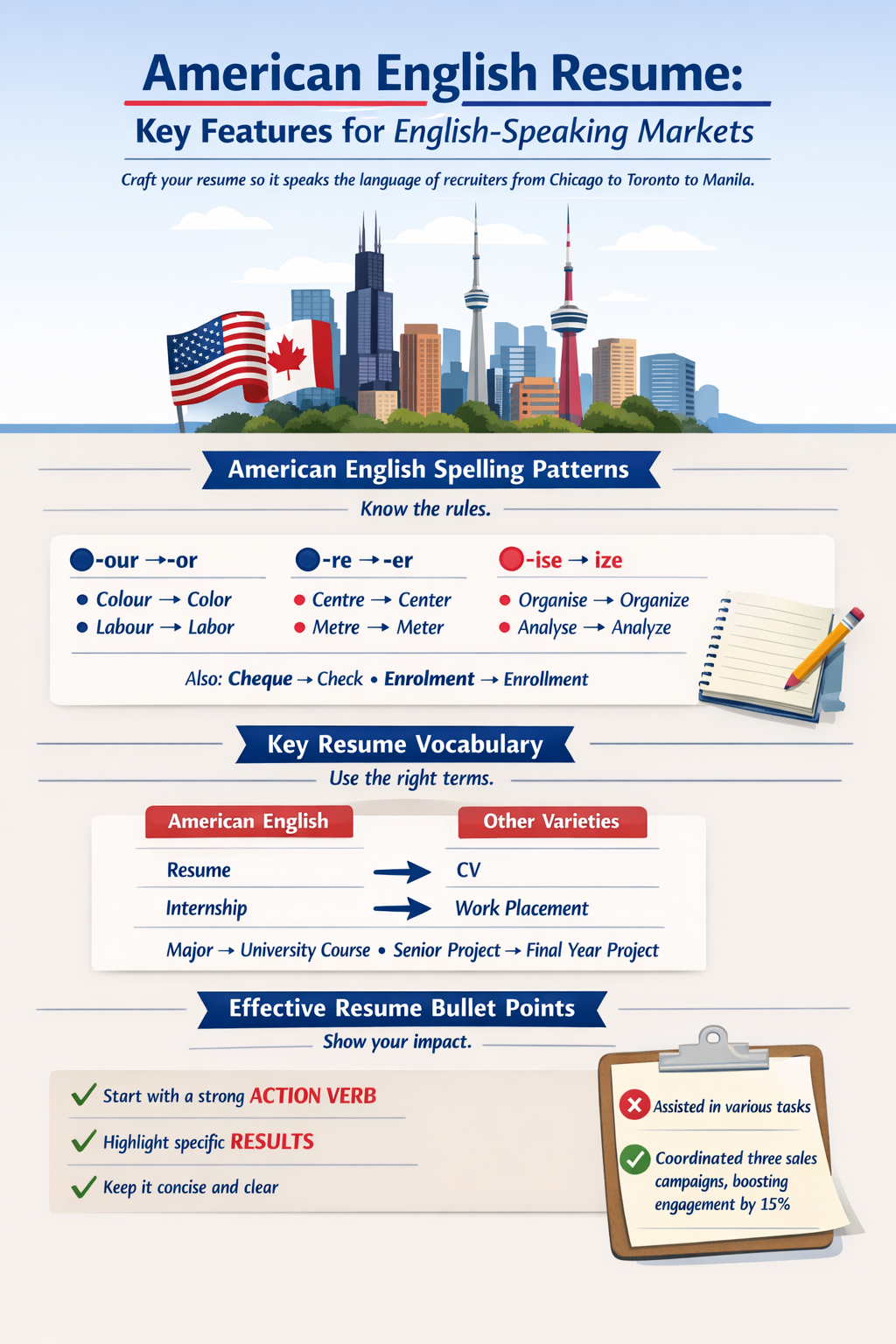
The differences between American and other English varieties follow predictable patterns:
Rather than memorising each word individually, recognising the underlying patterns makes it easier to apply them consistently across your entire document:
- -our → -or: colour → color, labour → labor, honour → honor
- -re → -er: centre → center, metre → meter, theatre → theater
- -ise → -ize: organise → organize, analyse → analyze, recognise → recognize
- Simplified endings: enrolment → enrollment, cheque → check
Why consistency in spelling matters more than perfection ?
A single spelling variant from another English tradition will rarely cost you an interview. A document that alternates between "organisation" and "organization", or uses "analyse" in one bullet and "analyze" in another, signals something more damaging than unfamiliarity: it signals a lack of care. That separates a polished resume from one that feels rushed.
American English resume vocabulary: what terms recruiters expect

Spelling aside, certain words and phrases are simply more natural to American English readers. Using the expected terminology helps your resume scan effortlessly, without the recruiter pausing to mentally adjust.
Word choice that communicates initiative
Beyond direct equivalents, some American English phrasing simply carries more weight in a hiring context. "Leadership roles" reads as deliberate and results-oriented in a way that "student activities" does not. "Cross-functional collaboration" signals professional fluency that "teamwork" alone does not convey.
These are not mere synonyms. They reflect a vocabulary that American recruiters associate with candidates who understand how professional environments are described and discussed… the same clarity expected in a strong resume headline.
How to write bullet points in an American English resume
Bullet points are the core unit of a resume in American English. They appear under every role, project, internship, or leadership experience. And they follow a clear, consistent logic: one strong action verb, one specific outcome, no filler.
The structure of an effective American English resume bullet
Every bullet should answer two questions implicitly: what did you do, and what came of it? The structure is simple:
[Action verb] + [what you did] + [measurable result or context]
The difference in practice:
The second version is not longer, it is more precise. It replaces a vague duty with a concrete action and a visible result.
Action verbs for an American English resume
The verb that opens each bullet carries the entire sentence. Weak verbs like "helped," "assisted with," or "was responsible for" diffuse the impact before the recruiter reaches the achievement. Strong alternatives include:
- For leadership: Led, Directed, Spearheaded, Oversaw
- For analysis: Analyzed, Evaluated, Assessed, Identified
- For communication: Presented, Negotiated, Coordinated, Liaised
- For delivery: Implemented, Launched, Developed, Executed
- For improvement: Streamlined, Optimized, Redesigned, Reduced
American English resume style: Drop the academic register
One of the most common mistakes candidates make when writing in American English for the first time is carrying over academic writing habits. Yet, academic prose is long, cautious, and built around hedging. Resume writing in American English is the opposite: short, direct, and built around results.
The second version says more in fewer words, because it removes the scaffolding and leaves only the substance.
Active vs. passive voice on American English resumes
Passive constructions bury agency. "A new reporting system was implemented" tells the recruiter nothing about who did what. "Implemented a new reporting system adopted by four departments" puts you at the centre of the action — which is exactly where your resume needs you to be.
Common phrasing mistakes on American English resumes
Even candidates with strong English skills can fall into phrasing patterns that sound slightly off to American readers. These are rarely grammatical errors. They are register mismatches, and they create friction in exactly the wrong place.
Noun phrases that bury the action
Preposition errors common in non-American English
Certain prepositional phrases differ subtly between English varieties and stand out to native readers:
Overloading adjectives instead of demonstrating skills
Adjectives are easy to write and easy to ignore. Results are not.
The second version shows what those skills look like in action, which is what gives them credibility.
American English resume format: Conventions beyond the words
The language of an American English resume extends beyond vocabulary and spelling. Formatting conventions carry their own set of expectations. And deviating from them, even with flawless writing, can make a document feel subtly out of place.
Date format on an American English resume
Use the month–year format throughout: March 2023 – July 2024. Numerical formats (03/2023) are acceptable but less readable. Day-first formats common in other varieties (15 March 2023) are non-standard in American English resumes and best avoided.
Personal informations: What to leave off
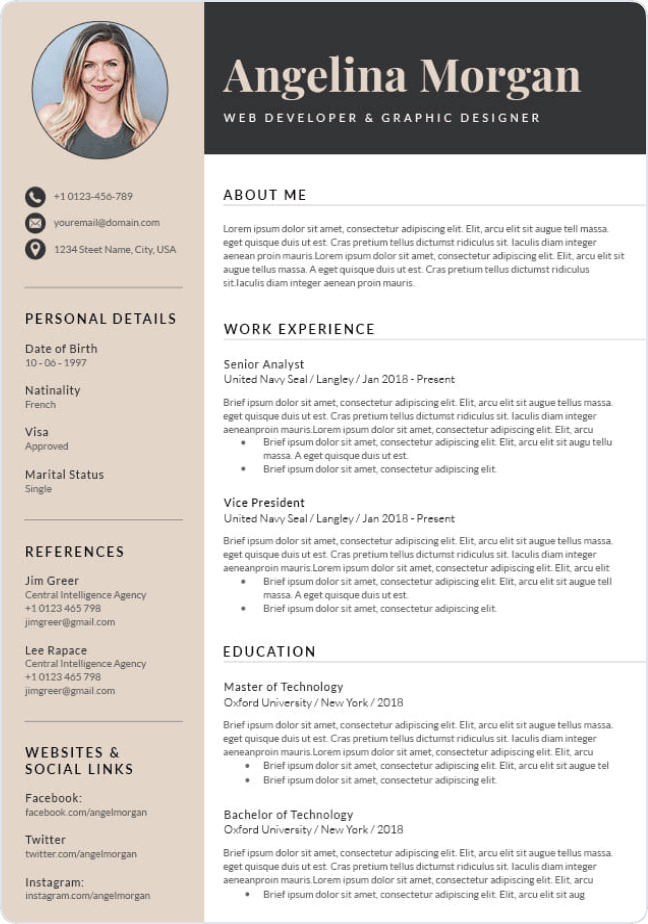
American and Canadian resume conventions do not include a photo, date of birth, marital status, or nationality. These are standard in some European and Asian markets but are considered unusual, and in some cases legally sensitive, in US hiring contexts. Including them signals unfamiliarity with the format.
Length in resumes in American English
One page is the standard for candidates with under ten years of experience. Two pages are acceptable for senior roles. A CV-style multi-page document, common in academic or European contexts, is not the norm in American English professional hiring outside of academia.
Final thoughts : what a polished American English resume communicates
When spelling, vocabulary, bullet structure, phrasing, formatting, and a strong professional resume summary all align, the resume does something beyond listing qualifications: it demonstrates cultural fluency.
That fluency is difficult to fake and easy to recognise. It is built from small, deliberate choices across every line of the document… the kind of choices that this short guide was designed to make automatic.
Create your resume with the best templates