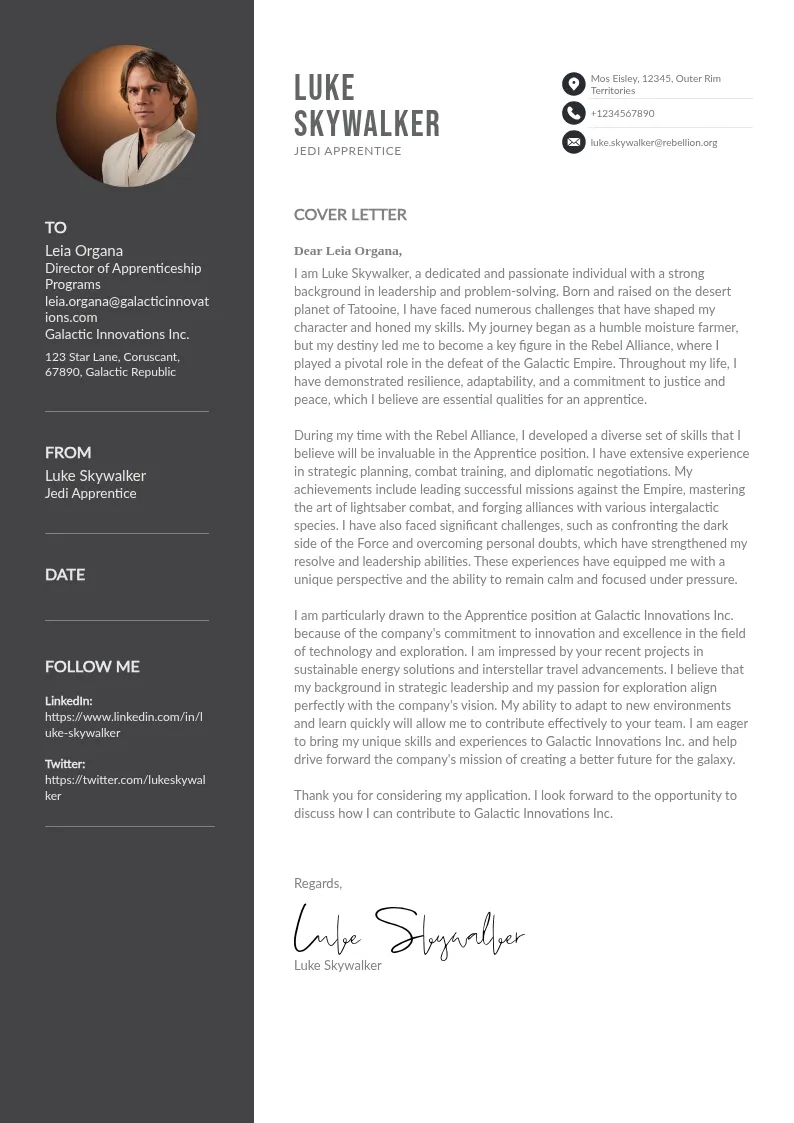
In practice, many hiring managers approach cover letters with limited time. Rather than reading every line, they tend to skim the page, quickly searching for signals that a candidate might be worth a closer look.
The examples below are designed with that reality in mind. Their goal is simple: give the reader a clear and compelling reason to keep going, instead of stopping after the first glance.
Cover letter examples by job type
Marketing cover letter
When to use this: Applying for any marketing role (digital, content, growth, brand). Lead with a campaign result or metric, not your passion for marketing.

Dear [Hiring Manager's Name],
I've been following [Company Name]'s shift toward performance marketing over the past year — specifically your Q3 campaign that drove a 47% increase in qualified leads through LinkedIn. That's the kind of work I want to be part of.
As a Digital Marketing Manager at Bloom Agency for the past 4 years, I've led multi-channel campaigns for B2B SaaS companies with budgets ranging from $50K to $800K. My most recent campaign for a cybersecurity client generated 1,200 MQLs at a 34% lower CPL than the previous quarter, through a combination of intent-based targeting and landing page optimization.
I specialize in the data layer of marketing — understanding why campaigns work or don't, and adjusting fast. I'd love to bring that discipline to [Company Name]'s growing performance team.
Available for a call this week — [phone number] works best.
[Your Name]
What makes it effective:
- Leads with something specific the candidate noticed about the company: a real campaign, a real number
- Core achievement is precise and business-relevant
- Candidate defines a clear value proposition ("the data layer of marketing") instead of listing generic skills
Software engineer cover letter
When to use this: Applying for developer or engineering roles. Skip the buzzwords: hiring managers want to see what you built and what it solved.
Dear [Hiring Manager's Name],
I've been building with [Company Name]'s API for the past 6 months on a side project, and when I saw the Senior Backend Engineer opening, I didn't hesitate to apply. I know your stack, I know the pain points, and I have some ideas.
At Databridge Inc., I led the migration of our monolithic payment processing system to a microservices architecture, reducing average transaction time from 840ms to 120ms and eliminating a class of timeout errors that had cost us roughly $40K in failed transactions per quarter. I'm comfortable owning complex projects end-to-end — from architecture decisions through to deployment and monitoring.
I'd love to talk through what you're working on and where I could add the most value.
[Your Name] | [Email] | [GitHub]
Why it stands out:
- Opening is disarming: the candidate has actually used the company's product, far more credible than "I admire your mission"
- Technical achievement is tied to a real business cost ($40K in failed transactions), legible to non-technical hiring managers
- Short, confident closing links directly to work samples.
Teacher cover letter
When to use this: Applying for teaching positions at any level. Lead with a student impact story, not your love of education.
Dear Principal Johnson,
One of my 6th graders told me last year that math finally "clicked" for her after she failed the same test three times. That moment — and the specific approach I used to get there — is what I'd bring to Jefferson Middle School.
I'm a licensed middle school Math teacher with 5 years of experience in Title I schools. At my current school, I implemented a peer tutoring program that improved standardized test scores by an average of 14 percentile points across my classes. I've also developed differentiated lesson plans used by four other teachers in my department, adapted for students with IEPs and ELL students.
I'm particularly interested in Jefferson's focus on project-based learning — it aligns directly with how I structure units to build toward real-world application rather than test performance alone.
I'd welcome the chance to visit and meet your team.
[Your Name]
Why it gets response:
- Opens with a student story that establishes teaching philosophy without stating it explicitly
- Quantified achievement ("14 percentile points") gives the story hard evidence
- Final paragraph connects the candidate's methods to the school's specific stated priorities
Nursing cover letter
When to use this: Applying for nursing roles: clinical, hospital, community... Certifications and patient care experience matter here, so, list them.
Dear Nurse Manager Williams,
During my clinical rotation at Boston Medical Center's cardiac care unit, I assisted with a code blue situation that required rapid coordination across a 6-person team. That experience crystallized why I want to specialize in critical care nursing — and why I'm applying to St. Mary's ICU program.
I'm a BSN graduate with clinical experience in medical-surgical and cardiac care settings, certified in BLS and ACLS. During my 180-hour practicum at BMC, I managed a 6-patient assignment independently, maintained a 0% medication error rate over the rotation, and received commendation from the charge nurse for my patient communication skills with non-English-speaking patients.
St. Mary's reputation for nurse-led patient advocacy is a significant draw for me — it's the kind of culture where I learn and perform best. I'd welcome the chance to speak with you about the ICU residency program.
[Your Name]
Why it builds trust:
- High-pressure clinical opening signals readiness without self-promotion
- Certifications listed naturally as context, not a checklist
- "0% medication error rate" is the kind of concrete detail that matters in care settings
- Cultural fit paragraph references something specific about this hospital, not hospitals in general
Administrative assistant cover letter
When to use this: Applying for admin, executive assistant, or office coordinator roles. Show that you prevent problems before they happen, not just that you handle tasks.
Dear Ms. Thompson,
When an executive's 7:00 AM flight gets cancelled and she has a board presentation at 10:00, the administrative assistant is the person who makes it work. I've been that person for the past 4 years at Cornerstone Financial.
Supporting three senior VPs simultaneously, I manage complex multi-timezone calendars, coordinate international travel logistics, and act as the primary liaison for board-level communications. This past year, I reorganized our document management system, reducing retrieval time for compliance files by 60% — which proved critical during a regulatory audit.
I work best in environments where being three steps ahead is the expectation, not the exception. I'd welcome the chance to discuss how I can support your team.
[Your Name]
What makes it memorable:
- Opening scenario demonstrates situational intelligence before claiming it
- Achievement in paragraph two is practical, specific, and directly relevant (compliance, document management, audit readiness)
- Closing is confident without being aggressive
Cover letter examples by experience level
Cover letter with no experience (student / entry-level)
When to use this: You're applying for your first job, an internship, or a position where you have no direct professional experience. Replace work achievements with academic projects, extracurricular leadership, or volunteer work.
Sarah Mitchell sarah.mitchell@email.com | linkedin.com/in/sarahmitchell | Boston, MA
March 15, 2025
Dear Ms. Rodriguez,
When I read that Brightwave Marketing was expanding its social media team, I immediately thought of the campaign strategy I developed for my university's student newspaper — which grew our Instagram following by 340% in one semester.
I'm a final-year Communications student at Boston University with hands-on experience in content creation, analytics, and community management. During my time as Social Media Editor at The Daily Free Press, I:
- Grew our Instagram account from 1,200 to 5,300 followers in 6 months
- Developed a weekly content calendar used by a team of 8 contributors
- Increased post engagement rate from 1.2% to 4.7% through A/B testing
Brightwave's focus on data-driven storytelling aligns directly with how I approach content — every post I create starts with audience data, not assumptions. I'd love to bring that mindset to your team.
I'm available for a call any time this week at (617) 555-0123.
Sincerely, Sarah Mitchell
What make this effective:
- Opens with a specific, quantified achievement, not a declaration of enthusiasm
- Bullet points turn academic work into concrete proof points
- Closing ties the candidate's approach directly to what the company cares about
- No generic sign-off, no filler
Career change cover letter
When to use this: You're switching industries or roles and need to address the gap between your current experience and the job requirements. Don't hide the change. Reframe it as a strength.
James Kowalski j.kowalski@email.com | Chicago, IL | (312) 555-0198
March 15, 2025
Dear Hiring Manager,
After 8 years managing customer operations at a mid-sized logistics firm, I've decided to make the move I've been building toward for two years: transitioning into UX research. I'm writing because Apex Digital's approach to user-centered design — and specifically your recent case study on reducing cart abandonment through behavioral research — is exactly the kind of work I want to do.
My background in operations gave me something most junior UX researchers don't have: I've spent years identifying why processes break down and what users actually need versus what they say they need. At TruckTrack Logistics, I:
- Redesigned our internal order management interface after conducting 40+ user interviews with warehouse staff, reducing order errors by 22%
- Analyzed support ticket data to identify the top 5 friction points in our client portal, leading to a redesign that cut support calls by 31%
I've since completed Google's UX Design Certificate and have been conducting independent usability tests for two local nonprofits. I'd welcome the chance to show you my portfolio and discuss how my background could bring a different perspective to your research team.
Best, James Kowalski
What sets it apart:
- Names the career change upfront. Honesty builds trust immediately
- Reframes "unrelated" experience as a genuine edge most junior candidates lack
- Concrete steps to bridge the gap (certification, independent projects) show initiative, not just intention
- Reference to a specific company publication proves this isn't a mass application
Experienced professional cover letter
When to use this: You have 5+ years of experience and are applying for a senior or specialized role. At this level, lead with strategic thinking and measurable impact, not just a list of responsibilities.
Priya Nair priya.nair@email.com | New York, NY | linkedin.com/in/priyanair
March 15, 2025
Dear Mr. Chen,
Vertex Capital's recent expansion into Southeast Asian markets caught my attention — particularly your approach to risk assessment in emerging market portfolios. As a Senior Financial Analyst with 9 years of experience across private equity and corporate finance, I've spent the last three years building exactly the kind of cross-border valuation models your team is developing.
At Meridian Partners, I led the financial modeling for a $340M portfolio expansion across Vietnam and Indonesia, coordinating due diligence with local teams in 4 countries. More recently, I developed a risk-weighting framework that reduced write-down exposure by 18% across our emerging market holdings.
What draws me to Vertex specifically is your stated commitment to local partnership structures — something I believe is consistently underweighted in traditional PE approaches to Southeast Asia. I have thoughts on this I'd be glad to share in a conversation.
I'm available for a call Thursday or Friday afternoon at (212) 555-0167.
Priya Nair
Why this works:
- Opens with a strategic observation about the company, not a self-introduction. It positions the candidate as a peer
- Every achievement is scoped, quantified, and mirrors the role being applied for
- Final paragraph signals genuine intellectual engagement with the company's direction
- Tone is direct in a way that's appropriate, and expected, at the senior level
Use this template → Senior Professional Cover Letter Template
Cover letter examples by situation
Cover letter for internal promotion
When to use this: You're applying for a higher role within your current company. Be direct. You are not an outside candidate, so don't write like one.
Dear [Manager's Name],
I'm writing to formally express my interest in the Senior Project Manager position posted last week. Having spent three years on the operations team — including 18 months as a Project Coordinator — I believe I'm ready to take on this role, and I'd like to make the case for why.
Over the past year, I've led three cross-functional projects with budgets over $200K, all delivered on time and under budget. I've also taken on informal mentoring responsibilities for two junior coordinators — something I'd like to formalize in a senior role.
I'd welcome a conversation about what success looks like in this position and how my trajectory aligns with where the team is heading.
[Your Name]
Why it signals readiness:
- Skips over-explanation — internal candidates don't need to introduce themselves
- Data-backed and forward-looking throughout
- Closing asks a strategic question about success criteria rather than simply requesting an interview
Cover letter after being laid off
When to use this: You were recently laid off and want to address it briefly without sounding defensive or apologetic.
Dear [Hiring Manager's Name],
Following a company-wide restructuring at TechCorp last month, I'm exploring my next opportunity — and [Company Name]'s Product Marketing Manager role immediately stood out.
In my four years at TechCorp, I led go-to-market strategy for three product launches, the most recent of which achieved $2.1M in first-quarter revenue against a $1.4M target. I'm proud of that work, and I'm ready to bring the same approach to a new team.
[Company Name]'s expansion into the enterprise segment is exactly the kind of challenge I enjoy most. I'd welcome the chance to discuss how I can contribute.
[Your Name]
What makes it work:
- Layoff addressed in one sentence, then immediately left behind — no defensiveness
- Pivots directly to a specific, strong performance achievement
- Final paragraph shows genuine research into the company's current direction
Cover letter with an employment gap
When to use this: You have a gap in your employment history like caregiving, health, personal reasons. Address it briefly, then move on quickly to your qualifications.
Dear [Hiring Manager's Name],
Between 2022 and 2024, I stepped back from my accounting career to care for a family member full time. During that period, I maintained my CPA license, completed an advanced Excel certification, and freelanced on three small business audits to stay current. I'm now ready to return full-time, and [Company Name]'s Senior Accountant role is exactly the kind of position I'm targeting.
Before my break, I spent six years at Grant Thornton, where I managed audit engagements for clients with revenues up to $80M. My most recent engagement involved leading a team of four on a complex revenue recognition project under ASC 606 — experience directly relevant to the role you've described.
I'd welcome the chance to discuss my background and the value I'd bring to your team.
[Your Name]
Why it is effective:
- Gap addressed proactively in the opening — better than letting the hiring manager notice it first
- Immediately paired with what the candidate did during that time to stay current
- Pivots quickly to a strong pre-gap track record, keeping focus on qualifications
Cover letter for CV applications: How to align your letter with your resume
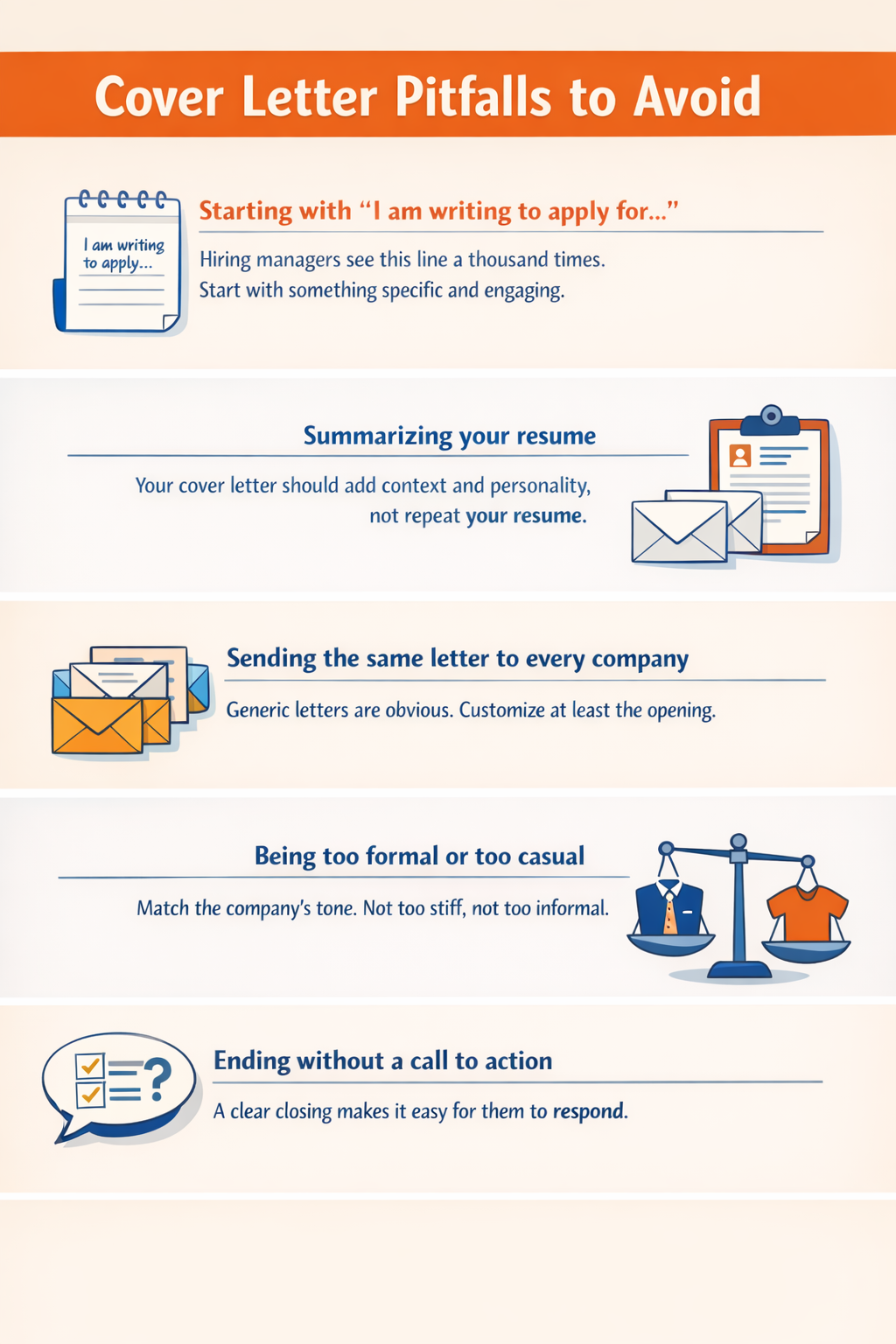
Most candidates treat the cover letter as an extension of their CV, a second chance to list the same experience, slightly rephrased… Yet it's one of the most common mistakes in job applications, and one of the least noticed by the people making it.
A cover letter isn't a summary of your CV or resume. It's an argument for why a specific part of your background matters for a specific role. The difference sounds small. In practice, it changes everything about how you write.
How to use your CV when writing a cover letter
The starting point isn't a blank page: it's your CV. But not all of it.
Before writing a single sentence, read the job description carefully and ask: what in my CV actually speaks to this role? A strong cover letter is built on selection, not completeness. In practice, that means identifying three things:
- One result you've delivered that directly mirrors what the company is hiring for
- One experience that shows you've already navigated similar terrain
- One skill the job description treats as non-negotiable
That's your material. Everything else stays in the CV, where it belongs.
Common mistakes in CV and resume cover letters
The failure mode is almost always the same: the letter reads like a prose version of the CV, with slightly warmer language. The candidate lists responsibilities, mentions a few skills, and closes with something about being "excited for the opportunity."
None of that adds context. It just adds length. What a recruiter actually needs is a clearer picture of fit: not more information, but better-framed information. A cover letter that repeats the CV also signals something else: that the candidate hasn't thought hard about what the employer actually needs.
The most common culprits:
- Repeating job titles and responsibilities already visible in the CV
- Including experience that has no bearing on the role
- Writing in terms generic enough to fit any company in the industry
What strong cover letter examples have in common
Look at the cover letters that actually get responses, across industries and experience levels, and a pattern emerges: they don't try to be comprehensive. They make the recruiter's job easier — not by being shorter, though brevity helps, but by doing the interpretive work upfront.
That means:
- Drawing an explicit line between something you've done and something the role requires
- Showing that you understand what the company is trying to solve, not just what they've listed on paper
- Being willing to leave things out (A cover letter that tries to cover everything covers nothing well)
The question to ask of every sentence is whether it helps a recruiter understand your fit faster. If it doesn't, it probably shouldn't be there.
CV and cover letter: Two documents, One argument
It helps to think of the CV and the cover letter as doing different work toward the same end. The CV establishes your record: what you've done, where, for how long. The cover letter frames that record:
- why it's relevant,
- what it demonstrates,
- what you'd bring to this particular role.
When they work together well, they tell a coherent story: one that starts with the letter and ends with the CV confirming it. When they don't, the recruiter reads the same information twice and learns nothing new.
What makes a cover letter stand out in 2026
Needless to say that hiring managers read dozens of cover letters per role. Here's what separates the ones that get responses from the ones that don't:
- It's specific to the company: Generic cover letters are spotted immediately. Good cover letters reference something real: a recent product launch, a stated mission, a piece of content they published... One specific sentence does more than three generic paragraphs.
- It leads with impact, not intention: A sentence like "I am passionate about marketing" tells a hiring manager nothing. One "I grew our email list by 40% in 6 months through segmentation and A/B testing" tells them exactly what you can do.
- It's short: one page maximum. 3 to 4 paragraphs. Know that hiring managers skim, so make every sentence earn its place.
- It matches the job description's language: Most companies use Applicant Tracking Systems (ATS) to filter applications before a human sees them. Use the exact terminology from the job posting, especially for required skills and qualifications.
- It has a clear closing. For example: "I look forward to hearing from you" is weak. "I'm available for a call Thursday or Friday — [phone] works best" is an actual next step. Be direct.
Common cover letter mistakes to avoid
Cover letter format and structure
Every strong cover letter follows a proven structure, but the real impact comes from knowing why each section matters. Recruiters spend an average of 6 seconds scanning a letter’s opening, so the first paragraph must hook them with relevance.
Clear cover letter formats, including a concise introduction, evidence-backed middle, and confident closing, consistently outperform freeform letters. That may increase interview callbacks by up to 30% according to recent industry studies.
[Your Name]
[Email] | [Phone] | [LinkedIn or Portfolio URL]
[City, State]
[Date]
Dear [Name — specific if possible, "Hiring Manager" if not],
PARAGRAPH 1 — Hook
Specific, company-focused opening. Show you've done your research.
Make them want to read paragraph 2.
PARAGRAPH 2 — Value
1–3 concrete achievements with numbers. What you've done,
not what you're “responsible for.”
PARAGRAPH 3 — Connection
Why this company specifically. One genuine reason that ties
your background to their work or mission.
PARAGRAPH 4 — Close
Specific, confident call to action. Your availability and
preferred contact method.
[Your Name]
- Length: 250–400 words. Never more than one page.
- Font: Match your resume, 10 to 12pt, professional typeface.
- File format: PDF unless the application specifically asks for Word.
Cover letter checklist before you hit “send”
Run through this before every application :
- Did you address it to a specific person, not "To Whom It May Concern"?
- Does the first sentence mention something specific to this company?
- Is there at least one achievement with a number in paragraph 2?
- Is it under 400 words and fits on one page?
- Did you use keywords from the job description?
- Is the closing a specific ask — not just "I look forward to hearing from you"?
- Did you proofread for spelling, grammar, and the correct company name?
If your cover letter is ready, your resume should be too. A strong application is always both: one gets them interested, the other closes the case.