A simple resume is not a compromise. It is a strategy. Clean, single-column, no graphics, no distractions: it is the format recruiters read fastest, the format ATS systems parse most reliably, and the format that forces your content to carry its own weight. This guide gives you two ready-to-use templates, annotated examples, and the one rule that turns a mediocre resume into one that actually gets interviews.


A simple resume (also called a basic resume) is a single-column document containing only the essentials: contact information, summary or objective, work experience, education, and skills. No graphics. No colored sidebars. No tables. Standard fonts. Enough white space to breathe.
That is not a limitation. That is the point.
Simple and basic resume templates mean the same thing — the two terms are used interchangeably across the industry. Both refer to a clean, minimal format that prioritizes content over design.
Not every job seeker needs a simple resume. But the vast majority do. The decision comes down to one question: is the format helping or competing with your content? For most industries and most applications: simple wins by default.
Each section in a simple or basic resume serves a specific informational role. The contact section records essential personal and communication data. The summary condenses your profile into key points. The Experience part details professional history with tasks and outcomes. The Education section lists formal qualifications. The skills section specifies measurable abilities and competencies.
Together, these sections organize information in a clear and structured way for efficient evaluation.

Use this format if you have two or more years of relevant work experience. Copy the structure below, replace the placeholder text with your own details, and you are done.

FULL NAME
Job Title You Are Applying For
phone · email · city, state · linkedin.com/in/yourname
PROFESSIONAL SUMMARY
Two to three sentences. Lead with your job title and years of experience, name your strongest area of expertise, close with one concrete achievement supported by a number.
WORK EXPERIENCE
Most Recent Job Title
Company Name, City, State
Month Year – Month Year
Previous Job Title
Company Name, City, State
Month Year – Month Year
EDUCATION
Degree, Major
Institution Name, City, State — Year
SKILLS
[Hard skill] · [Tool] · [Certification] · [Language + level]
The professional summary is the first thing a recruiter reads. It has two to three seconds to earn the rest of the document. Here is the difference between a summary that gets skipped and one that pulls the reader in.
No job history does not mean no resume. It means a different kind of resume: one that leads with what you know rather than where you have worked. This is the most searched simple resume sample for first job applications and fresh graduate profiles, and for good reason. It works because it replaces the implied requirement of a work history with demonstrated ability in any form.
Use this format if you have little or no formal work experience. Education moves to the top. Work experience is replaced by a broader "Relevant Experience" section that accepts internships, academic projects, volunteer work, club leadership, or any paid work, formal or informal.
FULL NAME
phone · email · city, state
RESUME OBJECTIVE
One to two sentences. State the role you are targeting, name one or two relevant skills, and connect them to something you have already done — even informally.
EDUCATION
Degree or Diploma (in progress or completed)
Institution Name, City, State — Expected Year
GPA: X.X (include only if 3.5 or above)
Relevant coursework: [list 2–3 subjects tied to the role]
RELEVANT EXPERIENCE
(internships, academic projects, volunteer work, club leadership, informal jobs)
Role or Project Title
Organization or Context
Dates
SKILLS
[Technical skill] · [Tool] · [Language + level]
The resume objective does one job for entry-level candidates: it tells the recruiter what you are aiming for and gives them one concrete reason to keep reading. A vague objective is worse than no objective. A specific one changes everything.
Responsibilities describe what your job was supposed to do. Results describe what you actually produced. Every bullet point on a simple resume should be a result, not a task.
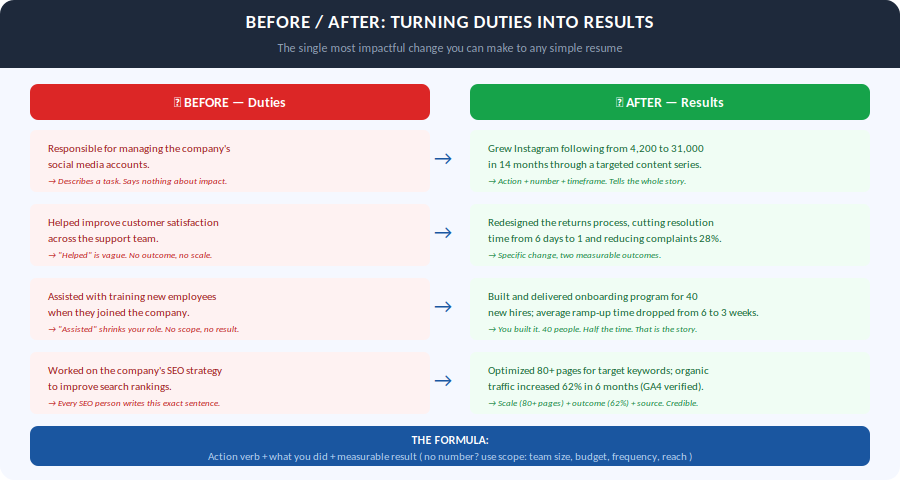
If you do not have a number, use scope: team size, budget managed, number of clients, frequency, geographic reach. Something concrete always beats something vague.
A simple resume earns its reputation on two fronts: it passes automated screening reliably, and it lets a human reader find what they need without effort. Both matter. But simple is not the answer for everyone, and being honest about that limitation is more useful than pretending it does not exist.
A simple format cannot save a weak resume. What it can do is make every mistake more visible. There is nowhere to hide behind design. These are the errors that appear most often in simple resume samples submitted by candidates who do not get callbacks.
These errors happen before any formatting decision is made. They are the reason a polished, well-structured resume gets ignored.
Formatting mistakes on a simple resume are especially counterproductive: you chose the clean format precisely to avoid distraction, then undermine it with avoidable errors.
The three main resume formats each serve a different purpose. Simple (reverse-chronological) is the default for most job seekers. The other two exist to solve specific problems: hiding a fragmented work history, or leading with skills over experience. Choose based on your situation, not on what looks more impressive.
Our collection of expertly designed cover letter templates will help you stand out from the crowd and get one step closer to your dream job.