The ATS resume template you used in 2025 may no longer be enough.
In 2026, almost 80% of companies have automated at least part of their hiring process, and the systems doing the filtering are smarter, faster, and less forgiving than they used to be. What worked two years ago (a clean layout, a few keywords, a standard font) is now table stakes.


[FULL NAME]
[JOB TITLE]
[CITY, COUNTRY] | [PHONE WITH COUNTRY CODE] | [EMAIL ADDRESS]
[LINKEDIN URL] | [PORTFOLIO / GITHUB URL — optional]
PROFESSIONAL SUMMARY
[Job Title] with [X] years of experience in [sector / industry / domain], specializing in [core skill 1], [core skill 2], and [core skill 3].
Track record of [quantified achievement, e.g. reducing operational costs by 25% through process reengineering across a team of 40].
SKILLS
Technical Skills: [Tool / Software 1], [Tool 2], [Tool 3], [Platform 1]
Core Competencies: [Hard Skill 1], [Hard Skill 2], [Hard Skill 3]
Certifications: [ABBREV1 — full name on first use], [ABBREV2]
Languages: [Language 1 — proficiency level], [Language 2 — level]
WORK EXPERIENCE
[JOB TITLE]
[Company Name] · [City, Country] [Month YYYY – Present]
[JOB TITLE]
[Company Name] · [City, Country] [Month YYYY – Month YYYY]
[JOB TITLE — optional 3rd role]
[Company Name] · [City, Country] [Month YYYY – Month YYYY]
EDUCATION
[DEGREE TITLE] — [Field of Study]
[Institution Name] · [City, Country] [Year]
CERTIFICATIONS
[Full Certification Name (ABBREV)] · [Issuing Body] · [Year]
[Full Certification Name (ABBREV)] · [Issuing Body] · [Year]
ADDITIONAL — optional
Volunteer: [Role, Organization — include only if directly relevant]
Publications: [Title, Publication, Year — for senior / academic profiles]
Modern Applicant Tracking Systems use AI-powered parsing, semantic matching, and skills-based filtering that changes how your template needs to be structured from the ground up.
This guide focuses specifically on what is new in 2026: the formatting shifts, the structural priorities, and the template requirements that reflect how ATS software actually works today.
The hiring landscape has shifted significantly over the past 18 months. According to the Resume Genius 2026 Hiring Insights Report, more than 70% of hiring managers now use applicant tracking systems, and 19% use AI specifically to screen out applications before any human review takes place.
That second figure matters. It means a growing share of rejections happen with zero human involvement, not because a recruiter glanced at your resume and passed, but because an algorithm eliminated it in under a second.
Three structural changes are driving this shift around ATS-friendly resume templates:
Older ATS platforms operated on simple logic: if the keyword is present, the resume passes. Modern platforms (Workday, Greenhouse, Taleo, and iCIMS...) now use natural language processing to understand context.
This means keyword stuffing no longer works and may actively hurt your score. The system can tell the difference between a resume that mentions "project management" in a meaningful context and one that repeats it five times in a list.
More than 60% of companies now filter candidates by specific skills before they even look at job title or career history. Your Skills section, which many candidates treat as a footnote, is increasingly the first thing the ATS evaluates. A template that buries skills at the bottom of the page is structurally misaligned with how 2026 screening actually works.
Some enterprise ATS platforms have begun identifying resumes that appear entirely AI-generated without personalization. A template helps you with structure. But the content you put inside it still needs to be specific, human, and results-oriented to pass both the algorithm and the recruiter who reviews shortlisted candidates.
The core formatting rules have not changed dramatically: single-column layout, standard fonts, no graphics or tables. But the internal structure of a competitive template in 2026 reflects new priorities. Here is what matters now.
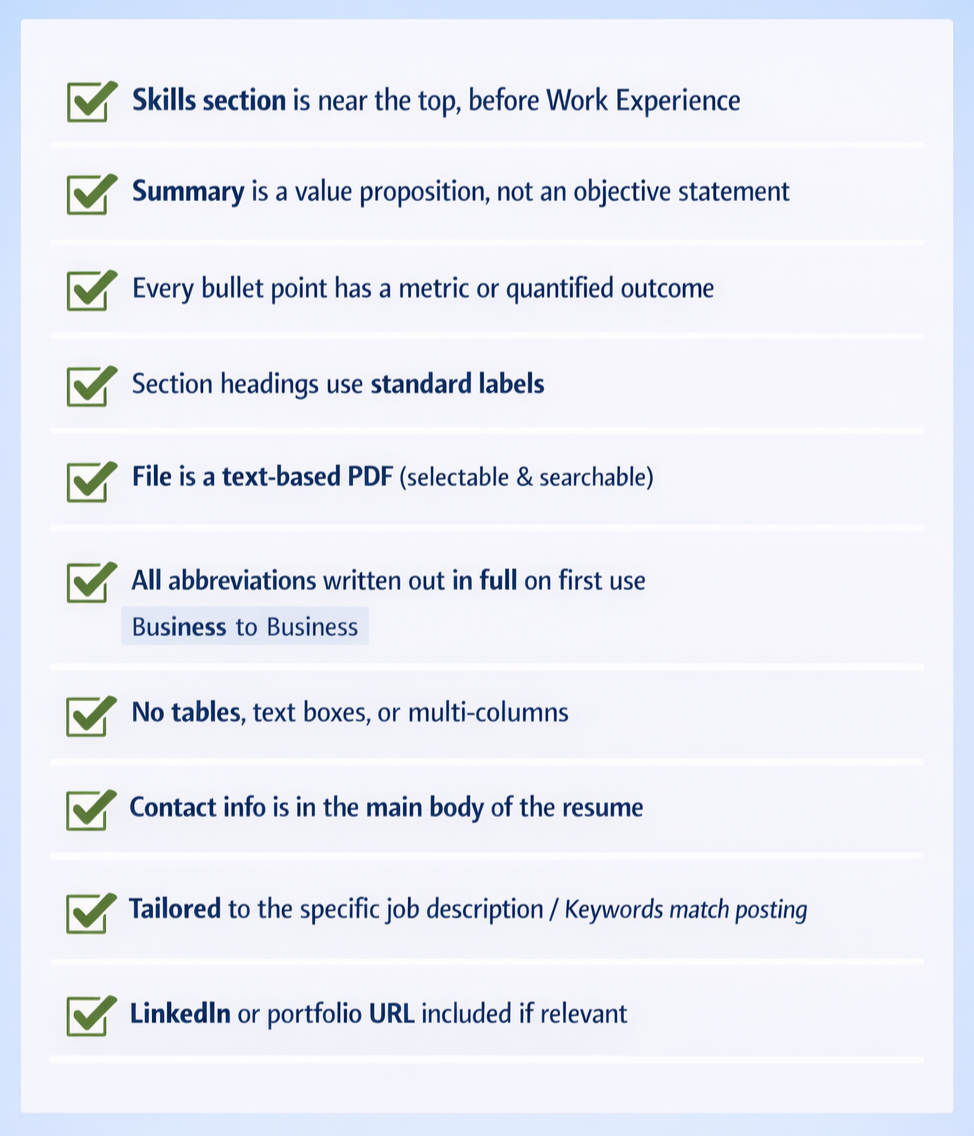
In 2026, the Skills section belongs near the top of your resume, immediately after your summary or professional headline, and before your work experience. This is a direct response to skills-based filtering: if the ATS evaluates competencies first, your template needs to surface them first.
The Skills section should be broken into clearly labeled categories rather than a flat list:
A flat, undifferentiated skills list is harder for AI parsing to interpret. Structured categories give the system clear signals.
The 2026 ATS does not evaluate your summary for keywords alone. It reads it for evidence of competence and role alignment.
 Bad example
Managed social media accounts for the brand.
 Good example
Operations Manager with 8 years of cross-functional team leadership in logistics, with a track record of reducing delivery costs by 20–30% through process reengineering
Your template should reserve 3–4 lines at the top for this value proposition. It is not an objective statement. It is a compressed proof of fit.
Modern ATS platforms increasingly distinguish between achievement-oriented resumes and duty-listing resumes. Research from 2026 suggests that bullet points containing metrics score up to 40% higher in ATS match rates than those describing responsibilities without measurable outcomes.
The format that works: Action verb + context + quantified result.
Weak:"Managed social media accounts for the brand."
Strong:
"Grew Instagram engagement by 43% in six months by implementing a weekly content calendar and A/B testing post formats."
Your template should structure each experience block with space for 3–5 metric-driven bullet points per role. Avoid paragraphs in the experience section — they are harder for parsers to break down and slower for recruiters to scan.
This rule has not changed, but it matters more in 2026 because AI parsing is less tolerant of ambiguity than older rule-based systems. Thus, use these exact headings:
Avoid: "Where I've Worked," "My Expertise," "What I Bring to the Table." These headings are invisible to ATS. The system cannot map them to recognized data fields, and the information inside them may be discarded entirely.
Two-column templates are still common, and some are technically ATS-compatible depending on how the PDF is structured.
But the consensus among practitioners in 2026 is clear: single-column layouts parse more reliably across all major ATS platforms. If you are unsure whether your template is being read correctly, switching to single-column is the highest-impact formatting change you can make.
A persistent myth in the job search space is that PDF resumes cannot pass ATS. The reality is more nuanced. And in 2026, it matters to understand the distinction.
A text-based PDF, one where the text is selectable, searchable, and properly encoded, is fully readable by modern ATS platforms. Hiring managers can confirm this: text-based PDFs and Word documents both work reliably. The problem arises with image-based PDFs (scanned documents, or PDFs exported from design tools like Canva or Figma where text is embedded as an image). Those are invisible to any ATS.
The test is simple: open your PDF and try to highlight your name with your cursor. If you can select and copy the text, the file is text-based and ATS-readable. If the text is not selectable, the file is image-based and will be rejected.
The templates available on this page are downloaded as text-based PDFs and are editable in Microsoft Word and Google Docs. They pass the highlight test by design.
Here is the recommended section order for a 2026 ATS resume template, reflecting both AI parsing priorities and recruiter reading patterns:
1. Contact Information
Full name, phone number (with country code), professional email address, LinkedIn URL, location (city and country).
Keep this in the main body of the document, not in a header or footer, which many ATS platforms ignore entirely.
2. Professional Summary (3–4 lines)
Value proposition framed around the target role. Include your primary job title, years of experience, 2–3 core skills, and one quantified achievement. Mirror the language used in the job description.
3. Skills
Structured by category. Positioned before work experience. Include both full terms and abbreviations on first use (e.g., "Search Engine Optimization (SEO)").
4. Work Experience
Reverse chronological. Each role: job title, company name, location, dates. Followed by 3–5 metric-driven bullet points. Avoid paragraphs.
5. Education
Degree, institution, graduation year. For recent graduates, this can move above Work Experience.
6. Certifications
Certification name, issuing body, year. Include both abbreviation and full form (e.g., "Project Management Professional (PMP)").
7. Additional Sections (optional)
Languages, publications, volunteer work, portfolio link. Include only what is directly relevant to the target role.
Several formatting choices that candidates avoid out of caution are not actually problematic in 2026:
Not every candidate needs the same template structure. Here is a quick guide based on career stage and context:
Use a hybrid format: lead with a strong skills section and a summary that frames the transition explicitly, then follow with reverse-chronological experience that highlights transferable achievements.
Yes, although the requirements are evolving rapidly.
By 2027, Gartner predicts that 75% of hiring processes will include AI proficiency tests, and most of companies will use AI in recruiting. The filter is not going away. It is getting smarter. Clean structure, skills-first positioning, and quantified achievements will remain the floor, not because the rules are static, but because the systems evaluating them are becoming less forgiving, not more.
What changes is the ceiling. The resume is shifting from a keyword document to a proof-of-competence gateway... one click away from a portfolio, a credential, a measurable result. The World Economic Forum projects AI will handle 71% of initial recruitment processes by 2030. Being found will matter as much as applying.
The template gets you through the door. What you put inside it (specific, human, results-driven...) is still what gets you the interview.
Our collection of expertly designed cover letter templates will help you stand out from the crowd and get one step closer to your dream job.