Write your resume in 15 minutes
Our collection of expertly designed resume templates will help you stand out from the crowd and get one step closer to your dream job.


This guide breaks down exactly what makes a professional resume summary work in 2026, with real examples, common mistakes to avoid, and actionable keyword strategies.
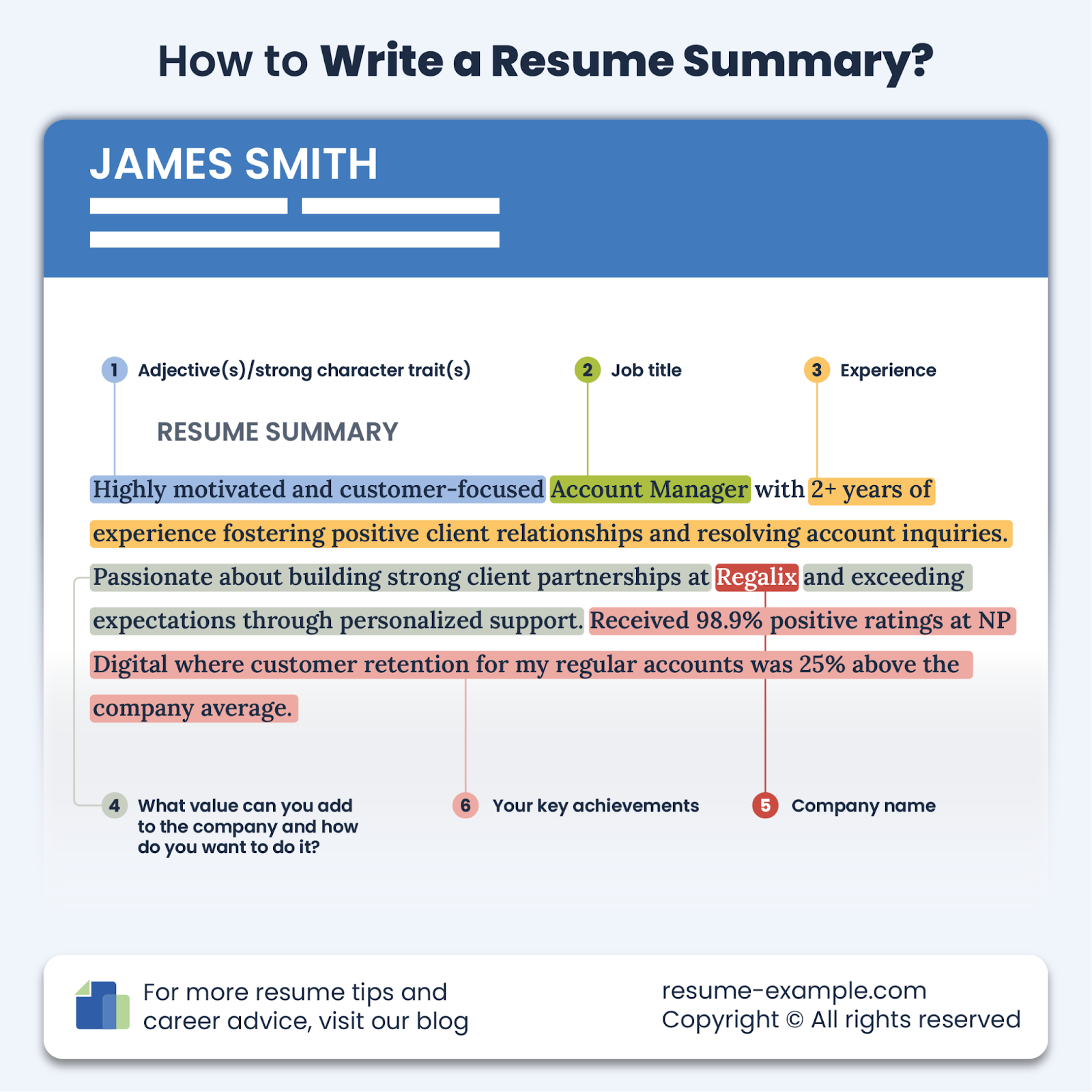
What is a professional resume summary?
A professional resume summary delivers a sharp snapshot of your key skills, accomplishments, and experience relevant to a specific role. It differs from a general “Profile” by focusing on measurable impact and immediate relevance, designed to engage both recruiters and ATS at first glance.
A resume summary sits at the top of your CV and is the first section evaluated by both human recruiters and ATS platforms. In one concise paragraph, it should highlight:
- Your most relevant skills
- Key career achievements with measurable outcomes
- Years of experience in your field
The critical distinction between a weak and a strong summary is specificity. Instead of writing "Managed social media campaigns," write "Led digital campaigns that increased audience engagement by 22% over six months." Modern ATS systems don't just scan for keywords — they evaluate contextual relevance.
Resume Summary vs. Objective
These two formats serve different purposes, and choosing the wrong one can cost you credibility.
- A resume summary provides a snapshot of your skills, achievements, and experience. It gives ATS a dense, keyword-rich opening and gives recruiters a reason to keep reading. It's the right choice for most candidates with relevant work history.
- A resume objective focuses on your career goals rather than your track record. It's better suited for entry-level applicants, career changers, or candidates re-entering the workforce after a gap. Objectives can work well when framed around what you bring to the role, not just what you want from it.
When used thoughtfully, objectives can highlight what you bring to a role, but recruiters typically respond more favorably to proven results. So when in doubt, default to a summary.
Universal resume summary template
Regardless of industry or seniority, every effective resume summary follows the same core formula:

[Job title] with [X years] of experience in [area of expertise]. [Key achievement or skill #1]. [Key achievement or skill #2]. [Forward-looking statement tied to the target role or company.]
How to adapt it by level:
- Entry-level: Replace years of experience with your degree and strongest internship or project result.
- Senior/Director: Expand the achievement lines to reflect scope… budgets, team sizes, revenue influenced.
- C-Suite: Lead with impact at the business level and compress tactical details entirely.
The template is a starting point, not a cage… And the job description is the key that unlocks it. Once you have a working draft, layer in keywords from the posting and cut anything that doesn't directly support your candidacy for that specific role.
How to write the resume summary using a job description
Every strong summary starts with the job description. Take this example for a Digital Marketing Manager role:
Responsibilities:
- Creating and implementing multi-channel campaigns
- Leading and mentoring creative teams
- Evaluating marketing performance through data
- Collaborating with department heads on strategy
- Studying market trends and competitive positioning
Required Skills & Qualifications:
- Bachelor's degree in marketing or a related field
- Minimum four years in a leadership role
- Expertise in Facebook Ads and LinkedIn Ads
- Graphic design proficiency
Aligning your summary to these points ensures both ATS algorithms and hiring managers immediately see your relevance.
Good Example:
 Digital Marketing Manager Resume Summary
Experienced digital marketing manager with 6 years leading multi-channel campaigns that boosted revenue by 16%. Proficient in Facebook Ads, LinkedIn Ads, and data-driven strategy. Strong background in graphic design and video editing. Prepared to implement targeted initiatives maximizing [Company Name]'s ROI.
This summary works because it combines measurable achievements, role-specific tools, and forward-looking intent… It is exactly what both ATS and recruiters prioritize.
Bad Example:
 Digital Marketing Manager Resume Summary
I am a marketing manager with a lot of experience. Looking for new challenges to grow my professional career. I'm a thought-leader and team-player and can provide expertise to this company.
This version fails on every level. "A lot of experience" is unquantifiable. "This company" signals a copy-paste approach. Buzzwords like "thought-leader" and "team-player" add noise without substance. Neither ATS nor recruiters reward vague language, they reward results.
Learn more about effective keyword use in resumes.
Professional resume summary by seniority level
The structure and tone of your summary should shift significantly depending on where you are in your career. Here's how to approach each level.
Entry-level / recent graduate resume summary
At this stage, you have little or no formal work history to lead with. The goal is to reframe academic achievements, internships, and transferable skills as professional assets, without sounding apologetic about your experience level.
What to emphasize: Degree and field of study, relevant coursework or thesis projects, internships, GPA (if strong), soft skills backed by context, and eagerness to contribute.
Avoid: Filler phrases like "seeking an opportunity to grow" with no substance behind them.
Marketing graduate with a 3.8 GPA and two internships in social media strategy. Hands-on experience running paid Instagram campaigns that grew a client's following by 34% in three months. Eager to bring data-driven creativity to a fast-moving brand team.
Mid-level professional resume profile (2-6 years)
At this level, you have results to show, and that's exactly what should lead your summary. Recruiters expect quantified achievements and role-specific keywords. Generic summaries are the most common mistake at this stage.
What to emphasize: Specific accomplishments with numbers, tools and platforms you've mastered, your area of specialization, and the value you've consistently delivered.
Avoid: Listing responsibilities instead of outcomes. "Managed a team" is weak; "Led a 4-person team that cut deployment time by 40%" is strong.
Full-stack developer with 4 years building scalable web applications in React and Node.js. Delivered three client-facing products from conception to launch, reducing average load time by 52%. Experienced in Agile environments and cross-functional collaboration with design and product teams.
Senior professional resume profile (7-12 years)
Senior summaries should convey strategic thinking, not just execution. At this level, hiring managers want to see that you've shaped outcomes, influenced decisions, and developed others… not just performed tasks well.
What to emphasize: Scope of impact (budgets managed, team sizes, revenue influenced), leadership style, cross-departmental influence, and domain expertise.
Avoid: Summarizing your career chronologically. A senior summary is a positioning statement, not a timeline.
Senior finance manager with 10 years driving FP&A for mid-market SaaS companies. Led annual budgeting cycles exceeding $40M, introduced automated reporting that saved 120+ hours per quarter, and mentored a team of six analysts. Track record of translating financial data into executive-level strategy.
Director / Head of department resume summary
Directors need to signal that they think in terms of organizational outcomes, not individual contributions. The summary should reflect vision, stakeholder management, and a history of building functions (not just running them).
What to emphasize: P&L ownership, organizational transformation, hiring and team building, executive stakeholder relationships, and measurable business impact at scale.
Avoid: Tactical details that belong in a mid-level resume. Focus on the "what changed because of you" angle.
Director of Marketing with 12 years building demand-generation engines for B2B tech companies. Scaled a team from 3 to 18 across three markets, oversaw a $6M annual budget, and drove a 3× increase in qualified pipeline over two years. Known for aligning marketing strategy tightly with sales and product roadmaps.
C-Suite / VP CV profile
At the executive level, your summary is less about proving competence and more about articulating a leadership philosophy and a record of transformational impact. Boards and executive search firms are looking for someone who has defined the direction of a function or company, not just managed it well.
What to emphasize: Company-wide transformation, revenue or growth milestones, board-level communication, M&A experience if relevant, and the through-line of your leadership approach.
Avoid: Any language that sounds like you're still proving yourself. Confidence and concision are everything.
Chief Marketing Officer with 15 years leading growth for global consumer brands. Built and scaled marketing organizations across the US, UK, and APAC, contributing to two successful IPOs and one acquisition. Championed brand repositioning initiatives that increased net promoter scores by 28 points. Trusted advisor to CEOs and boards on growth strategy and market expansion.
Quick reference: What changes by level in a professional resume summary?
Resume summary writing best practices
- Limit adjectives. Use one to three strong descriptors. More than that dilutes your credibility.
- Use professional, industry-standard language. Informal phrasing works only if the company culture explicitly calls for it.
- Drop the pronouns. American-style resumes favor direct phrasing: write "Content strategist with 5 years of B2B experience" instead of "I am a content strategist."
- Be accurate. Overstating skills or titles is increasingly detectable — ATS systems can flag contextual inconsistencies, and experienced recruiters spot inflated claims fast.
See more on verified resume summary practices.
How to capture the best keywords to use in a professional resume summary
Keywords are the foundation of ATS visibility. A resume with strong content but poor keyword alignment can be filtered out before any human sees it. Here's how to get it right:
- Research the job description and company thoroughly. Identify repeated phrases, required tools, and skill clusters. (Guide to analyzing job postings)
- Note multi-word keyword phrases. ATS platforms often search for combinations like "Project Manager AND Agile" or "SEO AND content strategy." A single word may not trigger the match. (ATS search strategies 2026)
- Integrate keywords contextually. Stuffing keywords in a list format raises red flags. Modern ATS systems evaluate whether the terms appear in a meaningful context, inside a sentence describing an achievement, for instance. (Best ATS scanners in 2026)
- Use synonyms strategically. If the job posting says "data analysis," your summary might also reference "performance reporting" or "analytics." Vary the language while staying true to the original terminology.
Create your resume with the best templates