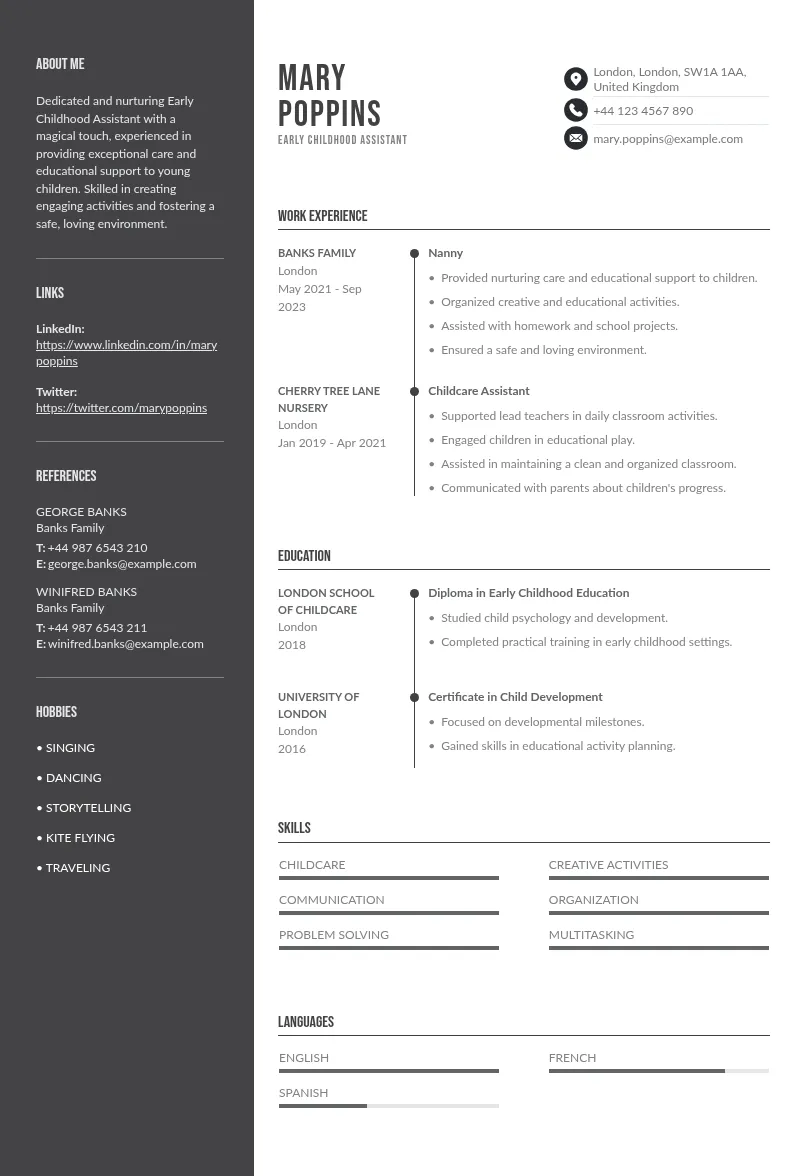
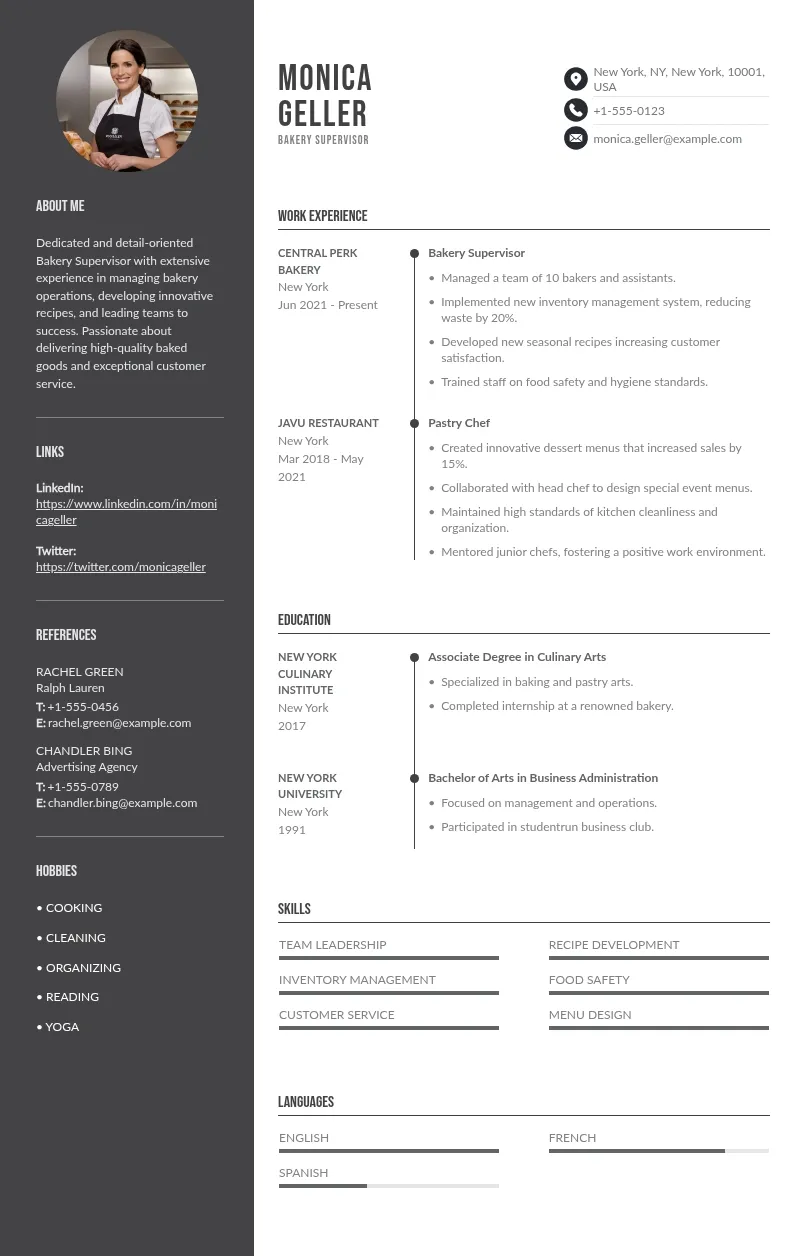
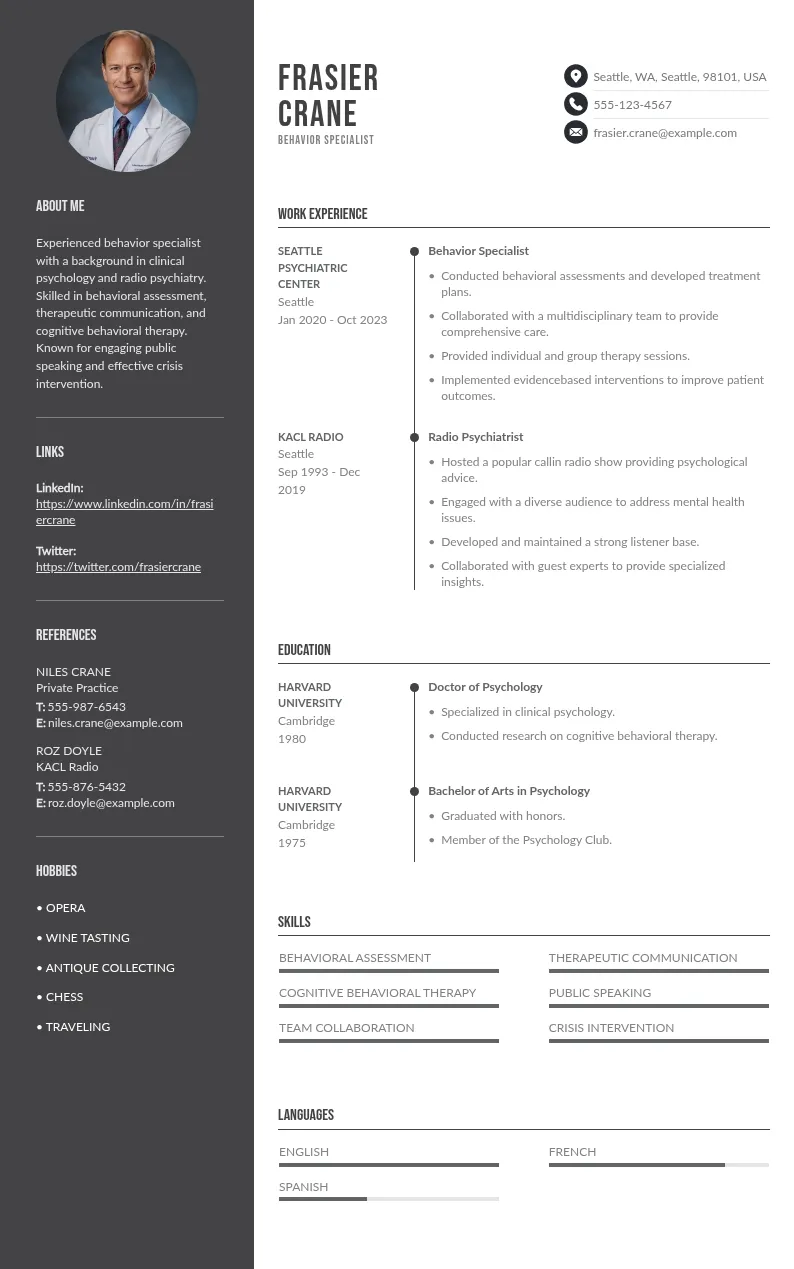
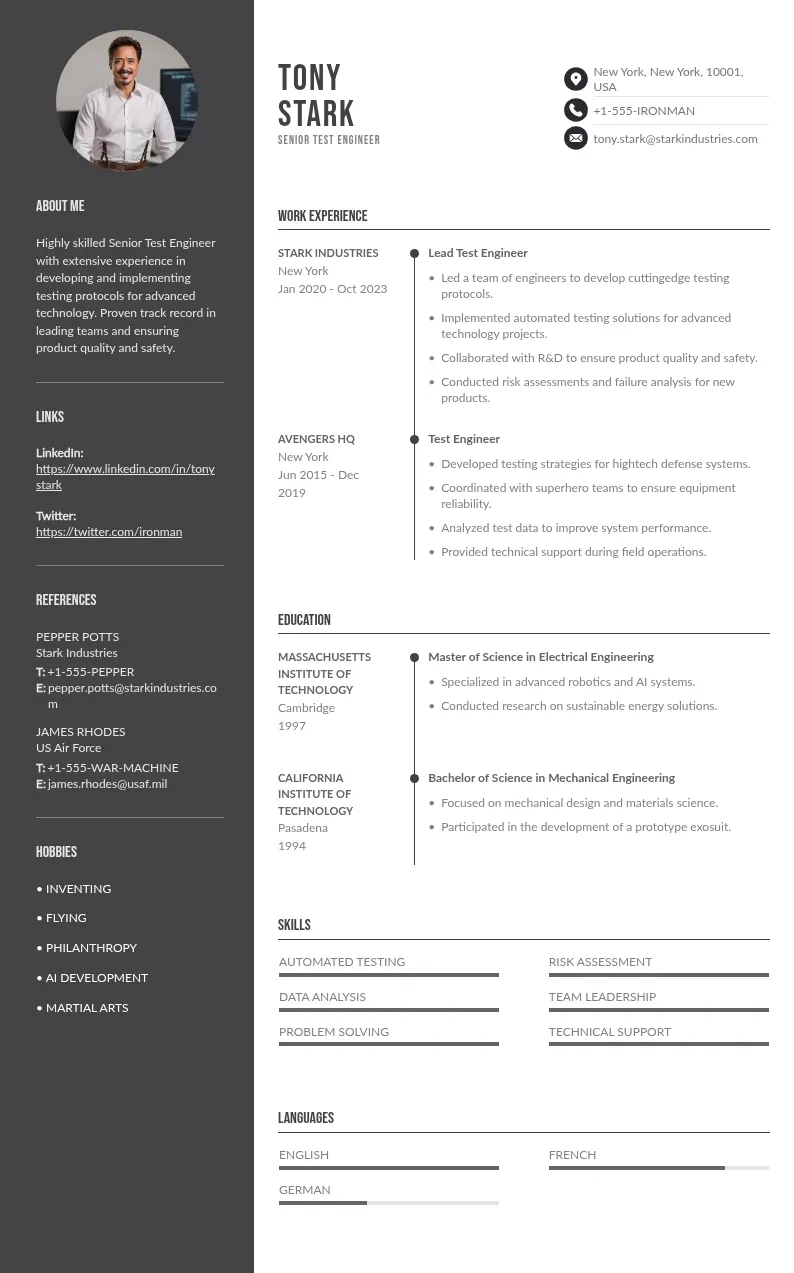
The About Me section is a short personal statement positioned at the very top of your resume, directly below your contact information. It's typically two to four sentences (roughly 50 to 80 words) that give a hiring manager an instant, compelling picture of who you are as a professional.
Think of it as your resume's opening argument. Before a recruiter reads a single bullet point in your experience section, this statement either earns their attention or loses it.
These terms are often used interchangeably, and functionally they serve the same purpose — a brief professional introduction at the top of your resume. The subtle differences worth knowing: a resume summary is the most formal version, structured and focused strictly on credentials. A resume profile sits between the two. An About Me section allows a slightly more direct, first-person voice. Whichever label you use, the rules for writing one well are the same.
Any candidate can use one. But for some profiles, it's especially valuable:
A good About Me section does three things simultaneously:
A weak About Me section does none of these things. It either says nothing ('results-driven professional with excellent communication skills') or too much. For a full breakdown of what every section of your resume should include, see our complete how to write a resume guide.
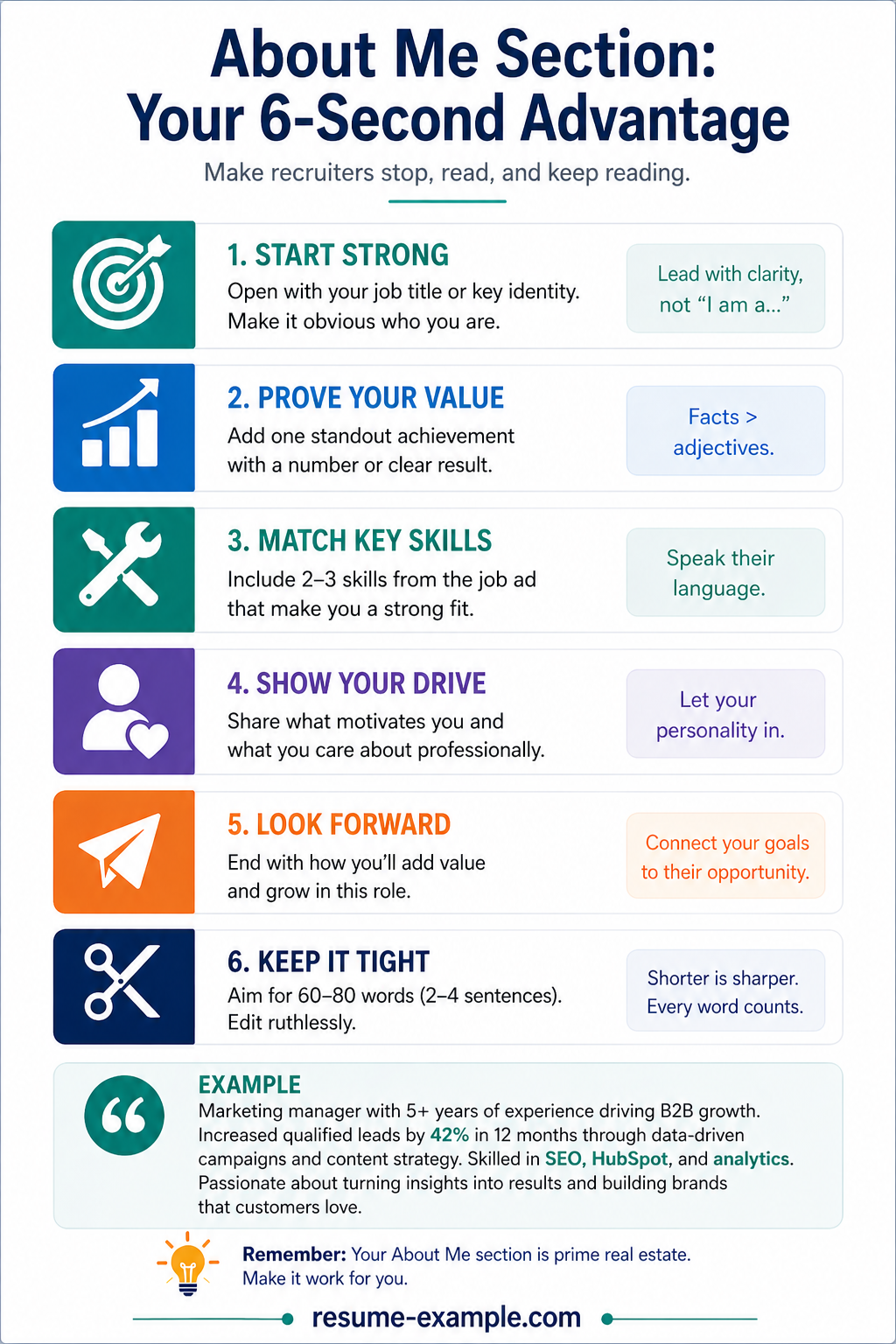
Writing about yourself is hard. It feels exposing. You don't want to sound arrogant, but you don't want to undersell yourself either. The method below removes the guesswork.
Read the job description carefully — not just the requirements list, but the language used throughout. Your About Me section should feel like it was written specifically for that company and role.
Your first three words should tell the reader exactly who you are. Don't start with 'I am a': start with the title itself.
One specific, verifiable credential or achievement, ideally with a number attached. Learning to quantify your resume at this stage is one of the highest-impact things you can do. No numbers? Use scope and specificity instead.
Not your full skillset. Just the two or three that matter most for this specific role. Mix hard skills (specific tools, techniques, languages) with one soft skill that's genuinely central to the role. This is also what gets resumes through ATS filters.
A sentence that reveals genuine motivation makes your profile memorable. Need inspiration? Our list of 150 powerful adjectives to describe yourself and our guide on words to describe yourself are good starting points. But always anchor them to proof.
End by connecting your trajectory to the opportunity in front of you. This signals genuine interest and shows the hiring manager that you've thought about why this role makes sense for you, not just why you're qualified for it.
Your first draft will almost certainly be too long. That's fine: that's what first drafts are for. Target 60 to 80 words maximum. Read it aloud. If any sentence makes you hesitate, rewrite it or cut it.
The examples below cover twelve different roles and experience levels. Each one is followed by an annotation of why it works, because understanding the reasoning is what lets you adapt it to your own situation.

Business administration graduate with a strong academic record and hands-on experience in project coordination through a six-month internship at a logistics firm. Adept at data analysis, stakeholder communication, and working to tight deadlines. Eager to bring fresh thinking and genuine commitment to a dynamic operations team.
See the complete fresher graduate resume guide.
Certified secondary school educator with four years of classroom experience across mixed-ability English and History groups. Known for designing curriculum that raises engagement and results, including a 22% improvement in Year 10 reading scores over two academic years. Seeking a role at a school where collaboration and continuous professional development are core to the culture.
Read more about teacher resume.
Customer service professional with five years of experience across retail and contact centre environments, specialising in complaint resolution and first-call resolution improvement. Recognised twice with peer excellence awards. Now seeking a team leader position to combine frontline expertise with a growing passion for coaching and performance management.
Find more ideas about a customer service resume.
Content strategist and writer with six years of experience producing editorial and SEO-optimised content across healthcare, fintech, and lifestyle verticals. Consistently grown organic traffic for B2B and B2C clients, including a 55% increase in search visibility for a SaaS platform within eight months. Committed to content that ranks and reads well.
See the complete content writer resume guide
Senior graphic designer with seven years of agency and in-house experience leading visual identity, packaging, and digital campaign design. 2024 Design Week Award finalist. Delivered 300+ projects for brands across FMCG and technology sectors, contributing to measurable improvements in brand recall and conversion rates.
Look at our guide on writing graphic design resume and examples.
Sales and marketing specialist with eight years of experience across demand generation, account management, and multi-channel campaign execution. Built and scaled a lead pipeline that contributed to a 35% year-on-year revenue increase at a Series B SaaS company. Data-driven by default, creative when it counts.
See the complete marketing resume.
Third-year Computer Science student at the University of Edinburgh, specialising in machine learning and distributed systems. Built and deployed two open-source projects with 200+ GitHub stars. Seeking a summer internship where I can contribute to real-world engineering challenges while developing production-level skills alongside an experienced team.
See more about a student resume.
Full-stack software engineer with five years of experience building scalable web applications for high-traffic consumer products. Proficient in React, Node.js, and PostgreSQL. Reduced page load time by 40% on a platform serving 1.5M monthly users through systematic performance optimisation. Passionate about clean code and the craft of engineering.
See the complete software developer resume guide
Registered nurse with seven years of clinical experience across acute medical and surgical wards. Proficient in complex patient assessment, medication management, and multidisciplinary team coordination. Committed to evidence-based practice and patient-centred care. Currently completing a post-graduate qualification in critical care nursing.
See the complete guide on healthcare resume.
PMP-certified project manager with nine years of experience delivering complex infrastructure and digital transformation programmes across financial services and public sector. Managed budgets up to £4M and cross-functional teams of 20+. Known for bringing structure to ambiguity and stakeholders to alignment, on time and within scope.
See the complete guide project manager resume.
Data analyst with four years of experience transforming raw business data into decisions. Proficient in Python, SQL, and Tableau, with a track record of building dashboards and models that stakeholders actually use. Most recently reduced monthly reporting time by 60% through automated pipeline development at a retail analytics firm.
See our full guide on data engineer resume.
CIPD-qualified HR business partner with eight years of experience across recruitment, learning & development, and organisational design in scaling tech companies. Reduced time-to-hire by 28% through structured interview frameworks and talent pipeline development. Passionate about building workplaces where people genuinely want to stay.
Know more about HR manager resume.
Most About Me sections fail for one of three reasons: too generic to be memorable, too long to be readable, or too modest to be persuasive. For a full picture of what strong and weak resumes look like side by side, see our bad resume examples page.
Our collection of expertly designed cover letter templates will help you stand out from the crowd and get one step closer to your dream job.