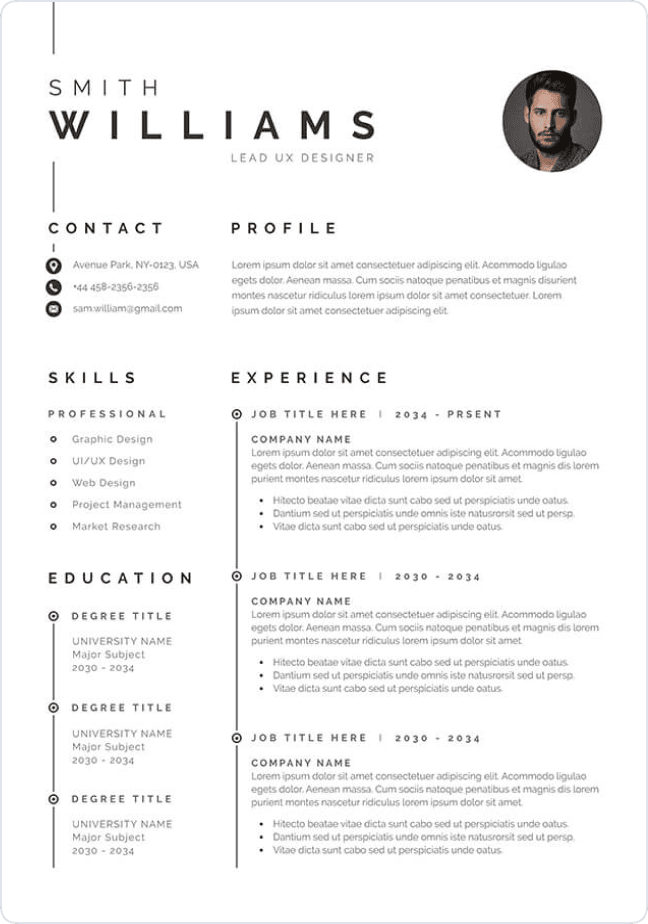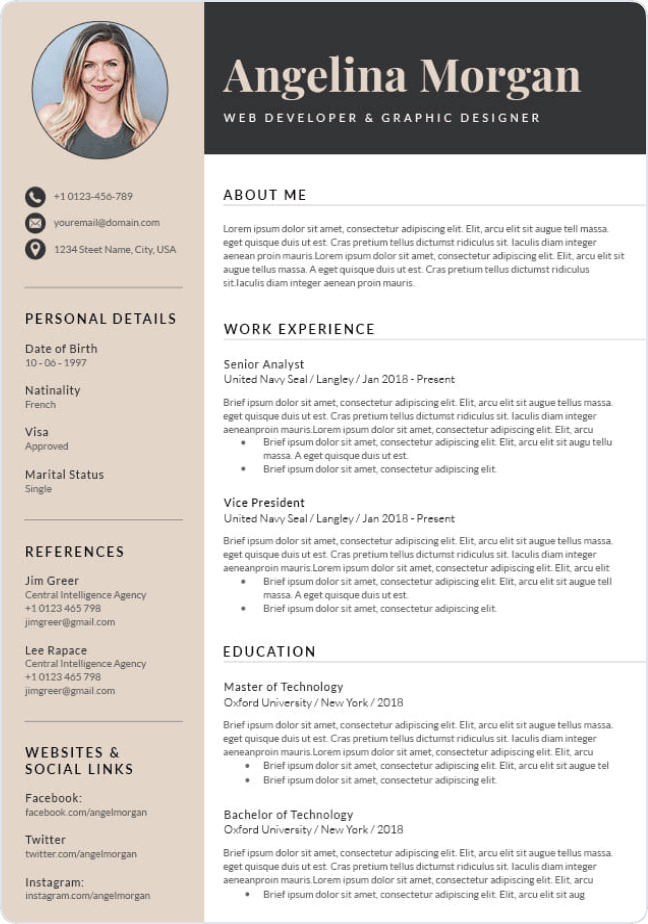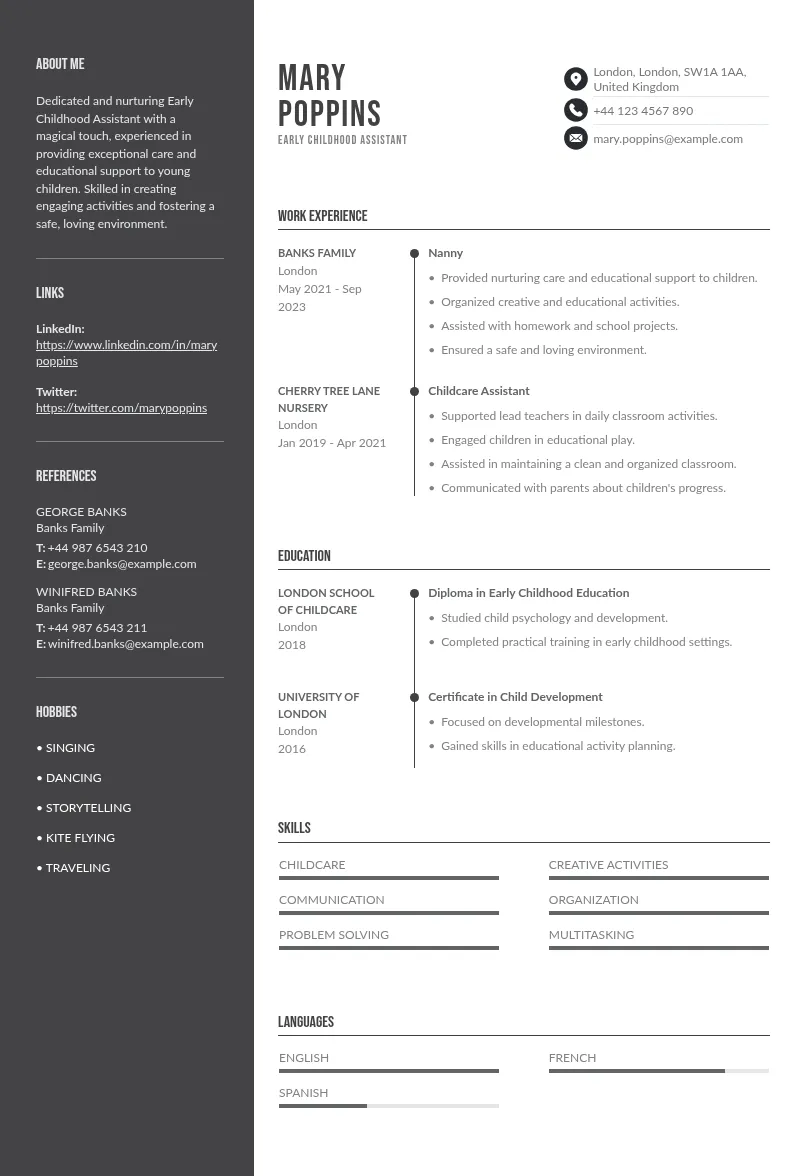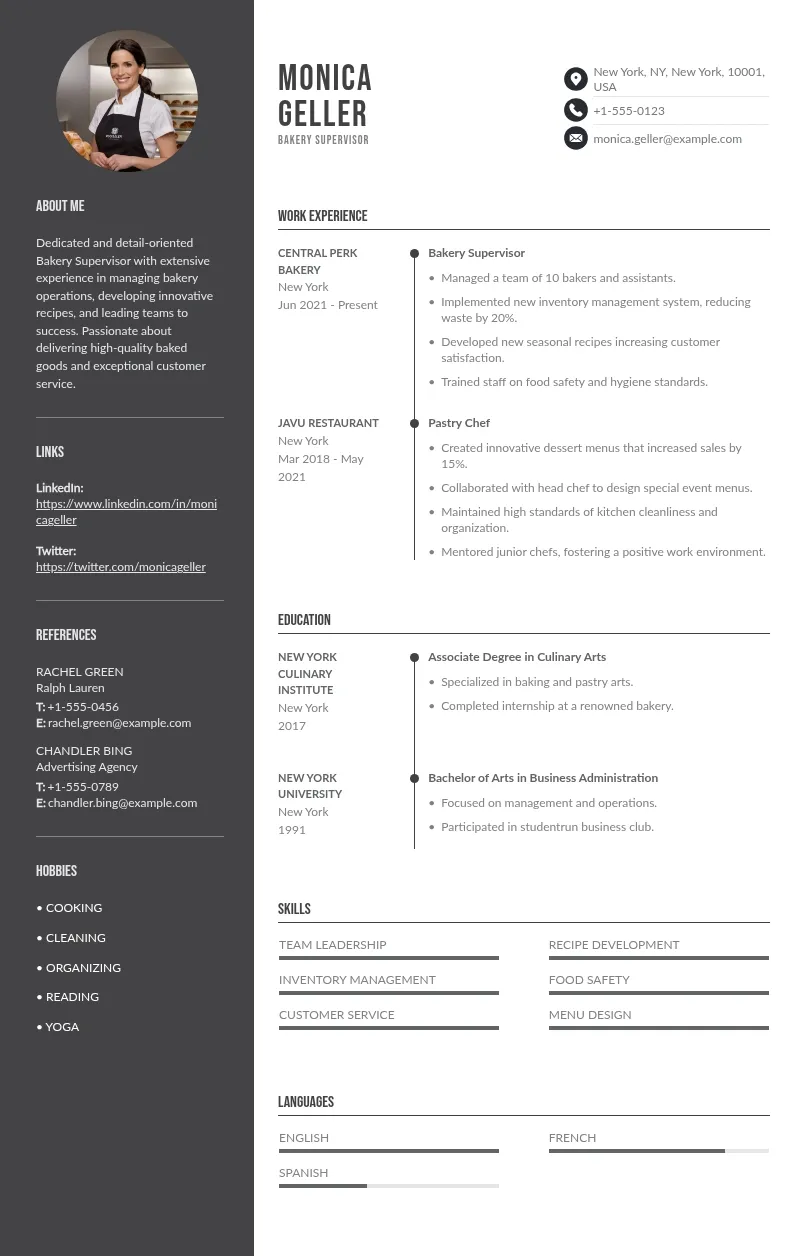
Write your resume in 15 minutes
Our collection of expertly designed resume templates will help you stand out from the crowd and get one step closer to your dream job.


The format you choose can make or break your resume. It directs the eye, highlights your strengths, and signals professionalism. In English-speaking markets, a well-structured CV helps your skills and achievements stand out, even before anyone reads the details.
Ahead, we’ll explore what works best in English-speaking markets, from formatting choices to subtle ways your CV can stand out. But first…
Best resume format for English-speaking recruiters

If you search for advice on resume writing in English, one recommendation comes up again and again: use the reverse-chronological format. It’s widely considered the safest option because recruiters are familiar with it and ATS systems handle it easily.
That said, it’s not the only format used in English-speaking job markets.
Depending on your experience, career path, or industry, other structures may present your profile more effectively. Some formats highlight career progression, while others put the spotlight on skills, projects, or transferable experience.
Let’s see the formats most commonly used in English-speaking countries, and when each one works best.
Reverse-Chronological format: To highlight career progression in English resumes
The reverse-chronological resume is the format most commonly expected by English-speaking recruiters. Instead of starting with your oldest job, it lists your most recent experience first, then moves backward through your career.
This structure helps recruiters quickly understand where you are now professionally and how your career has progressed over time.
Why this format works well
- Immediate clarity: recruiters see your current role and recent achievements first
- Logical career progression: promotions and increasing responsibilities appear naturally
- ATS-friendly structure: most Applicant Tracking Systems easily parse chronological work history
- Familiar format: widely used across the US, UK, Canada, and Australia
When to use a reverse-chronological English resume
This format works best if you:
- Have a consistent career path
- Have recent experience relevant to the role
- Want to highlight career growth or promotions
- Apply in corporate, finance, marketing, tech, consulting, or management roles
Quick view of the structure

Profile
[Job title or professional identity] with experience in [industry/skill area]. Skilled in [key skill], [key skill], and [key skill]. Interested in opportunities in [field or type of role].
Key Skills Section
- [technical skill 1]
- [technical skill 2]
- [industry knowledge1]
- [industry knowledge 2]
- [core competencies 1]
- [core competencies 1]
Professional Experience
Marketing Manager — ABC Company | 2022–Present
-
Led a team of 5 marketers to launch digital campaigns
Increased qualified leads by 35% within 12 months
Digital Marketing Specialist — XYZ Agency | 2019–2022
- Managed SEO and paid acquisition strategies
- Improved organic traffic by 60%
Education
Degree
University — City
Year – Year
[Optional details]
- dissertation topic
- academic distinction
- relevant coursework
Nevertheless, while this format is often recommended as the default choice, it’s not always the best option for every profile. In some cases, another structure may present your strengths more clearly.
Functional resume format: To emphasize skills over timeline
A functional resume organizes information by skills and competencies rather than by job history. Instead of presenting a strict chronological list of positions, it groups experience into key skill areas relevant to the role.
This format shifts the recruiter’s attention away from when you worked somewhere and toward what you can actually do.
Why some candidates choose this format
- It highlights transferable skills
- It can soften career gaps or frequent job changes
- It helps reposition experience when changing industries
- It allows candidates to focus on capabilities rather than titles
When a functional resume can work
This format can be useful if you:
- Are changing careers or industries
- Have limited professional experience
- Have worked on freelance projects or multiple short contracts
- Want to emphasize technical or specialized skills
However, in many English-speaking markets, recruiters can be cautious with purely functional resumes. When work history becomes less visible, some hiring managers may feel they lack context about your experience.
For that reason, this format tends to work better in: creative fields, freelance or project-based roles, early-career profiles and portfolio-driven professions.
Illustration of a functional structure
Professional Summary
[Profession / field] with expertise in [key skill], [key skill], and [key skill]. Experienced in applying these skills to [projects / tasks]. Looking for opportunities in [industry / role].
Core Skills / Key Competencies
- Skill / Competency 1
- Skill / Competency 2
- Skill / Competency 3
- Skill / Competency 4
Skills-Based Experience
[Skill Area / Competency 1]
- Bullet point describing an achievement or task using this skill
- Bullet point describing a measurable result or impact
- Bullet point showing application across a project, volunteer work, or job
[Skill Area / Competency 2]
- Bullet point describing an achievement or task using this skill
- Bullet point describing a measurable result or impact
- Bullet point showing application across a project, volunteer work, or job
[Skill Area / Competency 3]
- Bullet point describing an achievement or task using this skill
- Bullet point describing a measurable result or impact
Work History
Job Title — Company Name
City, UK | Month Year – Month Year
Job Title — Company Name
City, UK | Month Year – Month Year
Education
Degree Title
University Name — City, UK | Year – Year
Optional details:
- Dissertation / final year project: Title
- Grade / classification
- Relevant coursework
Because of its limitations, many candidates today opt for a hybrid approach that combines the strengths of both chronological and functional formats.
Combination (Hybrid) resume format: Balancing skills and experience
The combination resume, also called hybrid resume, blends the two previous formats. It typically begins with a skills summary, followed by a reverse-chronological work history.
This structure lets you highlight key competencies first, while still providing a clear employment timeline.
Why this format is increasingly popular
- It gives recruiters immediate visibility on core skills
- It maintains a clear work history
- It adapts well to ATS scanning
- It works across many industries and career levels
In English-speaking job markets, the hybrid resume is often considered the most flexible option, especially for candidates with varied experience.
When a hybrid resume makes sense
You might choose this format if you:
- Have strong skills that match the job description
- Have built experience through different roles or industries
- Want to highlight specialized expertise before job titles
- Have 5–15 years of experience
Typical hybrid structure illustrated:
Profile
[Profession / field] with [X years] of experience in [industry]. Skilled in [key skill], [key skill], and [key skill]. Seeking to leverage skills and experience in [type of role / organisation].
Core Skills and competencies
- Skill / Competency 1
- Skill / Competency 2
- Skill / Competency 3
- Skill / Competency 4
Professional Experience
Job Title
Company Name — City, UK | Month Year – Month Year
- Action + task + measurable result
- Action + achievement
- Action + impact
Job Title
Company Name — City, UK | Month Year – Month Year
- Action + task + measurable result
- Action + achievement
- Action + impact
Education
Degree Title
University Name — City, UK | Year – Year
- Dissertation / project: Title
- Grade / classification
- Relevant coursework
From here, it becomes important to understand that classical or ATS resume format expectations also vary by industry in English-speaking countries. Some sectors strongly favor chronological resumes, while others welcome more flexible structures.
Best resume format by industry in English-speaking countries
Not all industries read resumes the same way. What works perfectly in one field can feel inappropriate, or just ineffective, in other places.
Recruiters in English-speaking markets often develop strong formatting preferences within their sector. Some want a clear career timeline. Others care far more about skills, projects, or measurable results.
Understanding these expectations helps you choose a format that aligns with how hiring managers actually evaluate candidates.
So what work best across major industries in the UK, US, Canada, and Australia ?
Corporate, finance and consulting: Reverse-chronological English resumes
In structured industries such as finance, consulting, and corporate roles, recruiters want to see career progression clearly and quickly.
The reverse-chronological format performs best because it immediately shows:
- Career growth
- Promotions
- Company reputation
- Increasing responsibilities
Recruiters often scan these elements first. In these industries, the goal is simple: demonstrate a stable and progressive career path.
Technology and IT: Hybrid English resumes
In technology fields, hiring managers often look for skills first, experience second.
Programming languages, frameworks, and tools frequently matter more than job titles. That is why hybrid resumes tend to work particularly well in tech roles. This structure allows recruiters to verify capabilities within seconds.
A recruiter might want to see immediately whether you know:
- Python
- AWS
- React
- Kubernetes
- Data visualization tools, etc.
A hybrid resume allows you to place technical competencies at the top, while still presenting a clear work history underneath.
Creative fields: Flexible or portfolio-driven English resumes
Creative professions often take a more flexible approach to resume formatting. Fields such as graphic design, marketing, content creation, media production, advertising… tend to value projects, campaigns, and creative output as much as traditional job history.
In these cases, candidates may use:
- Hybrid resumes
- Portfolio-focused resumes
- Project-based sections
 For example:
Selected Campaigns
Global Product Launch - Bright Agency
- Led visual identity design across digital and print platforms
Social Media Campaign - Urban Brand
- Increased engagement by 60% over three months
Creative recruiters frequently appreciate resumes that show impact through projects, not just job titles.
Early-career and graduate roles: skills-focused English resumes
For students or recent graduates, professional experience may still be limited. In these cases, a new graduate English resume that highlights skills, internships, and academic projects can work better than a purely chronological structure.
A functional or hybrid resume can help emphasize: coursework, internships, research projects, technical skills, leadership activities…
Example:
Key Skills
- Data analysis (Excel, R)
- Market research
- Presentation and reporting
Academic Projects
Market Research Study — University Business School
- Conducted consumer analysis based on a 1,200-respondent dataset
For early-career candidates, the goal is to demonstrate potential and transferable skills rather than an extensive employment history.
Resume formatting tips that work across English-speaking markets
Regardless of the format you choose, some formatting principles remain consistent across the UK, US, Canada, and Australia. Recruiters generally expect resumes that are clear, structured, and easy to scan.

Keep your English resume layout simple and readable
Complex layouts often create problems for both recruiters and ATS software.
Best practices include:
- Clear section headings
- Consistent spacing
- Bullet points instead of dense paragraphs
- Standard fonts such as Arial, Calibri, or Helvetica
A recruiter should be able to identify key sections within seconds.
Prioritize outcomes over job duties
Best English-language resumes often emphasize measurable results. So, instead of listing tasks, highlight outcomes : Numbers, metrics, and outcomes make achievements far more visible.
 Weak example:
- Responsible for managing marketing campaigns
Stronger example:
- Managed digital campaigns generating 35% growth in online leads
Keep resume length under control
Resume length expectations vary slightly between countries but follow similar principles:
But recruiters generally prefer concise documents that communicate value quickly: 1 page.
Choosing the right English resume format for your career
There is no single universal format that works for everyone. While the reverse-chronological resume remains the most widely accepted structure, many candidates benefit from hybrid or skills-focused formats depending on their background.
Before choosing your format, reconsider these three key questions:
- What do recruiters in your industry expect?
- What do you want them to notice first—experience, skills, or projects?
- Does your career path look stronger chronologically or by competencies?
The best resume format is simply the one that makes your strengths immediately clear.
Because in competitive English-speaking job markets, the real goal is straightforward:help recruiters understand your value within the first few seconds of reading.
Create your resume with the best templates