Write your resume in 15 minutes
Our collection of expertly designed resume templates will help you stand out from the crowd and get one step closer to your dream job.


And the stakes are higher than most candidates think. According to Jobseeker's 2025 HR survey of a thousand of professionals across 59 countries, 82.8% of recruiters almost always look for cover letters. 95.1% agree they must be tailored to the specific position... Sending a generic one doesn't just fail to impress. It signals you didn't try.
Here are 6 practical moves to make sure yours works in your favour.

Entry-level cover letter template

[First Name Last Name]
[Address]
[City, State ZIP]
[Phone Number]
[Email Address]
[Date]
Hiring Manager
[Company Name]
[Company Address]
Subject: Application for [Job Title]
Dear [Hiring Manager’s Name],
During my [project, class, or initiative], I led a team of [number] to [specific goal or achievement], resulting in [quantifiable outcome]. This experience taught me how to [key skills gained], skills I am excited to bring to your [team or department] at [Company Name].
In addition, I [describe another non-professional experience, such as volunteer work, club, or event], achieving [quantifiable result]. This allowed me to develop [transferable skills], which I believe are directly applicable to the [Job Title] role.
Your recent [specific project, product launch, or initiative by the company] caught my attention. In my previous experience [context], I [specific measurable accomplishment], and I would be thrilled to apply this experience to help drive similar success at [Company Name].
I would be happy to discuss my ideas and experience in a 20-minute call this week or next. You can reach me at [phone] or [email].
Thank you for your time and consideration. I look forward to the opportunity to speak with you.
Sincerely,
[First Name Last Name]
1. Open your entry-level cover letter with something concrete
Don't: "I am passionate about your company."
Do: Lead with a real achievement, project, or initiative, even if it wasn't a paid work.
Here's why this matters more than most candidates realize: according to late surveys, recruiters spend an average of just 30 seconds deciding whether an application is worth a closer look. Your opening sentence carries most of the weight. A vague enthusiasm statement wastes that window. A concrete result opens a door.
 Example:
"While organising a student awareness campaign, our team reached 200 participants in one week, twice as many as the previous year. This taught me how to craft clear messages and mobilize a community: skills I'm excited to bring to your marketing team."
2. Turn non-professional experience into proof points
Many entry-level candidates panic at the thought of writing without professional experience. The key is reframing: school projects, volunteering, and extracurriculars can all be presented as measurable results. Recruiters know how to read them that way.
So, even when your background doesn’t match every requirement on paper, a well-written cover letter can quietly connect the dots, showing how your existing experiences translate into skills relevant to the role.
Think about what you actually did, not just what you were part of:
- Academic projects: Did you lead a team, manage a deadline, or produce something tangible?
- Volunteer work: Can you show impact or contribution, not just involvement? Note that almost 60% of recruiters view volunteer work as relevant professional experience. So don't leave it out.
- Clubs or competitions: Is there an outcome you can put a number on?
Example:
"I coordinated a team of five to organize an event for 100 attendees while staying under a £/$/CAD 500 budget."
Many surveys found that most recruiters specifically value coherent storytelling in cover letters, especially when candidates use it to connect transferable experience to the role at hand. The story doesn't have to come from a paid job. It has to be credible, specific, and relevant.
3. Connect your story to the company
This is where most entry-level cover letters fall flat. It's not enough to want the job: your letter needs to show you understand this company, this team, this challenge and so on.
Research one specific project, product launch, or initiative the company has taken on recently. Then tie something from your own background directly to it. The connection doesn't have to be grand, it just has to be genuine.
Example:
"Your recent launch of a monthly newsletter for young creators caught my attention. During my time at the student newspaper, I built an editorial calendar and wrote content that doubled site engagement. I'd love to bring that experience to your team."
The datas back this up firmly. Jobseeker's 2025 HR survey found that 95.1% of HR professionals agreed cover letters must be tailored to the specific position. The year before (survey of 753 recruiters by Zety) 89% said they expect a cover letter alongside a résumé, with 87% calling it a key factor in deciding who gets the interview. More pointedly, 81% of those same recruiters had already rejected applicants based on their cover letter alone… a reminder that personalization is not optional !
4. Use numbers to make achievements concrete
Numbers make your experience tangible and memorable. They also signal something beyond the achievement itself. They show you think in terms of outcomes, not just activity: that matters to most hiring managers regardless of seniority level.
So, instead of "I improved engagement," show how much, in what timeframe, and under what conditions…
Examples:
- "Grew the club's Instagram following from 1,200 to 5,300 in six months."
- "Reduced time spent on monthly reports by 40% through automated templates."
- "Led a fundraising event that exceeded its goal by 150%."
The vast majority of recruiters expect cover letters and résumé summaries to highlight skills and achievements, not just responsibilities. They say they value quantifiable achievements overall. Quantified results, even small ones, demonstrate the kind of outcome-oriented thinking that separates strong entry-level candidates from average ones.
5. Close with a specific next step
Most cover letters end with some variation of "I look forward to hearing from you." It's inoffensive, and completely forgettable. A stronger closing proposes a concrete next step and reaffirms your motivation.
Example:
"I'd be happy to discuss my ideas in more detail during a 20-minute call this week or next. You can reach me at [phone] or [email]."
A confident, specific call to action signals exactly the kind of proactive mindset that stands out in a crowded pool of entry-level professionals.
6. Keep it concise and authentic
One page maximum. Every sentence should earn its place. Don't repeat your résumé — use the cover letter to add context, personality, and a point of view that the résumé can't convey.
And be honest. Exaggeration is easy to spot, and experienced recruiters notice immediately.
There's a bigger issue at play here too. Jobseeker's 2025 survey found that 81.6% of recruiters had already encountered AI-generated cover letters. The overwhelming majority can identify them ! Only 11.6% say they treat AI-assisted applications the same as any other. With AI now saturating the application pool, authentic, human writing has quietly become one of the most differentiated signals a candidate can send.
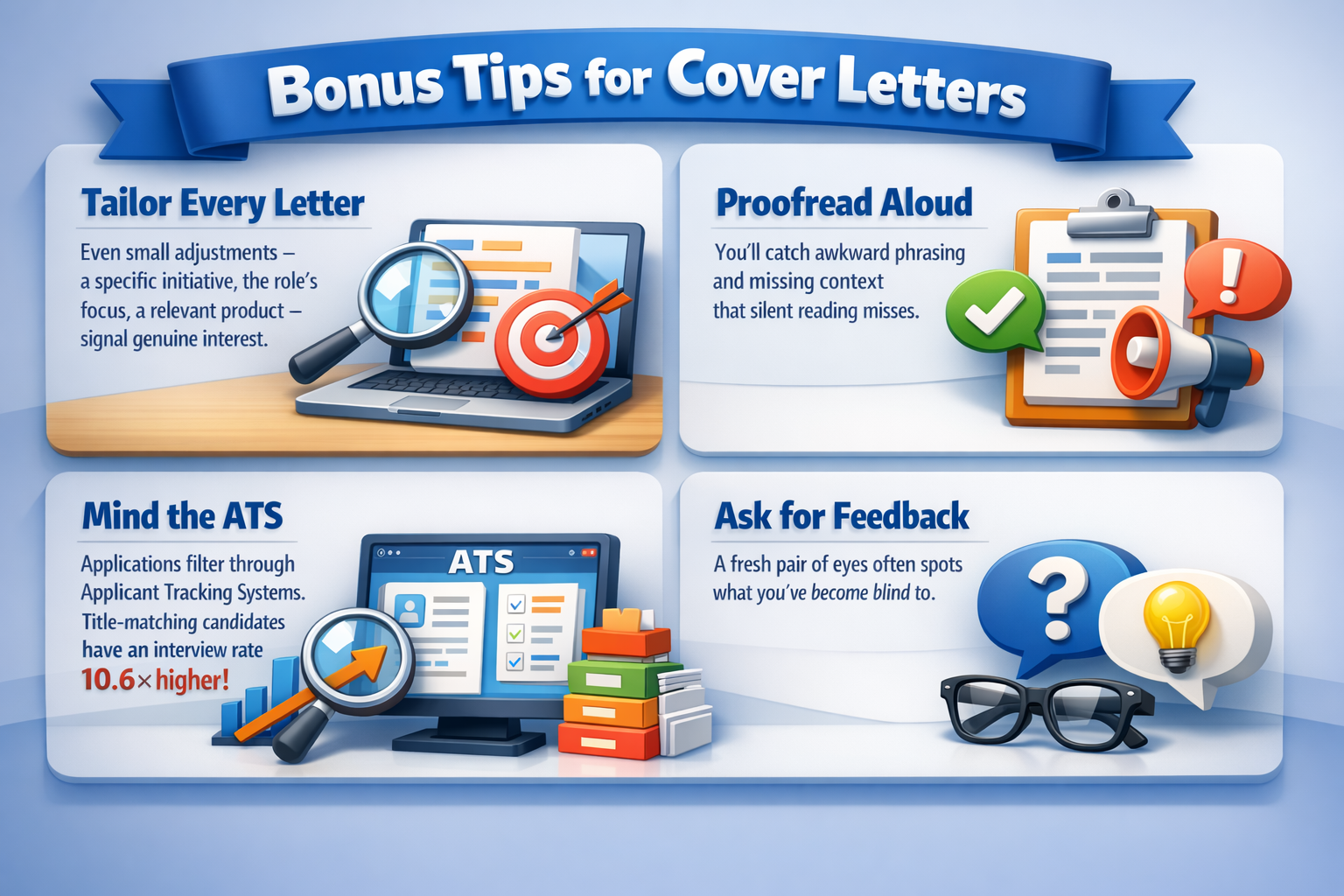
A strong entry-level cover letter is your story, backed by results, and connected to the company's real goals. Take small wins, frame them honestly, quantify them where possible, and show how they translate into value for the organization.
The data is unambiguous: in a job market where even small advantages compound, a well-crafted, personalised cover letter remains one of the few tools entirely within your control. Use it!
Create your resume with the best templates