Applying to jobs in Russia? Your CV needs to play by different rules.
Russian employers expect details that Western applications skip entirely. Photos. Birth dates. Marital status. Things that would raise eyebrows in the US or UK.
And that's just the start.
The structure shifts. The tone changes. Even the level of formality operates differently when you're writing for the Russian job market.


Личная информация:
Фамилия, Имя: Петров Иван
Дата рождения: 10 марта 1987 года
Адрес: г. Москва, ул. Смольная, д. 15, кв. 87
Телефон: +7-916-123-45-67
E-mail: petrov.ivan@mail.ru
Образование:
2004-2009 – Московский Государственный Университет. Факультет экономики.
Специальность: экономист. Диплом с отличием.
Опыт работы:
2010-2012 – ООО "Ромашка" - Аналитик
2012-2015 – ЗАО "Лотос" - Начальник отдела планирования
2015-2021 – ОАО "Сирень" - Заместитель директора по экономике
Навыки:
Личные качества:
Рекомендации:
предоставляются по запросу
Водительские права:
категория B, стаж вождения 10 лет.
Готов к командировкам, возможен переезд.
Зарплата по договоренности.
Russian hiring moves slower. Way slower.
Relationship-building matters as much as qualifications. Decisions crawl through multiple approval layers. What takes two weeks in New York? Plan on two months in Moscow. Not because Russians are inefficient - hierarchy just demands it.
First meetings? Expect tea and conversation. Contracts come later. Trust-building happens before business discussions. Round two or three is when deal talks actually start.
The technical landscape differs completely. HeadHunter.ru dominates job postings. 1C runs business operations across industries. Bitrix24 handles CRM for thousands of companies. Know these platforms? You've got an edge over applicants who don't.
This guide covers what Russian recruiters look for in applications. Five resume examples for common positions. Step-by-step writing instructions. Answers to questions job seekers ask most.
Whether you're an expat targeting Moscow or an international professional exploring opportunities in Saint Petersburg, this is your blueprint.
No fluff. No guesswork. Just practical guidance you can use today.
The examples below cover five positions Russian employers hire for regularly. Each one follows local formatting standards and includes the personal details Russian recruiters expect.
Treat these as templates. Pull in your own experience. Adjust sections based on your background. Change the language to fit whatever role you're chasing.
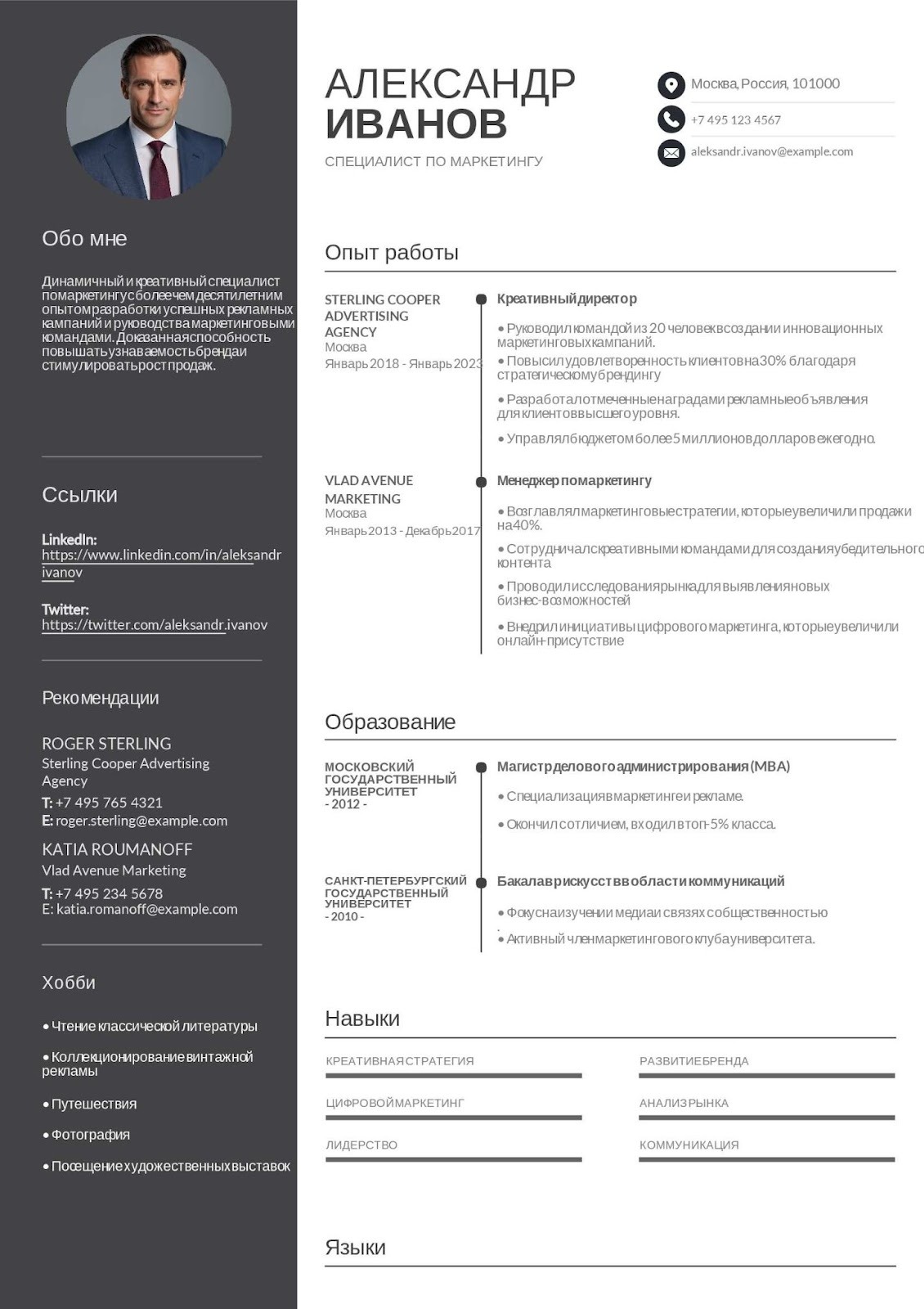
This resume example is built for marketing professionals going after jobs at Russian companies or international firms that have offices in Moscow, Saint Petersburg, and other regional cities. It follows what Russian employers actually expect - photos, birth dates, marital status. All the personal details Western resumes leave out.
The format puts two things front and center: bilingual skills and digital marketing chops. Why? Russian marketing jobs don't give you a choice about language. Monday you're crafting campaigns for local audiences. Tuesday you're jumping on calls with the global team. Fluency in Russian and English isn't a bonus - it's the baseline. Add in experience with Yandex Direct, VKontakte ads, and Russian social platforms? Now you're ahead of most applicants.
Design stays boring on purpose. Russian recruiters see flashy graphics and creative layouts and immediately think you're hiding weak experience behind pretty colors. Keep it clean and traditional. Let your actual results do the talking.
This format hits hardest for marketing professionals with 3-8 years under their belt who've run campaigns for Russian audiences, get how local consumers think, and won't lose their minds dealing with the approval process that crawls through multiple layers of management.
Additional Tips
This resume example is designed for developers, programmers, and IT specialists eyeing positions at tech companies like Yandex, Kaspersky, Sberbank, or the hundreds of startups scattered across Moscow and Saint Petersburg. It follows Russian CV conventions by including personal details and a professional photo while prioritizing technical skills above everything else.
The format front-loads your tech stack right at the top. Why? Moscow alone has thousands of developers competing for the same roles. Recruiters don't have patience. They skim fast. If they can't spot your languages, frameworks, and tools in the first five seconds, they've already moved on to the next candidate. Your technical skills and project experience need to be impossible to miss.
Russian IT companies care less about fancy degrees than you'd think. A computer science diploma from a prestigious university? Nice. But a solid GitHub portfolio with real contributions often wins the job anyway. Show what you've actually built and shipped. That's what gets callbacks.
This format works best for developers with 2-10 years of experience who have hands-on project work, understand that Russian dev culture values direct technical feedback over politeness, and can handle the reality that 50-60 hour work weeks at competitive companies aren't called overtime - that's just standard.

Additional Tips
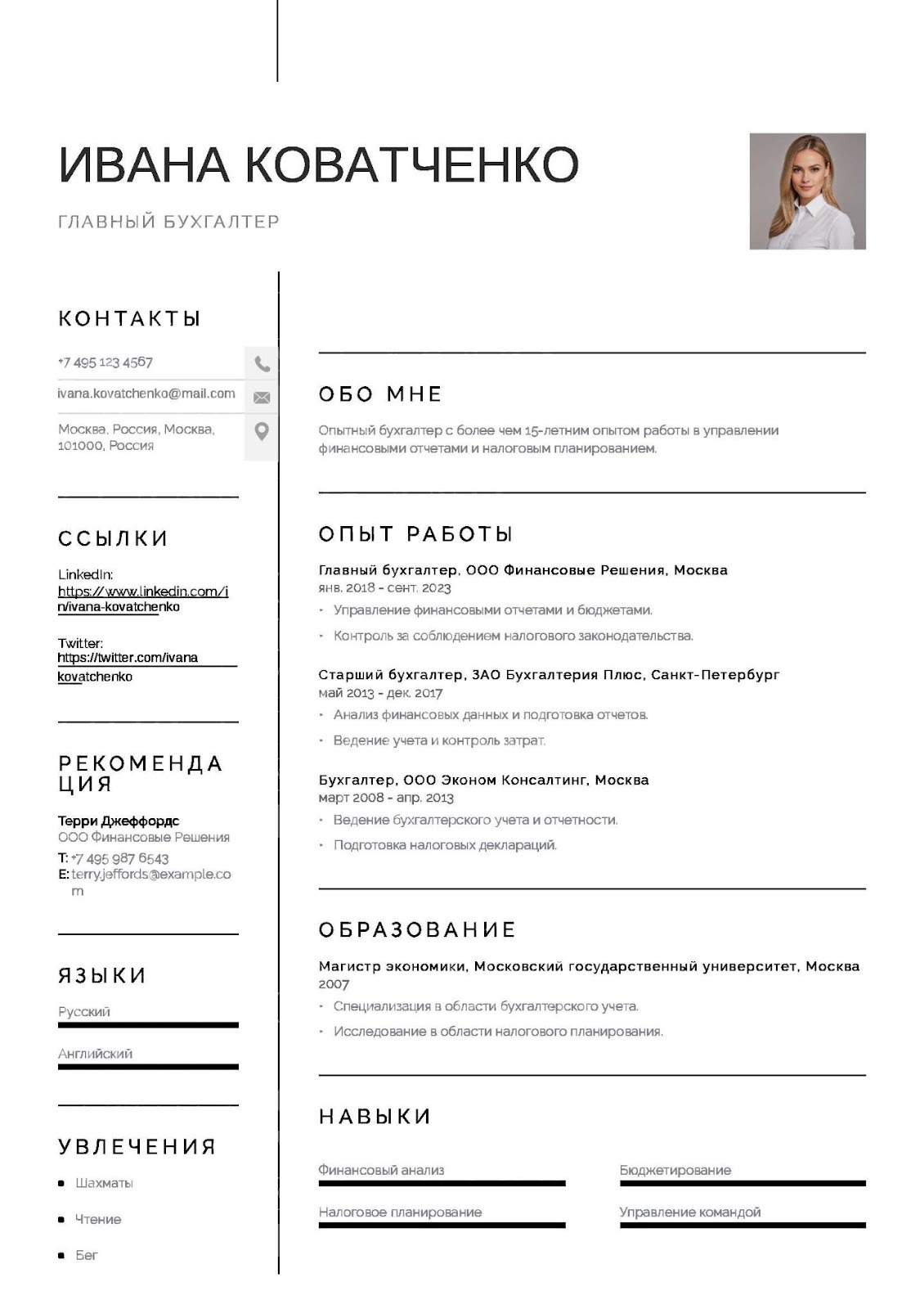
This resume example is built for accountants, financial analysts, and finance professionals targeting Russian employers - banks, audit firms, corporations, any company that needs someone who won't mess up the books. It follows Russian CV standards by including personal details, a formal professional photo, and emphasizing compliance knowledge alongside technical accounting skills.
The format highlights dual accounting systems knowledge right away. Russia runs its own standards - RAS (Russian Accounting Standards). International companies use IFRS. Some businesses juggle both systems at the same time.
Know how to work with both? You're immediately more valuable than candidates who only know one. Russian finance roles also demand fluency in local tax codes and 1C software - the accounting platform that runs absolutely everywhere in Russian business.
Russian finance hiring is brutally conservative. Employers want stability, precision, zero surprises. Your resume needs to look like it came from someone who respects that reality. Clean lines. Logical structure. Nothing creative or flashy. Finance rewards tradition over innovation every single time.
This format hits hardest for accounting professionals with 3-12 years of experience who've handled both RAS and IFRS reporting, know their way around 1C:Enterprise or 1C:Accounting, and understand that 60-hour weeks during tax season come with the territory - no complaints, no extra pay, just part of the job.
Additional Tips
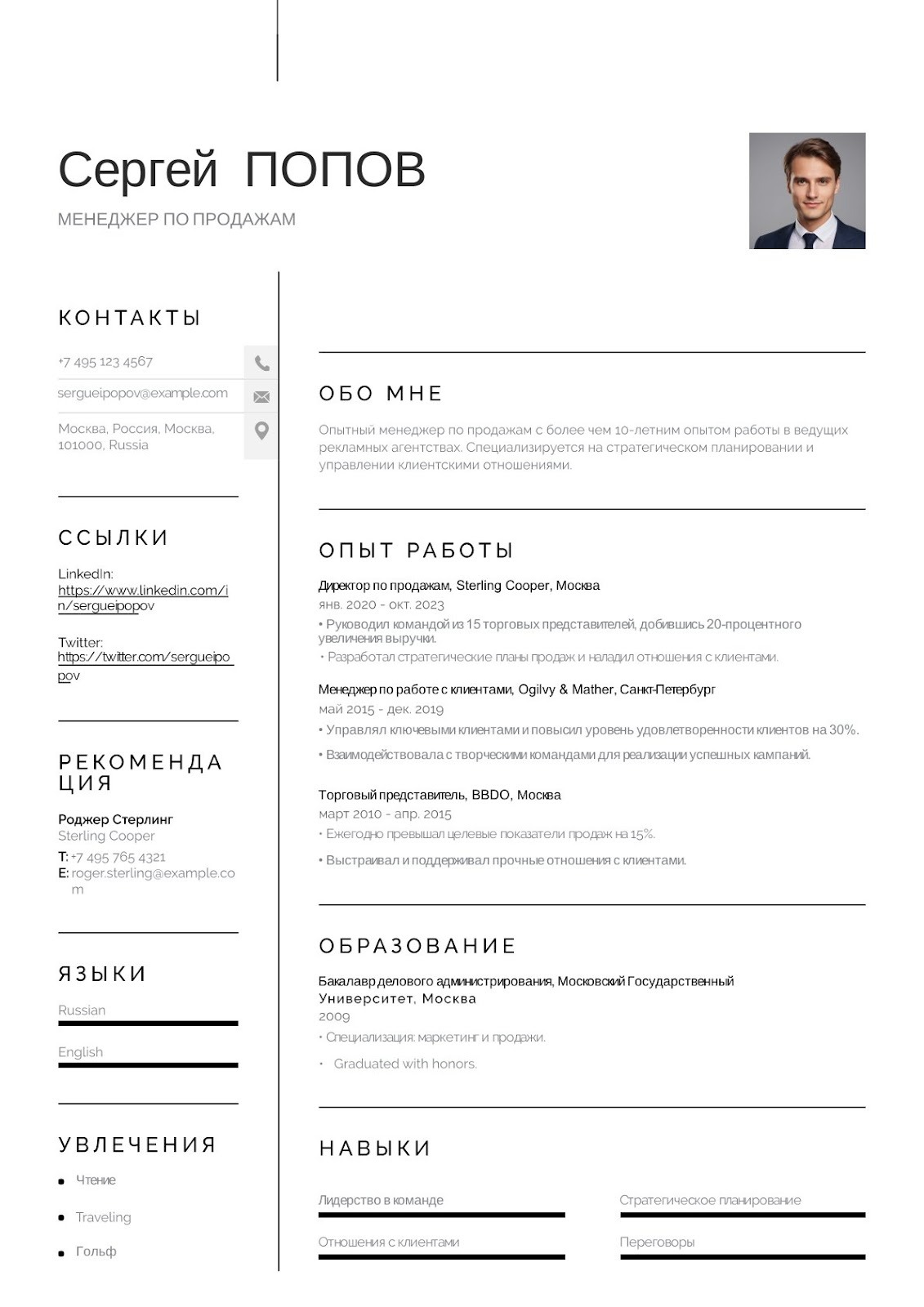
This resume example is designed for sales managers, business development leads, and account executives targeting Russian companies or international firms running local sales teams. It follows Russian CV conventions by including personal details and a confident professional photo while putting your biggest wins right at the top where they can't be missed.
The format screams results from the first line. Russian sales culture doesn't do subtle. Employers want closers who hit targets and skip the excuses. Your biggest deals go in the top third with actual ruble amounts - not just "managed accounts" or "increased revenue."
Numbers prove you can sell. Vague claims prove nothing. Territory size matters too. Managing clients across three time zones? Say so. That shows you can handle the reality that Russia spans eleven time zones and your workday starts at 6 AM regularly.
Russian business runs on personal relationships more than contracts. Your first meeting with a potential client? Expect tea and conversation about everything except business. Trust builds slowly here. What takes two weeks to close in New York takes two months in Moscow. Not because Russians are slower - because the relationship-building process can't be rushed. Push too hard and you'll kill the deal completely.
This format works best for sales professionals with 4-10 years of experience who've closed deals in the Russian market, understand that different cities have completely different buyer behaviors, and have the patience to sit through multiple approval layers without losing their minds.
Additional Tips
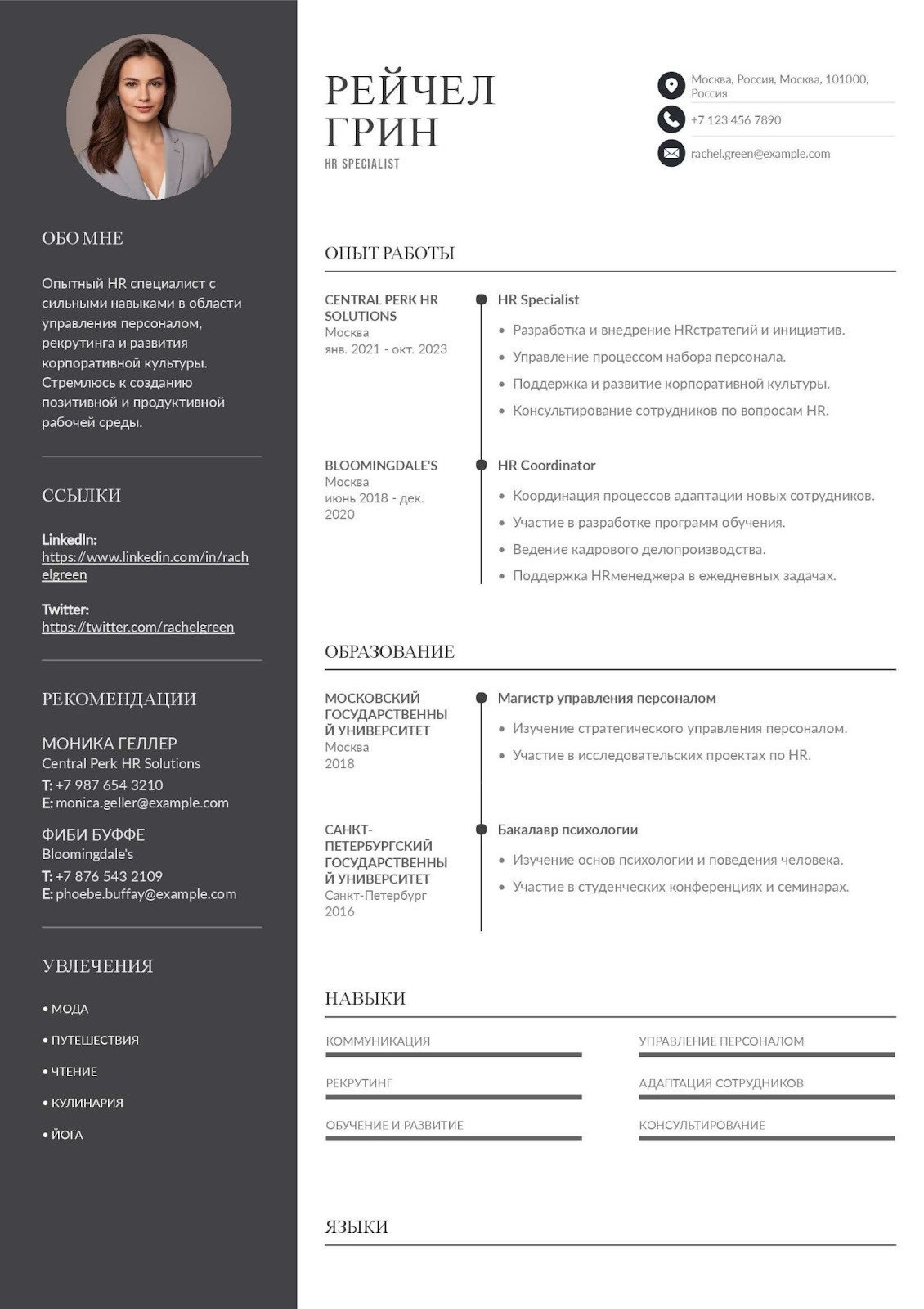
This resume example is built for HR specialists, recruiters, and personnel managers targeting positions at Moscow banks, Saint Petersburg tech firms, or any company operating under Russian labor law. It includes all the standard Russian CV elements - personal details, professional photo, the works. The difference? This format puts compliance knowledge right next to soft skills like communication and conflict resolution. Both matter equally.
The format puts Russian Labor Code expertise front and center. Why? Because HR in Russia isn't just about hiring good people and building company culture. It's about paperwork. Mountains of it. Russian labor law hits companies with heavy fines for documentation errors.
Missed a deadline on employee records? Problem. Botched a termination procedure? Bigger problem. Failed to document vacation accrual correctly? Even bigger problem. Russian employers need HR people who know these regulations cold and won't create legal nightmares.
HR specialists in Russia carry legal liability that Western HR professionals rarely face. Incorrect termination paperwork can result in personal fines for you, not just the company. Labor inspections happen without warning - inspectors show up, demand files, and start checking everything. One missing signature on an employment contract multiplied across dozens of employees? Your reputation is finished.
This format works best for HR professionals with 3-10 years of experience who understand Russian labor regulations, have worked with both digital systems and physical employee files (many companies still require stamped paper documents for government agencies), and can handle the stress that comes with compliance responsibility.
Additional Tips
Writing a CV for Russia isn't just translation. It's adaptation.
The basics stay the same. Contact info, work history, education, skills. But Russian employers expect details that would feel strange on an American or British resume. Personal information goes deeper here. Formatting follows stricter conventions.
Even your photo matters.
This section walks you through each part of a Russian CV. Structure, formatting, sections, and the small details that signal you understand local expectations.
Russian CVs follow a straightforward format. No creative layouts. No fancy graphics. Just clean sections in a logical order.
Here's the standard structure most Russian employers expect:
Keep the whole thing to one or two pages. Experienced professionals can stretch to two. Fresh graduates should stick to one.
Font choice matters less than consistency. Arial, Times New Roman, or Calibri all work fine. Pick one and use it throughout. Size 10-12 for body text. Slightly larger for your name and section headers.
Margins? Standard one-inch on all sides. Gives the page breathing room and leaves space for interviewers to scribble notes.
Your header is prime real estate. Russian recruiters look here first.
Start with your full name. Last name, then first name. That's the Russian convention. Make it bold and slightly larger than everything else.
Right below, add your profession or target job title. "Marketing Specialist" or "Software Developer" - whatever matches the role you want. This tells recruiters immediately what they're looking at.
Contact details come next. Phone number with country code. Email address - keep it professional, not your nickname from 2008. City of residence.
Russian employers care about location more than you'd think.
LinkedIn works if the company has international ties. For local Russian firms? Consider adding Telegram instead. It's the default messaging app for Russian business communication.
Here's where it gets different. Include a professional photo. Head and shoulders. Business attire. Neutral background. This isn't optional - Russian employers expect it.
No photo often means your CV gets skipped entirely.
 CORRECT
Фамилия, Имя, Отчество
Целевая должность или профессия
Город проживания
Телефон
Электронная почта
Мессенджер (по желанию)
CORRECT
Иванов Алексей Сергеевич
Менеджер по продажам B2B
Москва, Россия
+7 916 123 4567
ivanov.aleksey@email.com
Telegram: @aivanov
linkedin.com/in/aleksey-ivanov
 INCORRECT
Алекс Иванов
johnsmith79873@gmail.com
555-888-6565
012-555-0000
1413 Сент-Фрэнсис Уэй,
Филадельфия, 19107
Western applicants often freeze here. Date of birth? Marital status? Kids?
Yes. Russian CVs include all of this.
It feels invasive if you're used to American or European norms. But in Russia, it's standard practice. Leaving this section out can actually hurt you. Recruiters might assume you're hiding something.
What to include:
You don't have to include everything. Pick what you're comfortable sharing. But understand that more information typically builds more trust with Russian employers.
Think of this as your elevator pitch. Two to four sentences max.
Russian employers skim CVs at lightning speed. Your summary needs to hook them before they scroll past.
Lead with your profession and years of experience. Follow with your biggest win or strongest skill. End with what you're targeting.
Skip the corporate fluff. "Hardworking team player seeking new opportunities" tells recruiters absolutely nothing. Everyone writes that garbage. Be specific instead.
Weak:Strong:
See the difference? One could describe anyone. The other could only describe you.
Keep your tone confident without crossing into arrogance. Russian business culture respects competence. Bragging without numbers to back it up? That backfires every single time.
Compare these two:
CORRECT
Weak:This section carries the most weight. Especially for mid-career professionals.
List jobs in reverse chronological order. Most recent first. Go back 10-15 years max. Anything older than that rarely matters unless it's directly relevant.
For each position, include:
Now here's where most CVs fall flat. Responsibilities aren't achievements.
"Вёл клиентские аккаунты (Managed client accounts)" is a responsibility. "Увеличил клиентский портфель с 15 до 47 аккаунтов за 18 месяцев (Grew client portfolio from 15 to 47 accounts in 18 months)" is an achievement.
Russian employers want the second version.
Use strong verbs. Increased. Reduced. Built. Launched. Negotiated. These words show action. Avoid passive language like "was responsible for" - it sounds weak.
Numbers make everything more believable. Revenue generated. Costs cut. Team size managed. Percentages improved. If you can quantify it, do it.
CORRECT
Менеджер по продажам ООО "ТехноСофт", Москва
Июнь 2019 - настоящее время
Увеличил клиентскую базу на 40% за первый год работы
Заключил контракты на общую сумму 28 млн рублей
Обучил и курировал команду из 4 младших менеджеров
Внедрил новую CRM-систему, сократив время обработки заявок на 25%
INCORRECTМенеджер по продажам ООО "ТехноСофт", Москва
Июнь 2019 - настоящее время
Russian employers take education seriously. Sometimes too seriously.
Degrees still carry weight here. Especially from prestigious institutions like Moscow State University, Saint Petersburg State University, or Bauman Technical University. If you graduated from a respected school, make sure it's visible.
List your education in reverse chronological order. Most recent degree first.
Include:
Fresh graduates should put education near the top. Your degree is your main selling point right now. Experienced professionals can move it lower. After ten years of work history, where you studied matters less than what you've accomplished.
One quirk about Russian education. Many professionals list their secondary school too. This is optional. Only include it if you attended a specialized school or lyceum with a strong reputation.
Got additional training? Certifications? Professional development courses? Add them here or create a separate section. Russian employers value continuous learning. Shows you're not coasting on a degree from fifteen years ago.
CORRECT
Образование:
Московский государственный университет, Москва
Специалист по международным отношениям
Июнь 2015 – Июнь 2020
Специализация: международное право и международная политика
Дипломная работа: «Роль России в системе современных международных отношений»
Ключевые курсы: международная безопасность, дипломатия, внешняя политика РФ
Лицей № 1534, Москва
Аттестат о среднем (полном) общем образовании
Сентябрь 2005 – Июнь 2015
Углублённое изучение английского и французского языков
Участие в научно-практических конференциях и исследовательских проектах
Дополнительное образование и курсы:
Курс английского языка в «English First», уровень C1, 2019
-Онлайн-курс «Введение в международные отношения», Стэнфордский университет (Coursera), сертификат, 2018
Keep this section scannable. Recruiters won't read paragraphs here.
Split your skills into categories. Recruiters scan faster when skills are grouped.
Every language you speak goes here. Include proficiency levels - native, fluent, conversational, basic. Russian employers care about this. English proficiency especially opens doors at international companies.
Use a simple format:
List software, tools, and platforms relevant to your field. Get specific. "Computer skills" means nothing. "Advanced Excel, 1C:Enterprise, Bitrix24 CRM" means everything.
Group similar skills together. Programming languages in one cluster. Design tools in another. This helps recruiters find what they need fast.
Go easy here. Russian employers are skeptical of long soft skills lists. Everyone claims to be a "team player" with "excellent communication skills." These phrases have lost all meaning.
Pick two or three that genuinely describe you. Better yet, skip this section entirely and demonstrate soft skills through your work experience bullets instead.
Western CVs skip these. Russian CVs expect them.
Men, this line is mandatory. Russian employers always ask.
Completed your service? Say so. Currently exempt? Clarify why. Still liable for conscription? Better to address it now than in the interview.
A simple line works: "Военная служба: срочная служба пройдена, 2015-2016" (Military service: completed 2015-2016)
Women can skip this entirely.
Personal connections open doors in Russia. A recommendation from someone the hiring manager knows? That moves your CV from the "maybe" pile to the "call immediately" pile.
List two or three professional references if you have them. Name, title, company, contact info. Don't have strong references yet? Just write "Рекомендации предоставляются по запросу" (References available upon request).
Russian employers actually call references. Not just as a formality. So only list people who'll speak enthusiastically about you.
This section humanizes you. Gives interviewers something to chat about that isn't work-related.
Keep it to one or two lines max. Chess shows you think strategically. Team sports signal you're not a nightmare to work with. Reading suggests you're curious and always learning.
What to avoid? Anything controversial. Extreme political activities. Hobbies that scream "high-risk personality." When in doubt, pick something safe.
Your photo isn't a decoration. It's a requirement.
Russian recruiters expect to see your face. No photo often means no consideration.
CORRECT - Характеристики правильного фото:
What makes a good CV photo:
INCORRECT - Типичные ошибки:What to avoid:
Think professional headshot. The kind you'd use on LinkedIn. Spend twenty minutes getting this right.
Grammar mistakes kill credibility. Especially in Russian.
Russian is an inflected language. Verbs change based on gender. Nouns shift depending on their role in the sentence. One wrong ending and you sound like a foreigner who ran everything through Google Translate.
If Russian isn't your native language, get help. Seriously. Have a native speaker review your CV before sending it anywhere. This isn't optional. It's survival.
A few rules to follow:
Use past tense for previous jobs. Current position gets present tense. Everything else is past. Sounds obvious but people mess this up constantly.
Match verb gender to your own. Russian verbs in past tense change based on whether you're male or female. "Я работал" for men. "Я работала" for women. Mix this up and your CV looks sloppy.
Keep it formal. No slang. No casual expressions. Russian business writing is more conservative than English. When in doubt, go formal.
Be concise. Russian allows for long, complex sentences. Doesn't mean you should write them. Short sentences read faster. Recruiters appreciate that.
Russian recruiters are traditional. Your formatting should be too.
Stick to these guidelines:
Fonts: Arial, Times New Roman, or Calibri. Nothing fancy. Nothing decorative. One font throughout the entire document.
Font size: 10-12 points for body text. 14-16 for your name. 12-14 for section headers.
Margins: One inch on all sides. Standard and clean.
Alignment: Left-aligned text. Justified alignment can create awkward spacing.
Color: Black text. White background. Maybe dark blue for your name or headers if you want subtle contrast. That's it. No bright colors. No gradients.
File format: PDF unless they specifically request Word. PDFs preserve your formatting across devices.
File name: Include your name. "Ivanov_Alexey_CV.pdf" works. "resume_final_v3.pdf" doesn't.
Russian job boards run their own ATS systems that work differently than Western platforms. HeadHunter.ru (hh.ru) dominates the Russian job market. Superjob.ru comes second.
Both use automated screening that scans for exact keyword matches between your CV and job postings. Miss those keywords? Your application never reaches human eyes.
Match keywords exactly. Russian ATS systems look for exact matches more than Western platforms do. Job posting says "управление проектами"? Write "управление проектами" in your CV. Don't write "руководство проектами" assuming it means the same thing. The system might not catch it.
Front-load your professional summary. ATS systems scan the top of your CV most carefully. Put critical keywords in those first few lines where the system looks first.
Use job-specific terminology. Generic descriptions tank your match scores. "Работа с CRM Bitrix24" gets you past the filters. "Работа с системами управления клиентами" might not. The system wants specific platform names and technical terms.
Got gaps in your work history? Address them. Superjob especially flags blank periods. Add a quick explanation: "Перерыв по семейным обстоятельствам" or "Фриланс-проекты" works fine.
File format matters. Superjob reads .docx better than PDF. HeadHunter handles both fine. When applying through Superjob, upload as Word for better parsing.
Don't keyword stuff. Russian recruiters spot this immediately when they review ATS-filtered candidates. Three to five mentions per skill is plenty. More than that looks desperate and gets you rejected even if the ATS lets you through.

Your photo can sink your CV before anyone reads a word.
Cropped vacation photos? Instant red flag. Recruiters can tell when you've cut out your friends from a beach selfie. They're not impressed.
Casual clothing doesn't work either. Save the t-shirts and hoodies for weekends. Russian employers expect business attire in CV photos. Conservative industries like finance and law? Full suit, no exceptions.
Phone selfies look unprofessional. Period. The angle is wrong, the lighting is terrible, and everyone can tell you took it yourself. Spend thirty minutes getting a proper headshot. It matters.
Heavy filters scream "I'm hiding something." Natural lighting and minimal editing work better. High resolution matters too - blurry photos suggest you don't pay attention to details.
One more thing. Photos older than three years raise questions. Your appearance changes. Use recent photos so you actually look like yourself when you show up for the interview.
Google Translate will destroy your credibility. Russian recruiters spot machine translation instantly.
The problem isn't just wrong words. The sentence structure sounds wrong. Not grammatically wrong - just unnatural. Russian builds sentences differently than English. The word order shifts. The flow changes.
Get a native speaker to review your CV. Not optional. Even if your Russian is conversational, you need someone who understands business language conventions.
Mixing languages randomly throughout your CV looks sloppy. Pick one language and stick with it. The only exception? International certifications and proper nouns can stay in English.
Creative layouts? They backfire here. Russian recruiters see graphics and charts and immediately get suspicious. They think you're compensating for weak experience with flashy design. Clean and boring beats creative every time.
Stick to one font. Black text. White background. That's it. Multiple colors and fonts look unprofessional to Russian employers.
Three pages for a mid-level position? Too long. Fresh graduates need one page. Experienced professionals can use two. Nobody needs three unless you're applying for C-suite roles.
Missing the personal information section is a fatal error. Russian employers expect to see date of birth, marital status, and citizenship. Skip this and they'll assume you don't understand local conventions.
Date formats matter. Use DD.MM.YYYY consistently. Mixing American and European date formats creates confusion.
Responsibilities aren't achievements. "Managed accounts" tells recruiters nothing. "Grew account portfolio from 15 to 47 clients in 18 months" - that's a real number recruiters can evaluate.
Numbers prove your impact. Revenue generated. Costs reduced. Team size managed. Percentages improved. No numbers? Recruiters assume you didn't accomplish anything worth measuring.
Generic soft skills lists waste space. Everyone claims to be a "team player" with "excellent communication." These phrases lost meaning years ago. Demonstrate these skills through your achievements instead.
Russian-specific tools need to be visible. 1C, Bitrix24, Yandex Direct - if you know these platforms, say so prominently. They're huge differentiators in the Russian market.
Employment gaps without explanation raise red flags. Brief explanations work fine. "Семейные обстоятельства" or "Фриланс-проекты" beats leaving blank periods that make recruiters wonder.
Our collection of expertly designed cover letter templates will help you stand out from the crowd and get one step closer to your dream job.