You've probably rewritten your CV three times this week and you're still not sure if it'll work for Philippine employers. That's frustrating. Most advice online is either too generic or written for Western markets that don't match how things actually work here.


PERSONAL NA IMPORMASYON
Juan Dela Cruz
1234 Sampaguita St., Quezon City, Pilipinas
09123456789
juandcruz@gmail.com
LAYUNIN
Nagnanais makakuha ng posisyon bilang Tagapamahala ng Pamilihan sa isang tanyag na kumpanya na nagbibigay ng oportunidad para sa aking personal at propesyonal na paglago.
EDUKASYON
Unibersidad ng Pilipinas
Bachelor of Science in Business Management
2007 – 2011
Pamantasang Sekundarya ng Quezon City
2003 – 2007
KARANASAN SA TRABAHO
Tagapamahala ng Pamilihan, ABC Corporation
Enero 2015 – Kasalukuyan
Asistanteng Tagapamahala ng Pamilihan, XYZ Inc.
Hunyo 2011 – Disyembre 2014
KASANAYAN
MGA REPERENSYA
Magagamit sa kahilingan.
Here's the thing: Filipino employers look for different signals than what you'll find in international CV guides. They care about cultural fit just as much as your technical skills. They want to see that you understand pakikisama, that you can navigate workplace hierarchy, that you're ready to contribute to the team dynamic.
This guide walks you through exactly how to build a CV that works for the Philippine job market. You'll see real examples from fresh graduates to executives, learn what to include (and what to skip), and understand how to position yourself for roles at local companies, multinationals, or startups.
The CVs that land interviews in the Philippines? They don't follow generic templates.
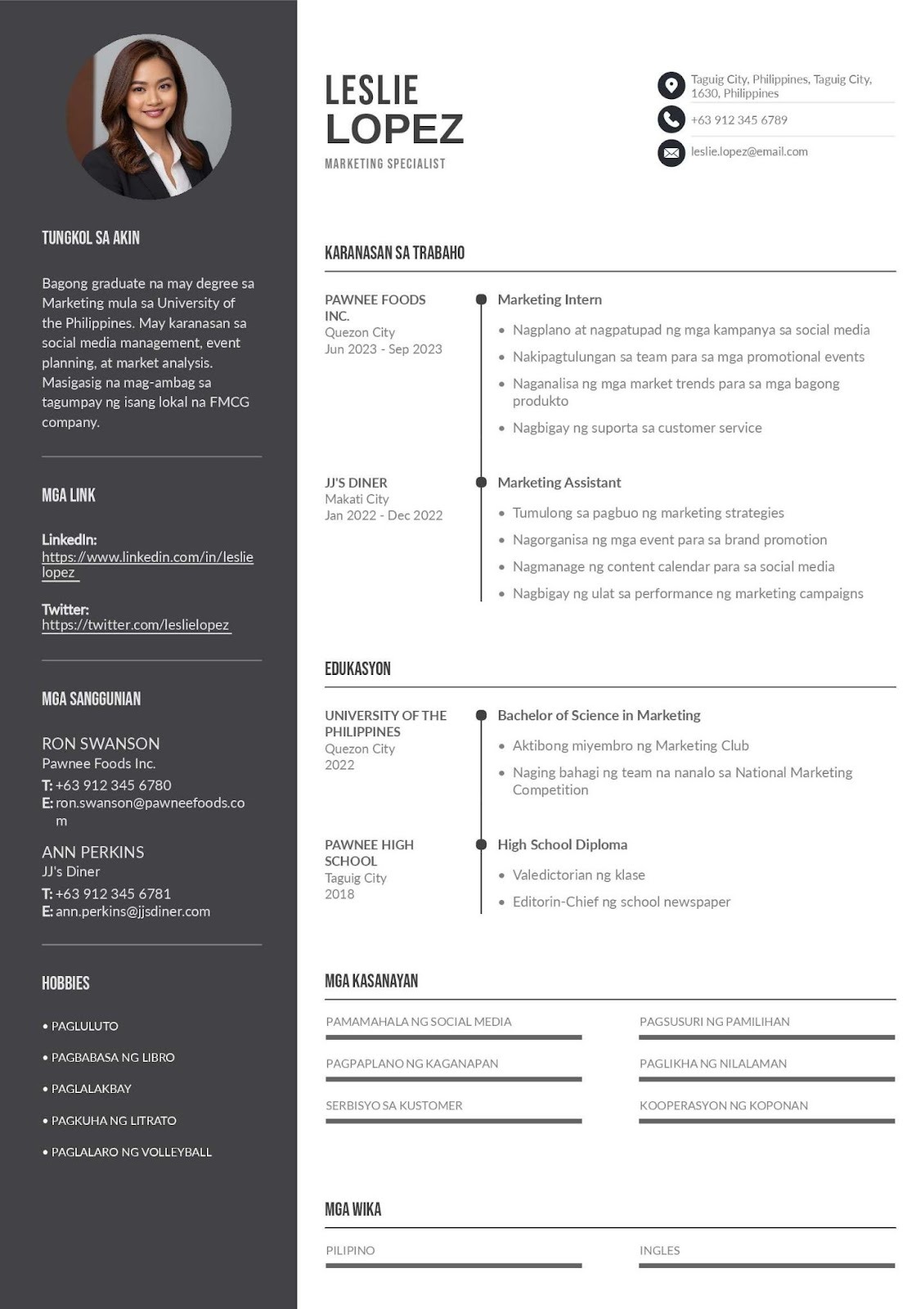
This CV example works for fresh graduates from UP Diliman, Ateneo, or De La Salle going after entry-level marketing jobs at Unilever Philippines, Nestle, or San Miguel Corporation. Zero full-time work experience? Your thesis, OJT stint, and org involvement matter more than you think.
Fresh marketing graduates aim for assistant brand manager, marketing coordinator, or digital marketing spots at FMCG companies. What do employers want? Graduates who get the local consumer market. Can you run social media campaigns? Bring digital engagement ideas that actually connect with Filipino Gen Z and millennials? That's what separates you.
Education leads because it's your strongest card right now. UP, Ateneo, De La Salle on your CV? FMCG recruiters already know what these schools produce. Show OJT impact with numbers: "Instagram engagement jumped 23% after reorganizing SM Supermalls content calendar."
Additional tips:
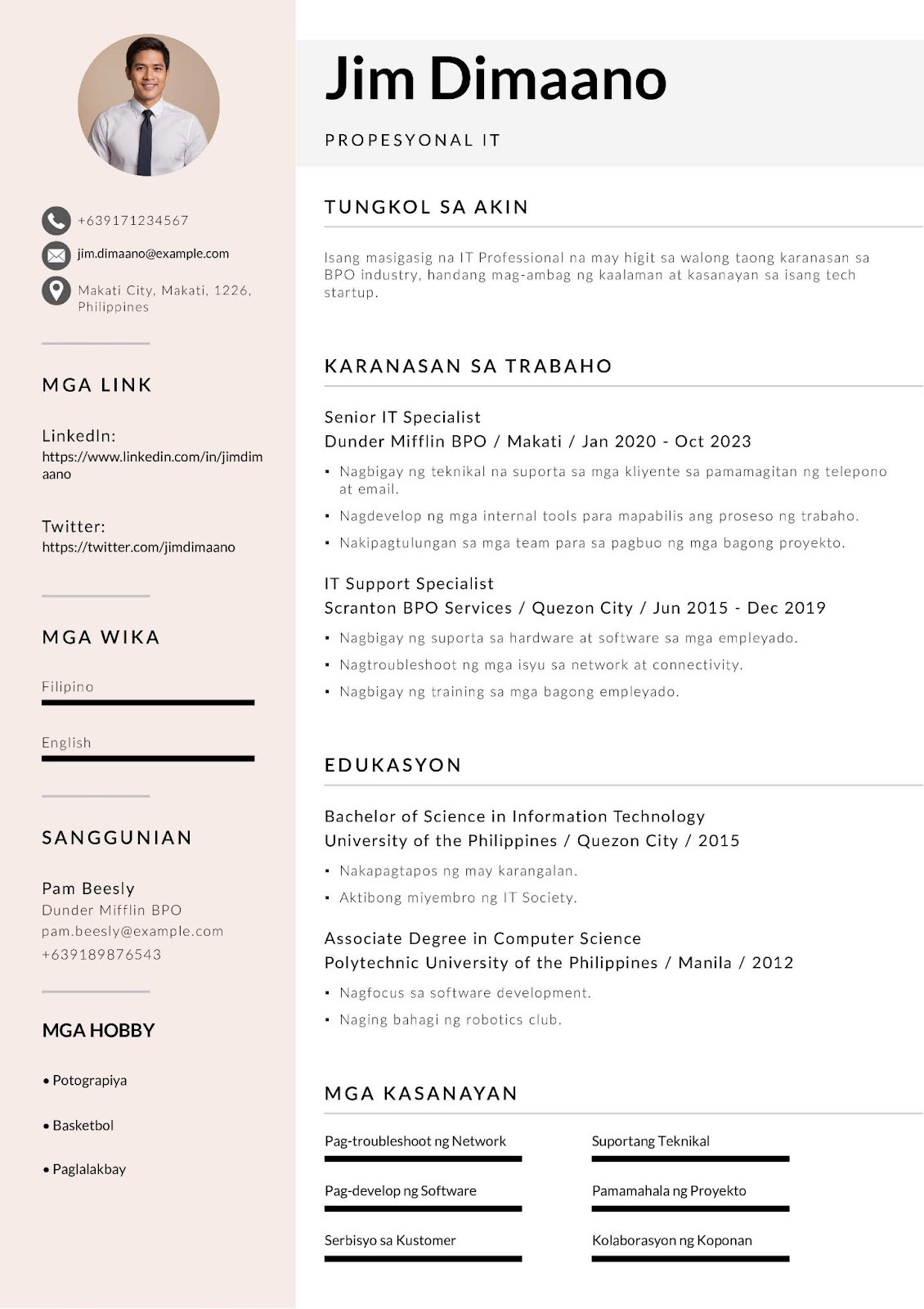
This CV example is designed for professionals with six years at companies like Accenture Manila doing IT support and project management who now want to write code for startups - Kalibrr, Sprout Solutions, PayMongo. Companies building products, not just maintaining them.
IT professionals shifting to development roles need to prove they can actually code, not just manage systems. What do startups want? Developers who've shipped real projects. Understand Agile workflows. Can talk with non-technical stakeholders without creating confusion. Six years at Accenture proves you're reliable and work well with teams, but your GitHub portfolio needs to back up your coding claims.
Technical skills go near the top - Python, React, JavaScript, Git, PostgreSQL. Each skill connects to an actual GitHub project with measurable impact: "cut page load time by 40%" or "automated three-hour reporting down to fifteen minutes."
Additional tips:
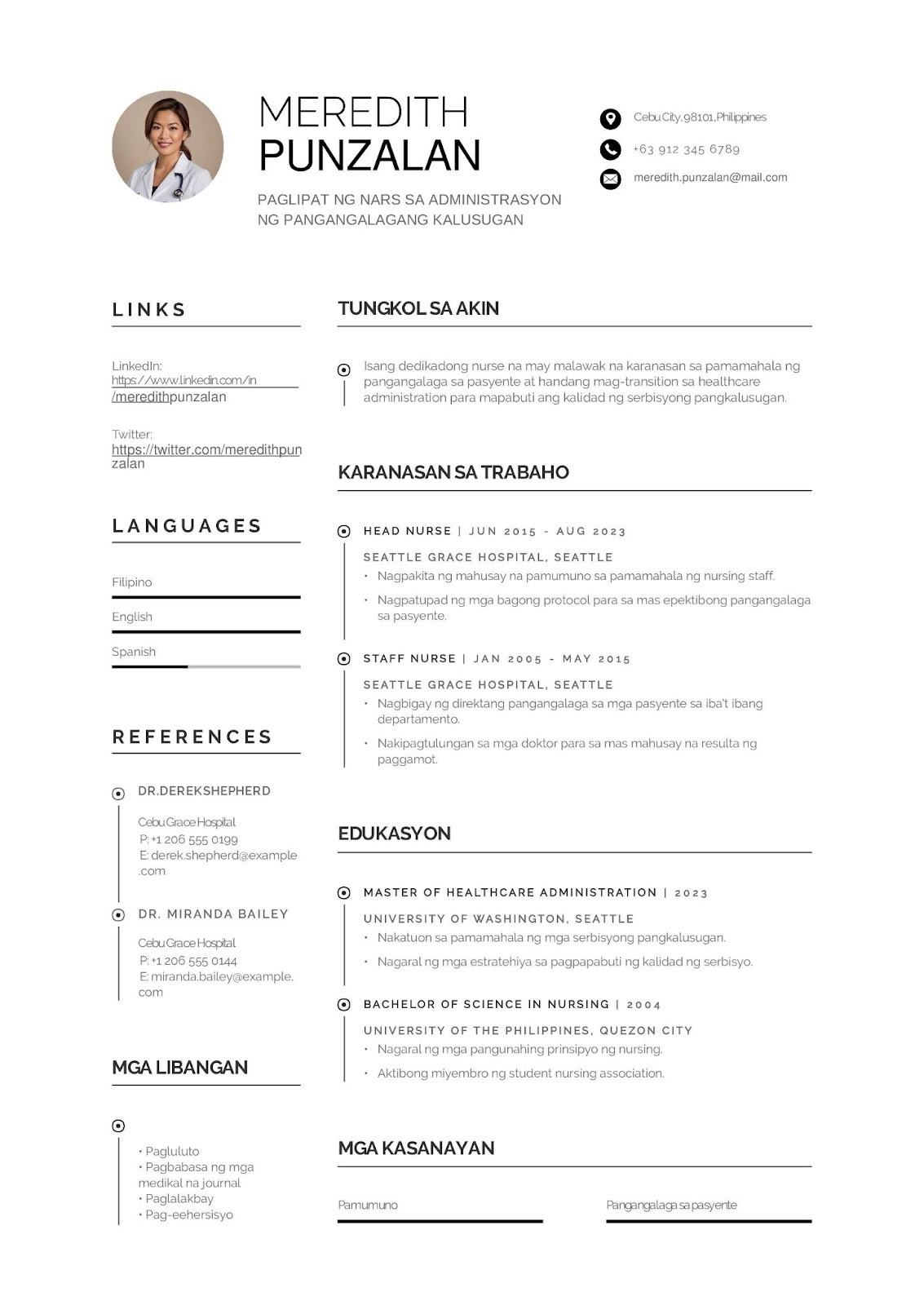
This CV example works for nurses with eight years in Dubai and Saudi Arabia who want to move into healthcare administration at Makati Medical Center, St. Luke's, or Asian Hospital. Your clinical work was solid. But you also handled training, scheduling, department coordination overseas - that's what matters now.
Nurses returning from abroad and targeting healthcare administration? You need to show you can manage operations, not just deliver patient care. What do Philippine hospitals want? Leaders who understand clinical workflows and can train staff. Process improvements? You've implemented them. Administrative complexity of running departments while keeping quality standards high? You've done that too in Middle East hospitals.
International credentials go right at the top - DHA license from Dubai, SCFHS license from Saudi Arabia. These show you worked at hospitals meeting international standards. Highlight every administrative responsibility: "trained 15 newly hired nurses" or "cut medication errors by 30% after implementing verification process."
Additional tips:
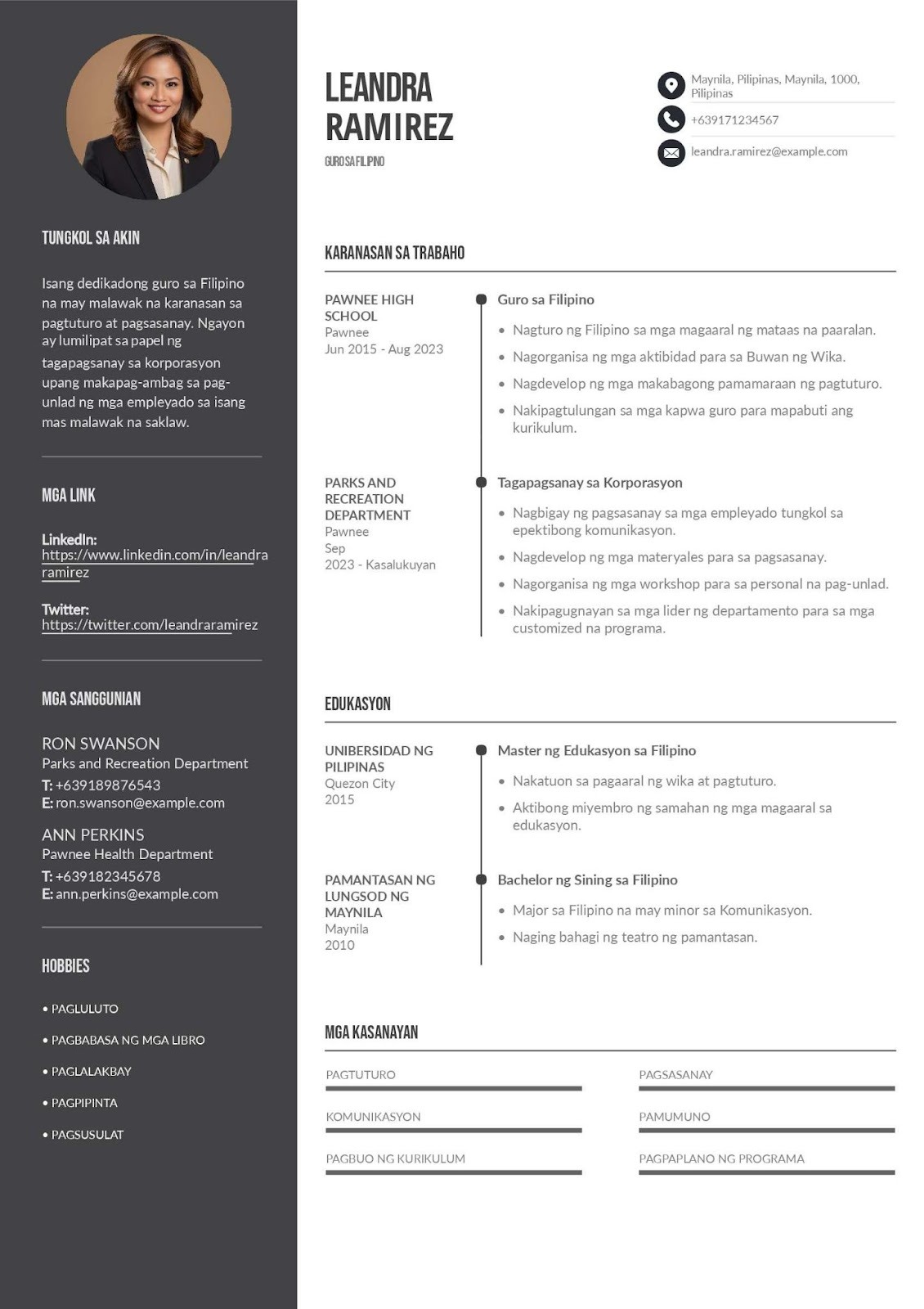
This CV example works for teachers with five years at schools like Ateneo de Manila High School who want to earn decent money in corporate training. You're going after Learning & Development Specialist positions at Ayala Corporation, Manila Water Company, the big corporations running real training budgets.
Teachers moving to corporate training need to reframe classroom skills into business language. L&D specialists design training programs, deliver workshops to adult learners, measure training effectiveness, and work with department heads to identify skill gaps across organizations.
Drop education jargon entirely - "pedagogical approaches" becomes "instructional strategies." Show teaching using business metrics: "delivered 120+ instructional hours annually to groups of 30-40 participants" instead of "taught History to high school students."
Additional tips:
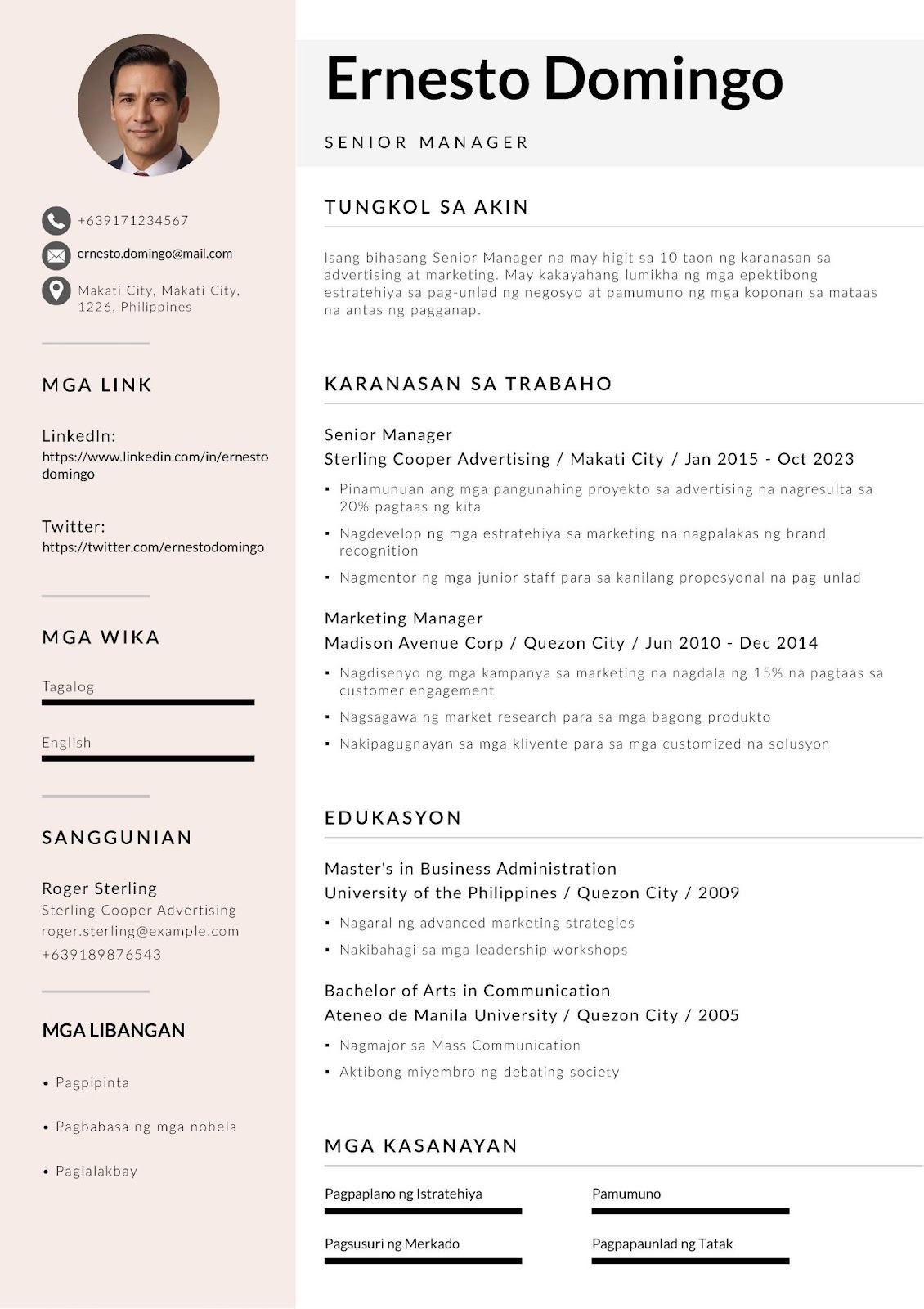
This CV example works for professionals with twelve years at San Miguel Corporation who are ready to jump to Director of Operations at multinationals like Procter & Gamble Philippines or Del Monte Philippines. You've got P&L responsibility for a ₱200M+ business unit, teams of 50+ reporting to you, and strategic initiatives that actually moved numbers.
Senior managers targeting director roles need to prove they can make decisions impacting an entire Philippine operation. Multinationals want executives who've run significant P&L, managed large teams across multiple sites, delivered measurable business impact through cost reduction and efficiency gains, and developed leadership talent that gets promoted.
Scope and impact go first. Professional summary hits hard: "Operations executive, 12 years at San Miguel. Ran ₱200M+ P&L. Managed 50+ person teams across multiple sites. Delivered ₱50M in annual savings through process improvements.".
Additional tips:
This example targets the most searched profile in the Philippine job market: students and fresh graduates with little or no formal work experience. It covers the sections Filipino recruiters most frequently search: Career Objective in Tagalog, Special Skills in Tagalog, and 'About Me' in Tagalog.
Who this example is for
[Full Name]
[Address, Barangay, City] | [Phone: +63 9XX XXX XXXX] | [Email]
CAREER OBJECTIVE / LAYUNIN
Naghahanap ng posisyon bilang [titulo] kung saan maipapakita
ko ang aking kaalaman at kasanayan, at maiaambag sa tagumpay
ng kumpanya. Handa akong matuto at lumago bilang propesyonal.
(English version:)
Seeking a position as [Title] where I can apply the skills
developed through my studies and OJT, and contribute to the
goals of the organization. Committed to continuous learning.
EDUCATION / EDUKASYON
[University Name] | [City]
Bachelor of Science in [Course] | Graduated [Month Year]
GPA: [X.XX] | [Latin Honors if applicable]
OJT / INTERNSHIP EXPERIENCE
[Company Name], [City] | [Month Year] – [Month Year]
[Department / Role]
SPECIAL SKILLS / MGA KASANAYAN
ORGANIZATIONAL INVOLVEMENT
[Organization Name] | [Role / Position] | [Year]
REFERENCES / MGA REPERENSYA
Available upon request. / Magagamit sa kahilingan.
Tips for this profile:
OFW and overseas applicants have specific needs that differ from local applicants. For the full breakdown of agency placement, direct hire, and Balik-Manggagawa applications including a sample opening line for returning workers, see: Filipino cover letter guide — OFW section.
Filipino employers expect CVs that look different from what you'd send to US or UK companies. Format and details both matter.
Length varies by experience. Fresh graduates? One page, maybe two if you have substantial OJT or org involvement. Mid-career professionals with 5-10 years? Two pages. Executives? Two to three pages maximum.
English dominates professional CVs here. Most business communication happens in English - emails, reports, presentations. Writing in Tagalog signals very specific roles where Filipino is primary. For 95% of jobs, write in English.
Language choice by sector - quick reference:
File format depends on submission method. JobStreet Philippines? PDF protects formatting. Email applications? Check the posting - some want .DOC or .DOCX for their HR systems. When unsure, PDF plus mention you can provide Word format.
Recruiters expect a specific section order. Contact info goes at top. Then your professional summary or career objective. After that, work experience or education - whichever is stronger leads. Skills section follows. Optional sections come last. Changing this flow makes recruiters work harder to find information they're scanning for.
Clean layout matters before content gets read. Visual chaos kills chances faster than typos.
Font choice: Calibri and Arial dominate Philippine offices. Installed everywhere, display clearly, print reliably. Size 10-11 for body text, 12-14 for headings.
White space gives recruiters' eyes room to breathe. Dense paragraphs covering every inch? Gets skimmed or skipped. Use 0.5 inch margins minimum. Space between sections. Line spacing of 1.15 or 1.5.
ATS systems at JobStreet and LinkedIn Philippines can't handle creative layouts. Two columns, tables, graphics, text boxes - all confuse the software. Simple single-column layouts with clear headers get past the robots.
Section headers need to stand out. Bold them. Increase font size slightly. All caps works. Make section breaks immediately obvious when someone glances at the page.
Consistency isn't negotiable. Bold company names in one entry? Bold them in all entries. "January 2020 - March 2023" format? Use it everywhere. Mixed formatting looks sloppy.
Top of your CV gets contact details. Full name, phone number (use +63 prefix for international applications), professional email, LinkedIn URL, and city location.
Email address needs to sound professional. Use firstname.lastname format. Avoid anything created during high school that sounds unprofessional now.
LinkedIn matters to Philippine recruiters. They check profiles before calling candidates. Keep it current.
Location at city level works fine. "Quezon City, Metro Manila" gives enough information. Complete street addresses with barangay details waste space.
 CORRECT example:
Juan Dela Cruz
+63 917 123 4567 | juan.delacruz@gmail.com | linkedin.com/in/juandelacruz
Maynila, Kalakhang Maynila
 INCORRECT example:
JC "Ang Marketing Guy" ♛
09171234567 | jc_coolguy123@yahoo.com | Walang LinkedIn
123 Maple Street, Barangay San Antonio, Lungsod ng Makati, Kalakhang Maynila 1203
Photos appear on many Filipino CVs but aren't required. If you include one, make it professional - headshot style with neutral background. Skip the selfies and party photos.
Civil status and age show up frequently on local CVs. Not legally required though. Multinationals and tech companies typically don't want this information. Traditional companies might expect it.
This is one of the most searched sections in Philippine CVs. Filipino job seekers consistently look for 'career objective in tagalog', 'layunin sa resume tagalog', and 'objective in resume tagalog examples'. Here are ready-to-use templates.
Career Objective templates in Tagalog
FOR FRESH GRADUATES / PARA SA MGA BAGUHAN:
Naghahanap ng posisyon bilang [Titulo] sa [Uri ng Kumpanya]
kung saan maipapakita ko ang aking [kakayahan/kaalaman]
na natamo sa aking pag-aaral sa [Pangalan ng Pamantasan].
Determinado akong mag-ambag sa tagumpay ng kumpanya
habang patuloy na umuunlad bilang isang propesyonal.
FOR CAREER CHANGERS / PARA SA MGA NAGBABAGO NG CAREER:
Nagnanais na ilapat ang [X] taon ng karanasan sa [Dating Larangan]
sa isang posisyon sa [Bagong Larangan], na may malakas na pundasyon
sa [transferable skill] at dedikasyon sa patuloy na pagkatuto.
FOR GOVERNMENT APPLICATIONS / PARA SA PAMAHALAAN:
Nais ko pong mag-apply sa posisyon ng [Posisyon] upang
makapaglingkod sa bayan at maiaambag ang aking [X] taon ng
karanasan sa [larangan] sa serbisyong pampubliko.
Fresh graduates and career shifters need career objectives. Limited relevant experience? State what you're targeting and why you qualify despite a thin resume.
Everyone else uses professional summaries. Your work history speaks. Package your value in two to three tight sentences.
CORRECT example (Fresh Graduate):
INCORRECT example (Fresh Graduate):CORRECT example (Experienced Professional):
INCORRECT example (Experienced Professional):Filipino employers want confidence balanced with humility. Show achievements directly. Don't sound arrogant doing it. Western-style summaries can come across too aggressive in Philippine workplace culture.
Keep it short. Two to three sentences maximum.
This section makes or breaks your CV. Most attention from recruiters. Needs to be tight.
Reverse chronological order. Most recent job first. Recruiters care most about what you're doing now.
Structure each entry consistently. Company name bold. Add brief descriptor if company isn't well-known. Job title next. Location (city level). Dates in Month Year format.
Your bullets need to prove impact, not list duties. Show what you accomplished. Revenue you generated. Costs you cut. Efficiency you improved. Teams you managed. Numbers make claims real.
Philippine recruiters want to see pesos, not just percentages. Use both when you can. The combination shows full impact.
CORRECT example:
Jollibee Foods Corporation - Nangungunang Filipino QSR chain Store Manager | Quezon City, Kalakhang Maynila | Hunyo 2020 - Kasalukuyan
INCORRECT example:Jollibee Foods Corporation
Store Manager | 2020 - Kasalukuyan
Strong bullets connect your actions to business outcomes. Weak bullets just describe job responsibilities anyone with that title would have.
OJT and internships go under Work Experience when substantial - three months or longer doing real work. Brief observation periods belong under Education.
Employment gaps lasting six months or longer? One line addresses it: "Career Break | Enero 2022 - Agosto 2022 - Nag-provide ng full-time family care, nagpatuloy ng skills through online courses."
Skills in tagalog resume' and 'halimbawa ng skills sa resume sample' are among the top searched terms for this page. Here are ready-to-use Tagalog formulations by skill type.
Communication and teamwork / Komunikasyon at pangkatgawa
Work values / Mga katangian sa trabaho
Technical skills - how to list them in Tagalog context
For local company applications, list tools in English but frame the sentence in Tagalog:
For BPO and multinational applications: list all tools in English, no Tagalog needed.
Fresh graduates: education goes before work experience. Everyone else: after work experience.
Structure: University name (full official name), location, degree (spell out completely), graduation date.
GPA or Latin honors only if impressive. Cum laude or higher? Include it. 1.75 GPA or better? Worth adding. 2.5 GPA? Leave it off.
CORRECT example:
University of Santo Tomas | Maynila, Kalakhang Maynila
Bachelor of Science in Accountancy | Nagtapos Cum Laude (GPA: 1.5) | Mayo 2023
Pumasa sa CPA Board Exam (Top 10, Mayo 2023 Examination)
INCORRECT example:UST
BS Accountancy | 2023
Fresh graduates can list 3-5 relevant courses that connect directly to target jobs. Mid-career professionals skip coursework entirely.
Thesis titles work for fresh graduates when topic matches target role. Generic thesis about leadership? Everyone wrote something similar. Skip it.
Scholarships and awards deserve mentions. Dean's List, academic scholarships, company-sponsored programs all signal excellence.
Multiple degrees get listed reverse chronologically. Most recent first.
'About me in resume tagalog sample' generates hundreds of monthly impressions. Here is a ready-to-use template.
SHORT VERSION (for local applications):
“Ako si [Pangalan], isang [titulo/propesyon] na may [X] taon ng
karanasan sa [larangan]. Naniniwala ako sa [core value, e.g.,
'serbisyong may malasakit at kahusayan']. Sa labas ng trabaho,
aktibo ako sa [volunteer work / sports / interest].”
LONGER VERSION (for government or traditional companies):
“Ako si [Buong Pangalan], ipinanganak noong [Petsa] sa [Lugar].
Nagtapos ako ng [Kurso] sa [Pamantasan] noong [Taon]. Mayroon
akong [X] taon ng karanasan bilang [posisyon] sa [industriya].
Isa akong [katangian], [katangian], at [katangian] na indibidwal
na naniniwala sa [values]. Ang aking layunin ay [professional goal].”
List specific technical abilities employers can verify. Software you use, platforms you know, programming languages you write, tools you operate. Get specific - "Microsoft Office" means nothing. Break it down to Excel with pivot tables and macros, PowerPoint for presentations, Word for documents.
Group skills by type. Makes recruiters' jobs easier. Technical skills go at the top. Language proficiencies follow - be honest about your level in each one. Native means you grew up with it. Fluent means you use it easily. Conversational covers basic work discussions. Basic is limited capability.
Words like "communication" and "teamwork" sound hollow when you just list them under skills. Smarter move: prove these abilities through specific achievements in your work experience section.
Certifications belong here if you have one or two. PRC licenses, TESDA certifications, industry credentials all add credibility. More than five certifications? Create a separate section for them.
Education and skills aren't the end of your CV. Additional sections can strengthen your application when they're actually relevant to the role you're targeting.
Certifications & Licenses deserve their own section if you have several. PRC professional licenses go here - Engineer, Nurse, CPA, Teacher, whatever applies to your field. TESDA certifications? They prove technical training. Industry certifications like AWS, Google Analytics, PMP? Show you keep developing professionally.
Keep the format simple: Certification name | Who issued it | When you earned it | Expiration date if there is one.
Volunteer Experience matters to Filipino employers. Bayanihan activities, NGO work, community organizing - these demonstrate values companies here actually care about. Don't just name organizations though. Show what you accomplished there.
Projects & Portfolio matter for creatives, developers, engineers. List the project name, what it does, your role, technologies used, and where to view it.
Professional Organizations prove you're connected beyond your current employer. Include organization name, membership level if relevant, and years active.
References work two ways. "Available upon request" saves space. Or list 2-3 professional references after getting their permission first. Each reference needs: full name, job title they hold now, company they work for, how they know you, ways to contact them. Always ask permission first.
What to skip entirely: hobbies unless directly relevant, personal information like height and weight, photos of family, high school information (unless you're a fresh graduate with no college degree), outdated skills nobody uses anymore, references who no longer work at companies listed.
Optional sections strengthen CVs when they add legitimate value. They weaken CVs when they're just filler taking up space. Be strategic about what you include.
For government applications: Civil Service Examination (CSE) eligibility level, Professional or Sub-professional, must appear in the CV and cover letter. GSIS familiarity and awareness of Plantilla position structure also signal institutional competence. See the Filipino cover letter guide for the full DepEd document checklist.
These errors show up constantly in Filipino CVs. Avoid them.
Three additional mistakes:
(1) Not including 'Civil Service Eligibility' for government roles: this is a screening criterion, not an optional detail.
(2) Generic career objectives in Tagalog with no specificity (See the templates above).
(3) Sending a Philippine-format CV (with photo, civil status, age) to international companies: multinationals in BGC and Ortigas actively avoid these signals to reduce hiring bias.
Our collection of expertly designed cover letter templates will help you stand out from the crowd and get one step closer to your dream job.