You've run campaigns. You've managed budgets, owned channels, delivered results someone could put a number on. And yet your resume isn't generating callbacks. The problem is rarely your track record. It's how that track record is presented…
What stands between you and that callback is a machine, then a human, both of whom need to be convinced in about ten seconds. This guide shows you exactly how to clear both filters.


[Full Name] | [Target Job Title]
[Phone] | [Email] | [LinkedIn URL] | [Portfolio / Case Study Link]
Professional Summary
Results-driven marketing professional with experience in [type of campaigns or channels]. Skilled in leveraging [tools, strategies, or methods] to drive measurable growth in [metrics, e.g., engagement, leads, revenue]. Adept at translating [data/insights] into actionable strategies and aligning campaigns with [business objectives/goals].
Work Experience
[Job Title] — [Company Name] | [City, State] | [Start Date – End Date]
[Job Title] — [Company Name] | [City, State] | [Start Date – End Date]
Skills
Hard Skills:
[SEO] | [SEM] | [Paid Media (Google Ads, Meta Ads, LinkedIn Campaigns)] | [GA4 & Analytics] | [HubSpot, Marketo, Salesforce] | [Email Marketing Platforms] | [CMS (WordPress, Webflow, Contentful)] | [A/B Testing & CRO] | [Copywriting & Content Strategy] | [AI Marketing Tools: name & usage]
Soft Skills:
[Project Management] | [Cross-Functional Collaboration] | [Stakeholder Communication] | [Analytical Thinking] | [Adaptability & Problem-Solving]
Education
[Degree - Major | University | Graduation Year]
[GPA if recent graduate or noteworthy]
Certifications
[Certification Name | Issuer | Year]
[Certification Name | Issuer | Year]
[Certification Name | Issuer | Year]
Freelance / Contract Work:
Languages:
Portfolio / Case Studies:
The samples below show what a strong marketing resume looks like, across seniority levels and specializations. Use them as a benchmark to evaluate your own document… or build from scratch.
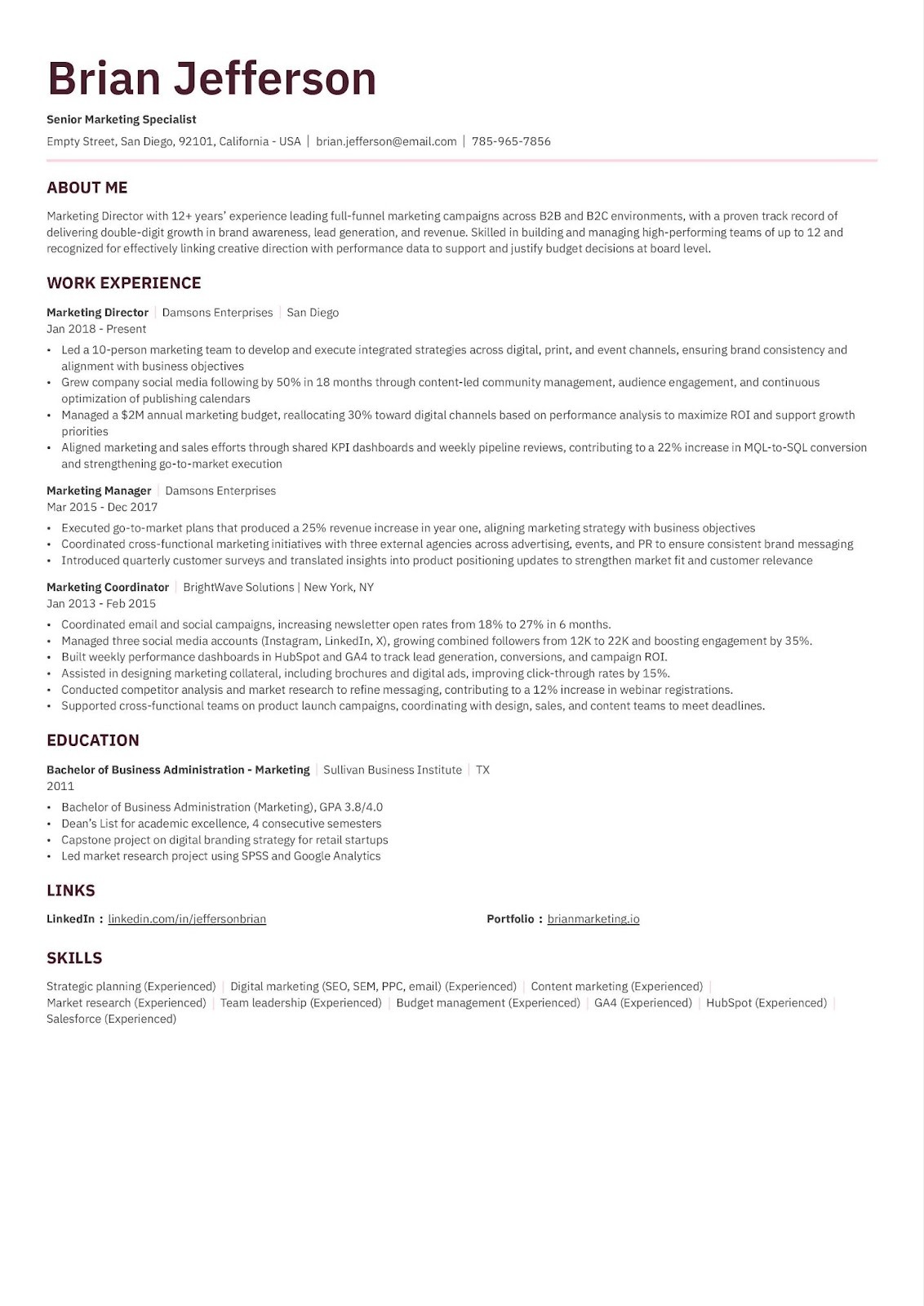
This first resume example works because it leads with scale. A hiring committee looking at a Director candidate wants to see budget ownership, team size, and evidence of cross-functional influence. And this example delivers all three upfront. The professional summary immediately signals seniority without being vague, and every bullet is tied to a measurable outcome rather than a task description.
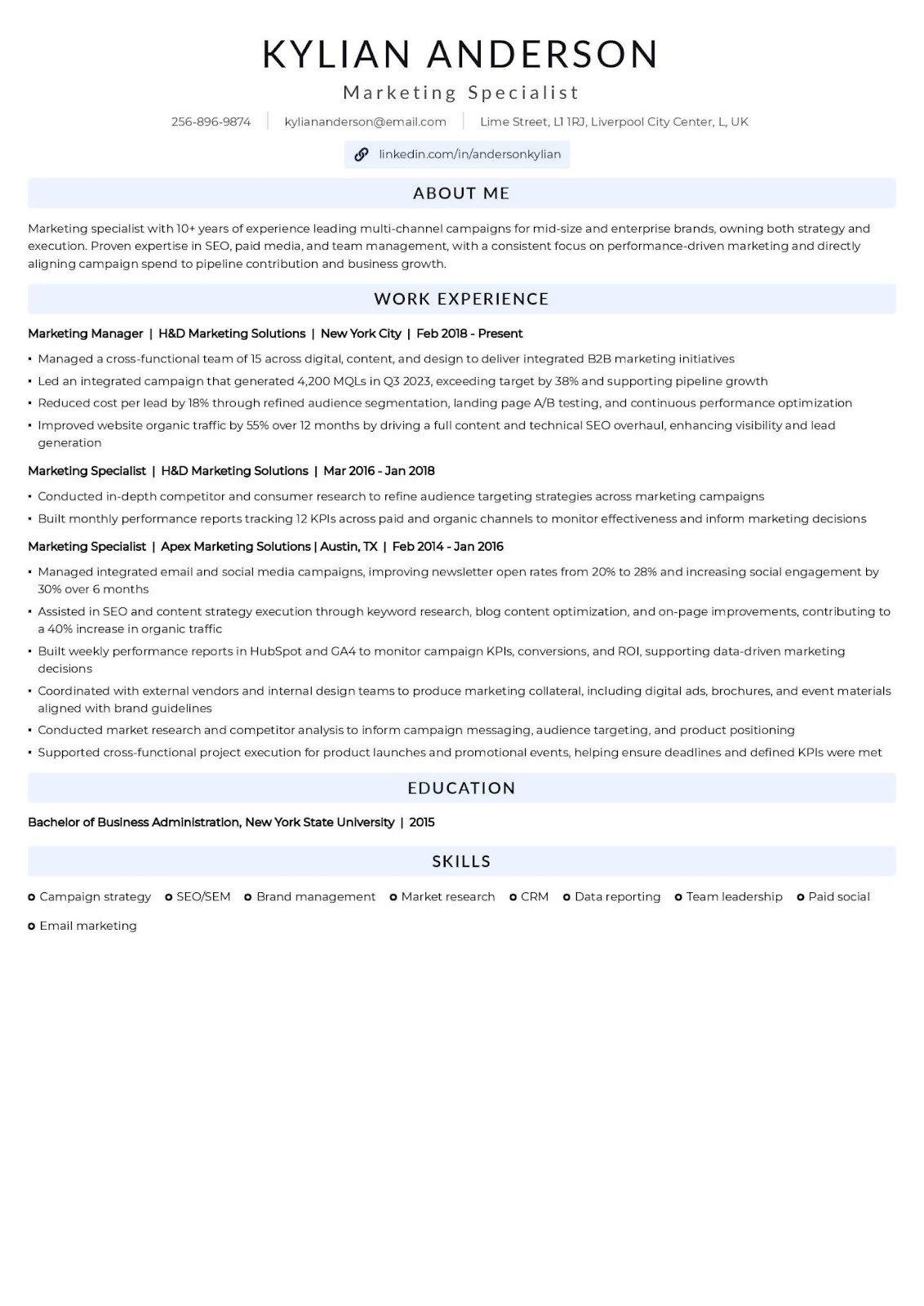
What stands out here is the balance between strategy and execution. Many Manager-level resumes fall into one of two traps: either they read too senior (claiming full strategy ownership they didn't have) or too junior (listing tasks without outcomes). This example threads that needle well, demonstrating both campaign oversight and hands-on channel expertise.
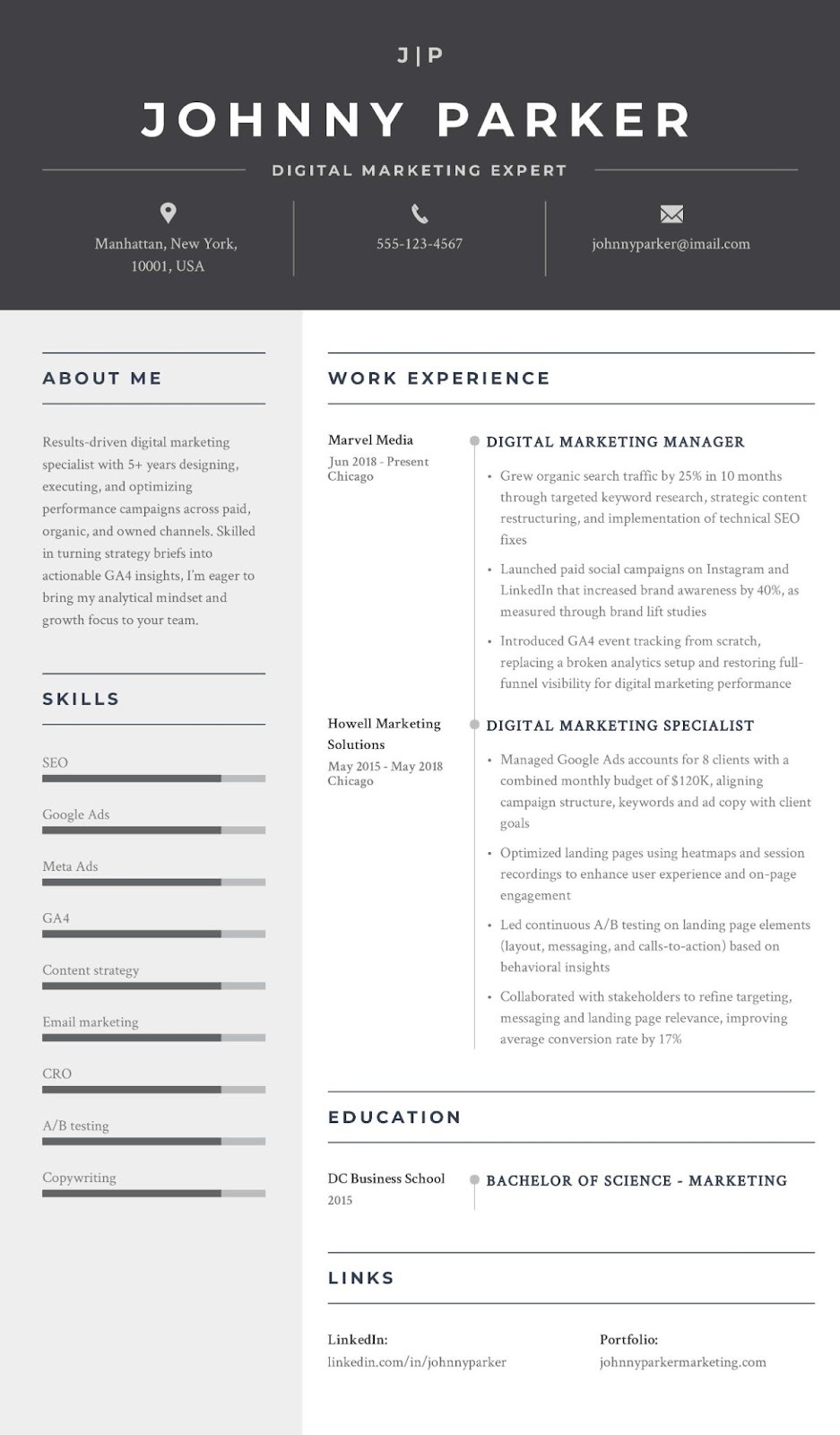
This resume is well-structured for a mid-level digital specialist because it shows channel breadth without losing depth. Recruiters screening for digital roles want to see that the candidate can own a channel end-to-end (from setup to optimization to reporting) and this example demonstrates that across paid, organic, and analytics.
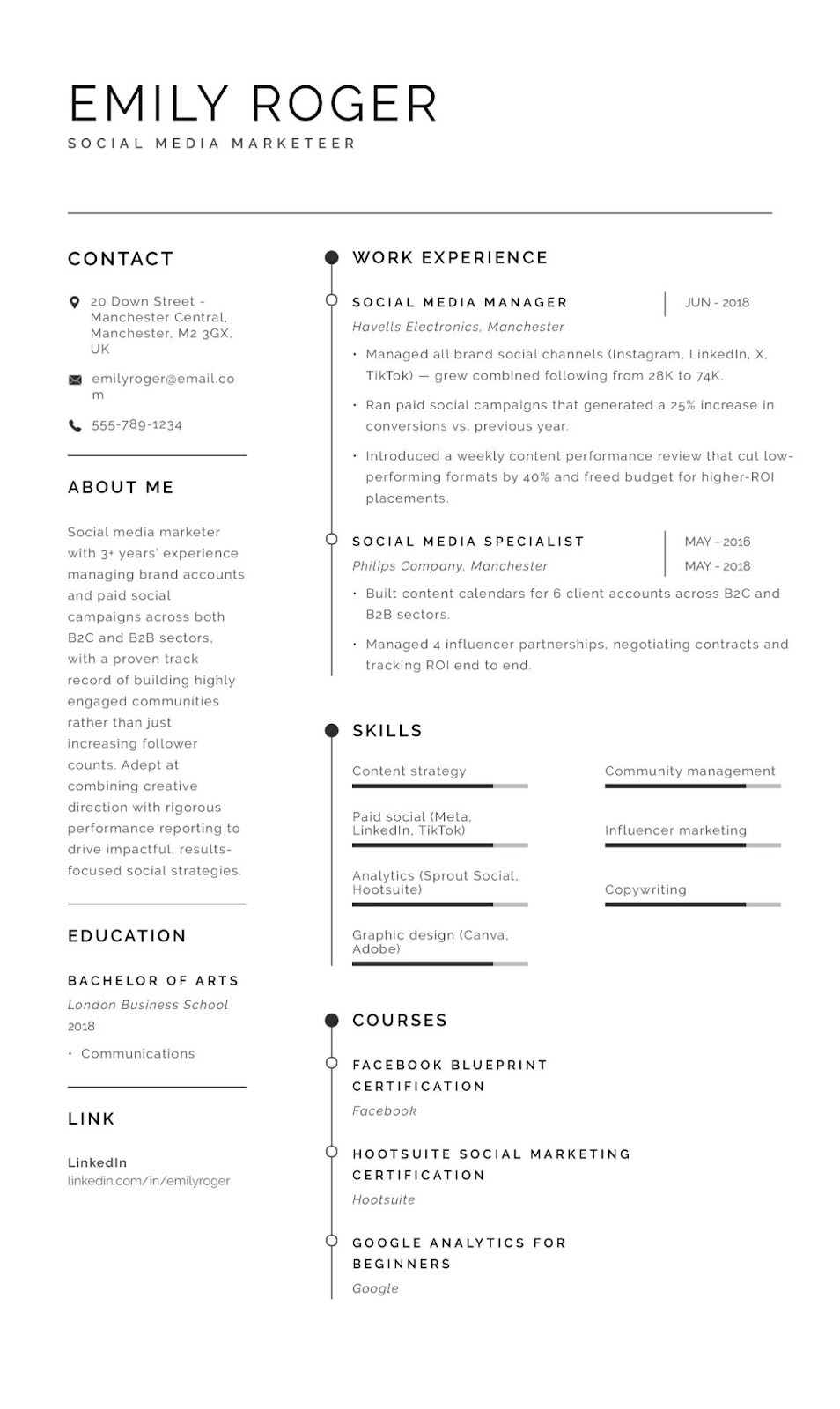
This resume avoids the most common social media résumé pitfall: focusing purely on content and creativity while ignoring business impact. Every major achievement here is tied to a performance metric, which is what separates candidates who can run social accounts from those who can run social programs.
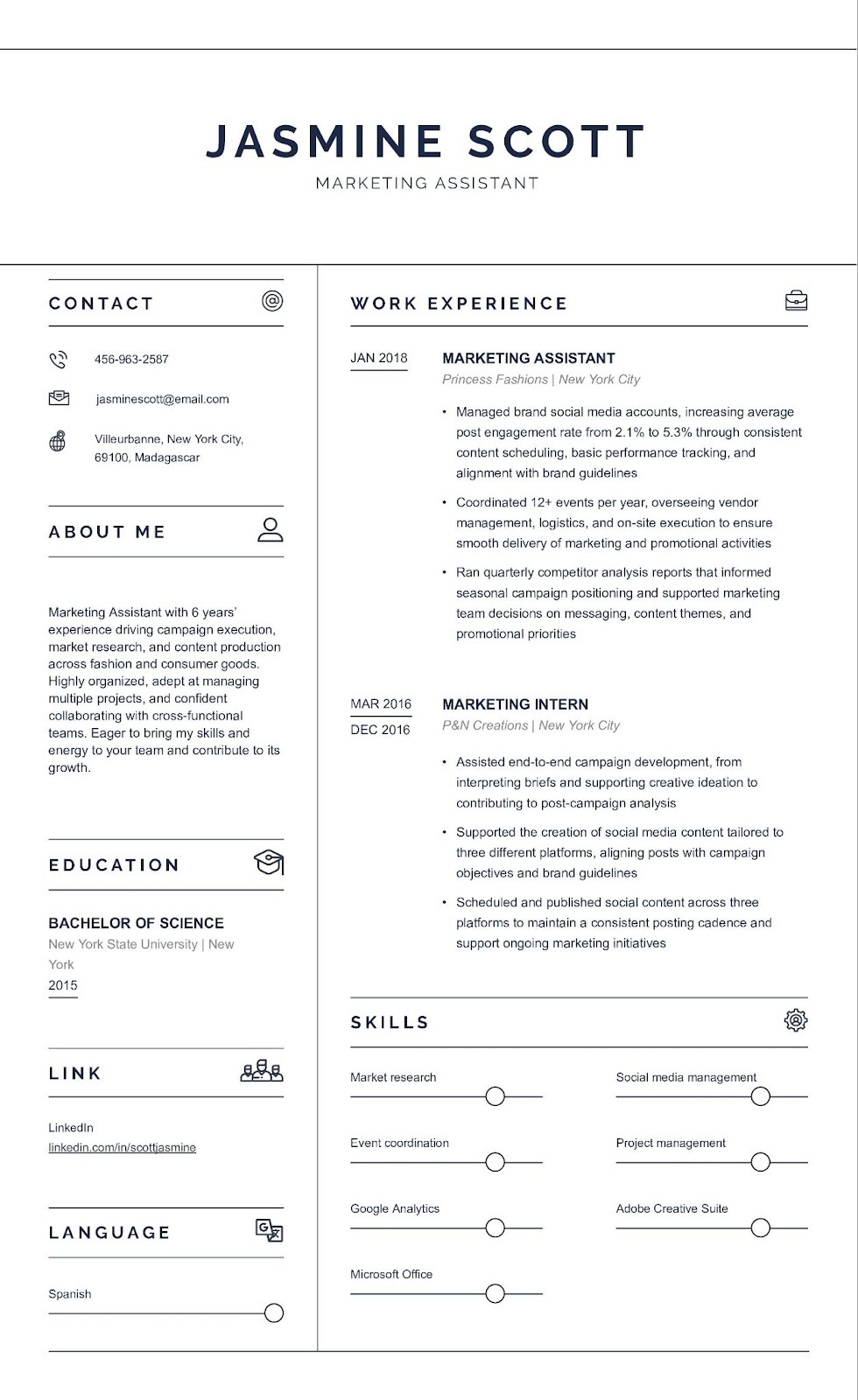
What makes this resume effective at the assistant level is the combination of demonstrated initiative and organizational range. Recruiters hiring at this level aren't just looking for someone who can execute tasks. They want to see signs of ownership and growth potential, and this example shows both through concrete outcomes even in a support role.
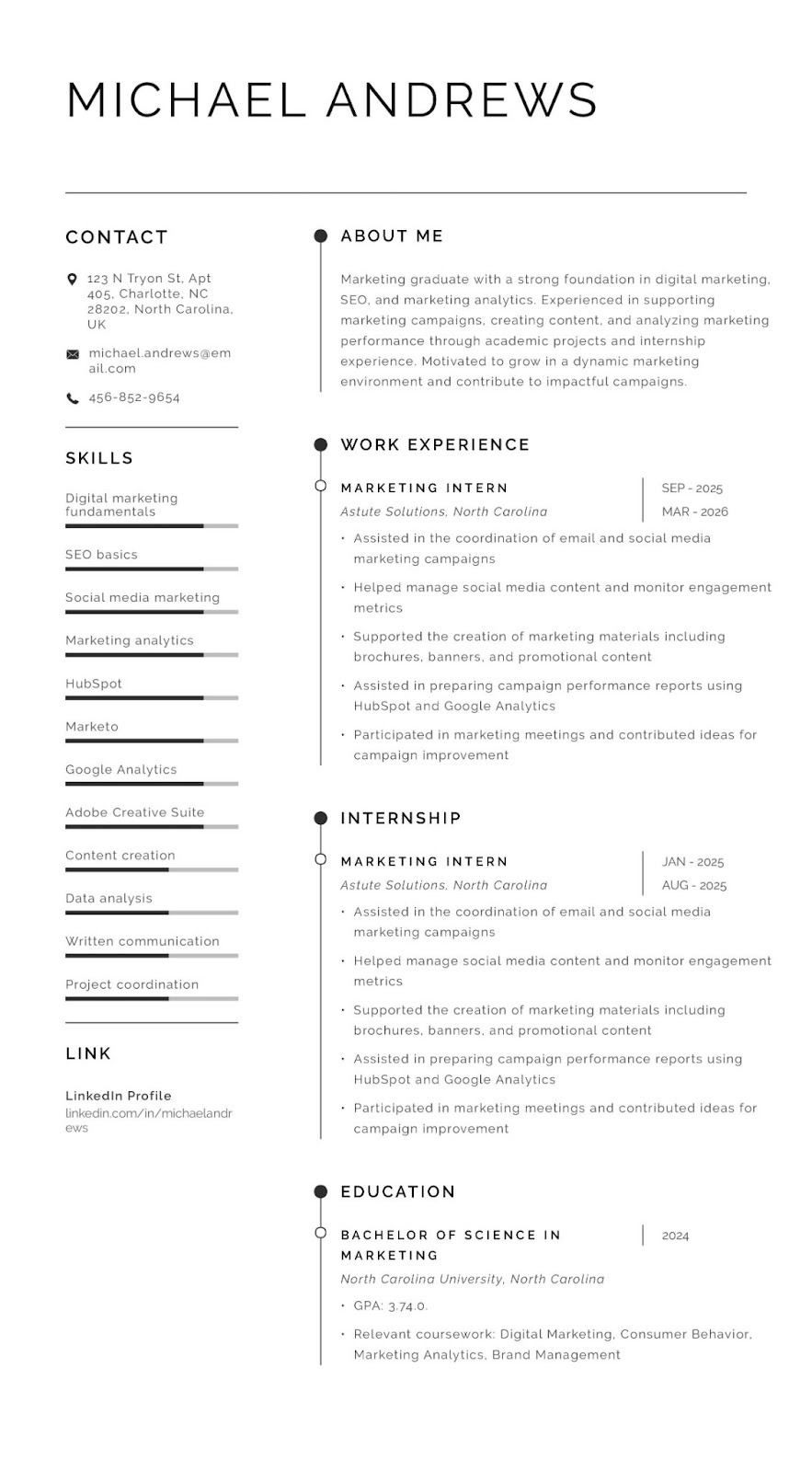
This resume makes smart structural choices for a candidate with limited professional experience. Moving education above work experience is the right call here, and the GPA inclusion is appropriate given the recency of the degree. The objective statement is also well-calibrated. It signals ambition without overpromising.
Hiring in the marketing field is increasingly selective, data-driven, and specialized. Understanding the system is as important as showcasing your skills.
Before you type a single line, think about:
To sum it all up, your resume for any marketing job is a machine-readable, results-focused showcase of what you’ve owned and delivered.
One non-negotiable on layout: no columns, no text boxes, no tables. Most ATS software can't parse these elements correctly: your information gets scrambled or dropped entirely. A clean single-column layout always outperforms a visually ambitious design in machine parsing.
If you want to demonstrate design judgment, put that in your portfolio. The resume itself is a data structure first. Every bullet should justify its presence.
On length: one page for under 5 years of experience / two pages for mid-career / up to three for senior and executive levels.
Name, target job title, phone, email, LinkedIn URL. If you have a portfolio, case studies, or documented campaign results online… add the link.
Modern resumes are digital-first, especially those for marketing positions. Recruiters expect to be one click away from proof of your work. In marketing specifically, this matters more than in most fields.
A hiring manager evaluating a Content Strategist or Performance Manager will want to see the work, not just a description of it. A portfolio link that shows real results is worth more than three lines of self-description.
Marketing hiring managers read a lot of summaries that say "results-driven professional with a passion for storytelling." None of those summaries get anyone hired.
A good professional summary is 3 to 4 sentences that answer three things: who you are professionally, what you've concretely delivered, and what you're looking for. That's it.
A powerful professional summary blends your unique value proposition with 2026-relevant keywords such as "growth hacking," "AI-driven campaigns," and "omnichannel strategy." But use those terms because they genuinely describe your work, not as decoration.
 Example - experienced profile:
Example - junior profile:
Example - experienced profile:
Example - junior profile:
No adjectives that aren't backed by numbers. No claims you can't support in an interview.
If you're a recent graduate with limited experience, write an objective statement instead — a short paragraph explaining what you're aiming for and what relevant coursework, projects, or internships you bring to the table.
This section carries the most weight for both the ATS and the hiring manager reading your resume.
How to structure each entry:
The single most common mistake marketers make on their resume: listing responsibilities instead of outcomes.
"Managed social media accounts"
"Managed Instagram and LinkedIn for a B2B SaaS brand, growing combined following by 8,000 in 9 months and increasing post engagement rate from 1.2% to 4.7%"
"Worked on SEO strategy"
"Rebuilt site architecture and content clusters for a retail client, taking organic traffic from 12K to 31K monthly sessions over 8 months"
Marketing is one of the few fields where every action has a measurable consequence — open rates, click-through rates, CAC, conversion rates, attributed revenue, organic rankings. Demonstrate skills with quantified achievements rather than just listing tools, showing specific ROI, conversion improvements, or revenue impact from your marketing efforts. Recruiters in this field know when numbers are real and when they're padded. Be precise.
Every bullet should follow this logic: action + tool or method + measurable result. Start with a verb: Led, Built, Launched, Managed, Reduced, Increased, Developed, Optimized, Coordinated.
A note on AI tools in your bullets:
Simply listing "used AI tools" means nothing. What reads well is showing the outcome: "used AI-powered sentiment analysis to monitor brand perception across 5 markets, reducing reporting time by 30%." More than half of hiring managers (60%) say they want to test, discuss, or see proof of a candidate's AI abilities rather than take resume claims at face value. Specificity is what makes it credible.
According to the American Marketing Association, the largest current competency gaps in marketing teams are in digital marketing, data and analytics, proving ROI, and data privacy and compliance. Those gaps tell you exactly which skills to put front and center.
Research from the American Marketing Association found that soft skills now eclipse technical skills in importance. They show up in things like innovation, change readiness, adaptability, and creativity.
But listing "adaptability" as a bullet point proves nothing. Show it through your experience: someone who has managed campaigns across three platforms, pivoted mid-campaign based on data, and coordinated between sales and product teams is demonstrating adaptability without ever naming it.
The soft skills worth naming explicitly: project management, cross-functional collaboration, presentation and stakeholder communication, analytical thinking.
78% of marketing and creative leaders offer higher pay to candidates with specialized skills compared with those without. The skills section is where you make that case visually. But it only works if it maps directly to what's in the job description.
Keep education short unless you're a recent graduate. Degree, institution, graduation year. If the GPA is strong and you graduated recently, include it.
Certifications matter in marketing because continuous upskilling is necessary to keep pace with rapid AI innovation. What you knew last quarter could easily become outdated by the latest feature release or a new competitor in the industry. A recent certification signals that you're current. An outdated one with no follow-up signals the opposite…
Certifications worth including:
List each with the issuing organization and year obtained.
These are optional, but any of them can tip a decision when two candidates are close.
ATS systems in 2026 use semantic matching. They understand meaning and context, not just string matching. But you still need the right vocabulary.
The method: read the job description carefully. Find the skills, tools, and phrases that appear most often or are listed as required. Use those terms naturally in your experience bullets and summary, in context, tied to outcomes.
What not to do: paste a wall of keywords at the bottom of your resume in white text, or repeat the same term five times in different bullets. Modern ATS parsers detect this and will flag or reject the resume. It also reads immediately as manipulation to any human who gets past that filter.
Aim for 5 to 7 core keywords, distributed naturally across your summary, skills section, and work experience.

A cover letter that restates your resume in paragraph form is not a cover letter, it's just filler. Skip it or make it do real work.
A useful cover letter does one thing: it explains the connection between your specific experience and their specific situation. Not marketing in general: their product, their audience, their growth challenge.
Three paragraphs:
Address it to the hiring manager by name if you can find it. A LinkedIn search takes two minutes.
Your marketing resume in 2026 has to do two things at the same time: pass an automated filter and convince a time-pressed human to pick up the phone.
That means a clean layout a machine can parse, a summary that leads with impact rather than self-description, experience bullets built on outcomes rather than task lists, and keywords used in context rather than stacked for appearances.
Salary growth happens when your role moves from supporting execution to owning outcomes. Your resume should already be telling that story…
Our collection of expertly designed cover letter templates will help you stand out from the crowd and get one step closer to your dream job.