A career as an accounting assistant is rewarding and has excellent growth opportunities. If your dream job is in the accounting field, this is a great way to get started and gain the experience you need to progress.
Ross Holmes Accounting Assistant 273-004-468 rossholmes@gmail.com Tupelo, MS linkedin.com/in/rossholmes
Professional Summary
Accounting professional with five years of experience in financial accounting. Proven ability to maintain bookkeeping records and prepare accurate financial reports using Ms. Excel and specialized accounting software like Quickbooks. Excellent communication and interpersonal skills.
Work experience
MGK Consulting Senior Accounting Assistant July 2016-December 2019
Reconciled bank statements and correctly documented all financial data in a general ledger, ensuring compliance.
Prepared analysis reports and managed all financial records for the company, with an approximate annual net income of $20M.
Reviewed financial statements, complied with IRS regulations in preparing tax returns, and calculated and paid taxes on time.
Cezam & Associates Ltd Accounting Assistant May 2014-June 2016
Researched and found resolutions for vendor and employee issues regarding payment transactions and credit memos.
Assisted with administrative tasks like filing documents, answering customer inquiries, and processing invoices for more than 20 clients.
Verified vendor statements and reconciled accounts payable with purchase orders to ensure accurate records.
Education
Bachelor's Degree in Finance Alcorn State University 2015
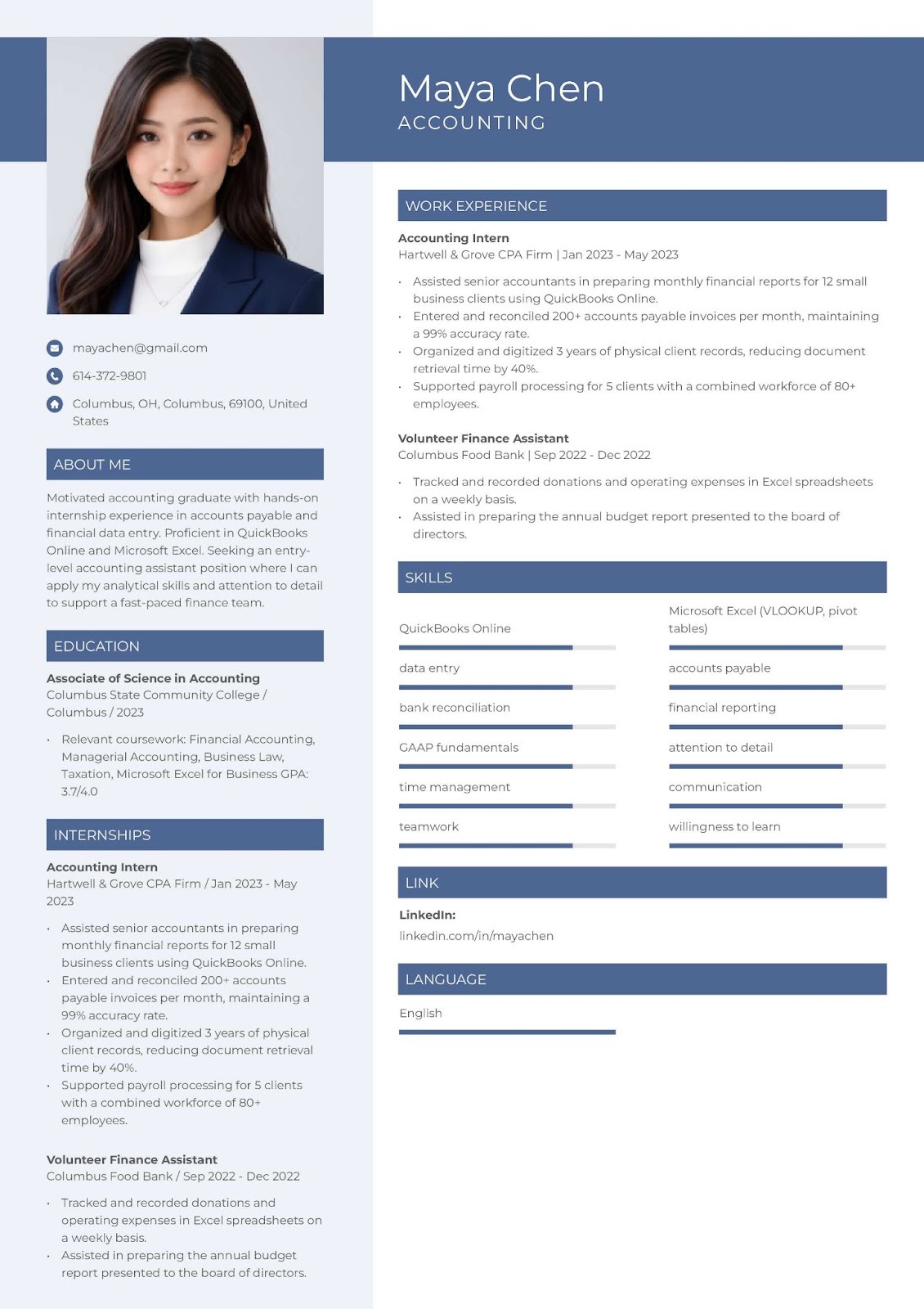
Objective over summary. You have no work history yet, so skip the professional summary. Write a 3-line objective: who you are, what you can do right now, what role you want.
Put numbers on everything. Even in a short internship, quantify: how many invoices, how many clients, how many hours saved. "Processed 200+ invoices/month" beats "helped with invoices" every time.
List your GPA if it is 3.5 or above — it signals diligence when experience is thin.
Include volunteer finance work. A treasurer role at a student club or non-profit counts. Frame it like a real job: title, dates, bullet points with results.
One certification changes everything. A QuickBooks Certified User (QBCU) badge on an entry-level resume immediately separates you from candidates who have the same degree and nothing else.
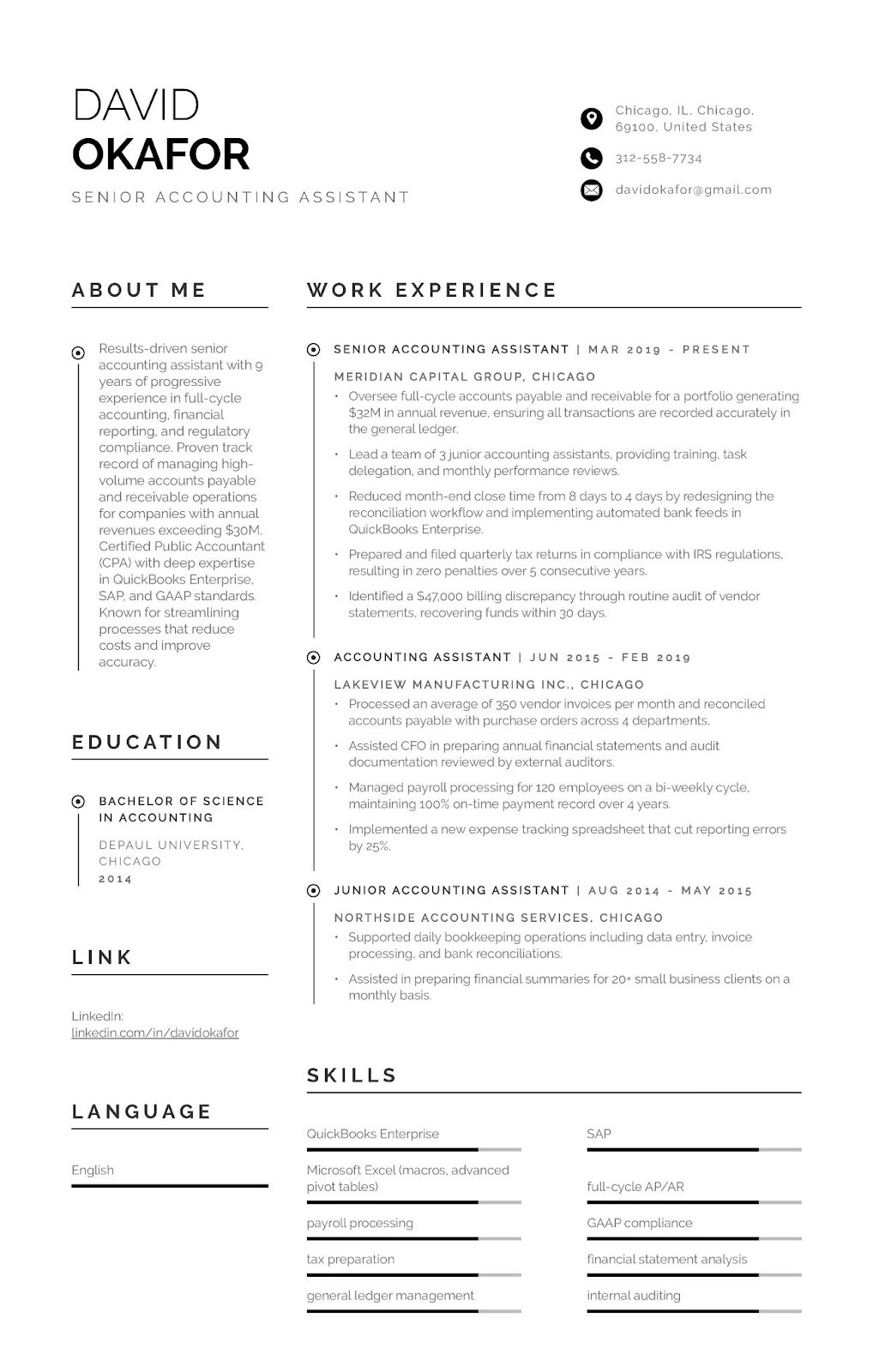
Senior Accounting Assistant Resume for Experienced Professionals
Show progression, not repetition. Each job listed should show more responsibility than the last: bigger revenue figures, more staff managed, higher-stakes tasks. If two roles look identical, merge them or cut the older one.
Lead with dollar impact. Senior-level bullets should anchor to money: revenue managed, costs saved, discrepancies recovered. Numbers like "$47,000 recovered" or "$32M portfolio" do more work than any adjective.
Certifications are non-negotiable at this level. A CPA or CMA signals that you have been formally vetted. Without one, a senior title feels unsubstantiated to recruiters.
Mention leadership even if it was informal. Training a new hire, reviewing a junior's work, or redesigning a workflow all count as leadership. Recruiters hiring seniors want to know you can multiply yourself.
Two pages are acceptable, but only if page 2 adds real value. Cut roles older than 12 years unless they are directly relevant.
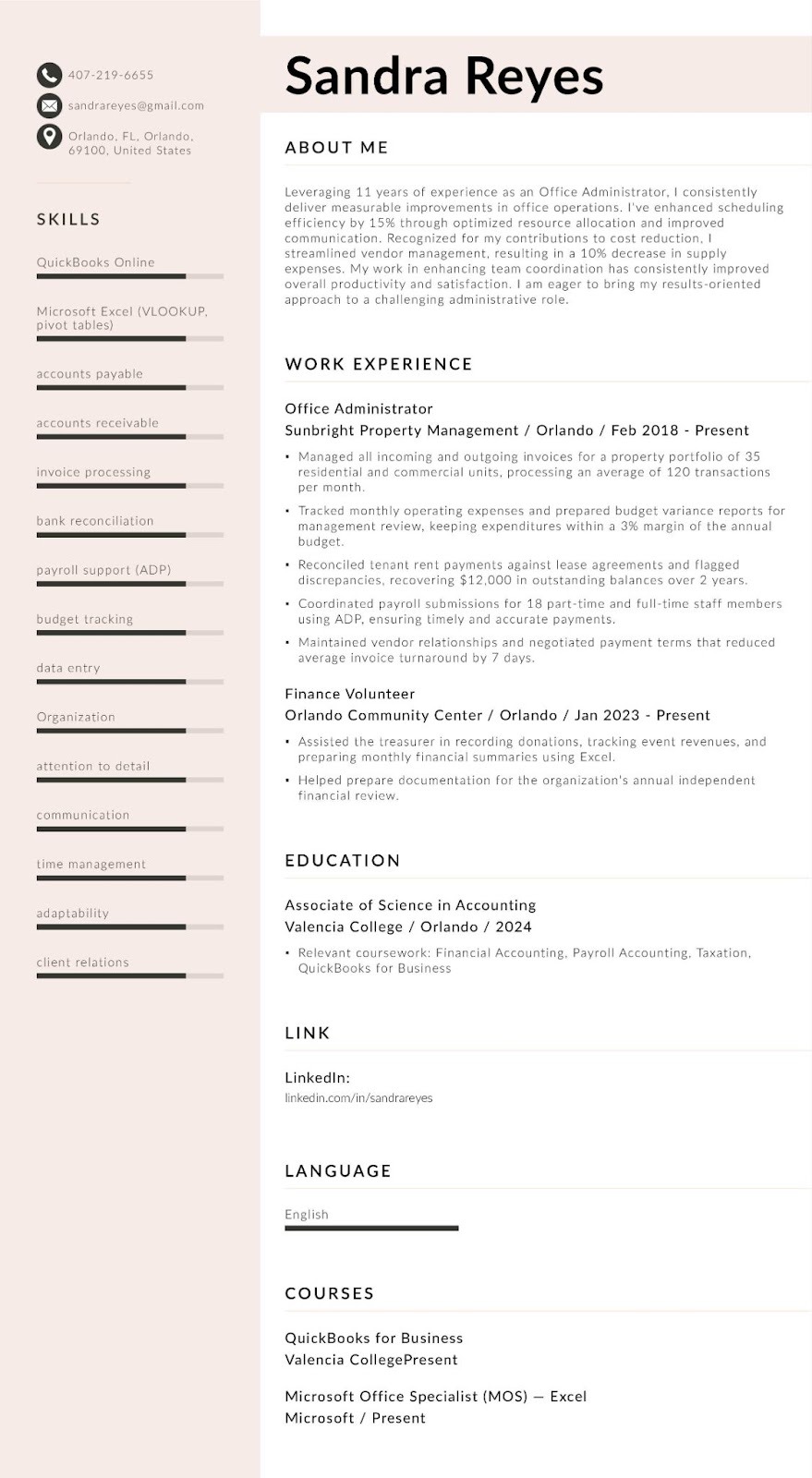
Reframe your past in accounting language. "Managed vendor invoices" and "reconciled payments" are accounting tasks even if your title was Office Manager or Admin. Translate your experience, don't hide it!
The objective statement is essential. You need one sentence that explains the transition clearly and confidently. Don't apologize for changing fields: frame it as deliberate: "6 years of financial recordkeeping experience, now formalizing it with an accounting degree."
A recent certification or degree is your strongest asset. It shows the transition is intentional, not opportunistic. Place it prominently: right after the objective, before work experience.
Highlight transferable wins with real numbers. "$12,000 in outstanding balances recovered" or "120 transactions processed monthly" prove you were already doing accounting work, just under a different job title.
Use a hybrid format. Open with a skills section that groups your accounting-relevant abilities together, then follow with your work history. This draws the recruiter's eye to what you can do before they see where you did it.
How to make an accounting assistant resume
Creating a resume is a skill that most job seekers struggle with, but this doesn't have to be the case. With a bit of guidance and a few tips, you can write a professional resume that gets you your dream job.
Consider going through the job description to find out what the recruiter is looking for. This allows you to tailor your resume accordingly, which is crucial if you want to increase your chances of landing the position. Ensure that your resume is one page long, as this is what most hiring managers recommend.
The job description will also have keywords and action verbs that you should incorporate in your resume to optimize it and ensure that it gets past the ATS systems. Check out our resume examples and get some tips to help create your resume.
Consider the layout, format, and structure of the resume.
Best format of a resume for accounting assistant role
There are three common formats that you can choose from. They include the following:
Reverse-chronological format: If you've worked as an accounting assistant before, this is the perfect format for you. It focuses on your experience and is easy to scan on the applicant tracking system.
Functional resume format: This format is perfect if you recently completed school or are changing careers. It focuses on the skills that make the candidate the best person for the job.
Hybrid/combination resume: This is the perfect format for you if you have the skills and experience required by the hiring manager. It combines the features of the two previous formats.
The layout of your resume should have easy-to-read fonts and a font size of 10-12pt. Some fonts you should consider include Cambria, Calibri, Times New Roman, Verdana, Georgia, and Arial.
The structure of your accounting assistant resume should have the following sections:
The header section
Professional summary/objective
Work experience
Education section
Skills section
An additional section (Languages, certifications, and interests)
What kind of header section for your accounting assistant resume
Beside making sure your contact and personal details are correct, you should prioritize only the most relevant information in your header. Leave out any details that the recruiter does not actually need.
Summarize your experience as Accounting Assistant
When presenting your experience as an Accounting Assistant, begin with your most recent role and focus on responsibilities that reflect the core functions of the position.
Highlight tasks such as supporting daily accounting operations, preparing and maintaining financial records, processing invoices and payments, reconciling accounts, financial reporting... Under each position, include 3 to 5 responsibilities using strong action verbs. Adding figures or measurable outcomes helps demonstrate the value of your contribution and gives recruiters a clearer view of your practical experience in the role.
If you don't have much experience, show the recruiter how your transferable skills from other jobs will be useful in the position.
Before/after example of a weak vs. strong bullet:
Weak:
"Helped with invoices and payments."
Strong:
Copy
"Processed and verified 80+ vendor invoices monthly, reducing payment errors by 15% through a double-check system."
Example for an entry-level accounting assistant
Copy
Baker Tilly International — Accounting Assistant | May 2014–December 2017
Managed payroll records and account books and entered data accurately in the accounting system.
Assisted the accounting team by preparing reports and reconciling balance sheet accounts every month.
Prepared and processed payroll for more than 30 employees hired by the month or the hour.
Example for an experienced accounting assistant
Copy
HLB International — Accounting manager | January 2015–May 2020
Ensured the company's legal compliance by keeping abreast of state and federal accounting procedures.
Assessed and reconciled general ledger accounts with senior accountants to ensure all entries were accurate.
Assessed the company's financial performance by analyzing financial documents and income statements and developed strategies that increased revenue by 12%.
Reinforce your resume with your accounting education
Accounting assistants can get a job with a high school diploma, which is the minimum requirement for most positions. However, if you have a bachelor's degree, you should add it here as it sets you apart from the other candidates.
Start with your most recent educational qualification and highlight the relevant courses, especially if you don't have much experience. Add the name of the degree/diploma, the name of the school, and the year of graduation.
It's always advisable to check the job description to determine the educational qualifications the recruiter is looking for and customize your resume accordingly.
If you are currently pursuing a degree or certification, list it as "In progress, expected [Year]". This shows ambition and forward momentum to recruiters.
Accounting assistant skills for your resume
When you have the right skills on your resume, you increase your chances of landing your dream job as an accounting assistant. Before you add the unique abilities that will help you perform your duties, check the job description and add the skills that the recruiter is looking for.
Separate the hard and soft skills in two sections and list them down using bullet points to make it easier to spot them on your resume.
You may need to go to school or learn on the job to perfect the hard skills. On the other hand, soft skills are the interpersonal traits you possess that make it easy to interact with your colleagues.
Here is a list of skills you can consider for your accounting assistant resume.
Hard skills
Business administration
Data entry
Record keeping
Account analysis
Financial reporting
Accounts receivable
Financial statement analysis
Payroll processing
QuickBooks
Microsoft Excel (pivot tables, VLOOKUP, macros)
Xero
SAP / Oracle (ERP systems)
GAAP compliance
Accounts payable (AP) / accounts receivable (AR)
Bank reconciliation
Tax preparation support
Soft skills
Excellent customer service
Creative problem solving
Multitasking skills
Communication
Critical thinking
Interpersonal skills
Teamwork
Analytical skills
Attention to detail
Time management
Discretion and confidentiality
Professional summary or profile in accounting assistant resume
A professional/resume summary is a crucial section of your resume. It gives the hiring manager an idea of what you've achieved by introducing your resume. Describe your top accomplishments and highlight your experience and skills. Remember to keep it short but make it engaging to interest the recruiter in wanting to know more about your qualifications.
CORRECT
Copy
Dedicated accounting assistant with five years of experience supporting all accounting projects through teamwork. Proven accuracy in recording data and processing bank reconciliations following company policies. Exceptional ability to proofread and identify errors to produce error-free accounting procedures and analysis reports reducing the resources lost annually by 20%.
INCORRECT
Accomplished Accounting Assistant capable of using initiative. Able to offer clerical support and assist with record keeping. Proven ability to keep accurate financial records.
Additional summary examples by experience level:
Entry-level:
Copy
"Detail-oriented accounting graduate with hands-on internship experience in accounts payable and data entry. Proficient in QuickBooks and Microsoft Excel. Eager to contribute accuracy and organizational skills to a fast-paced finance team."
Career changer:
Copy
"Administrative professional with 4 years of experience in financial recordkeeping and invoice processing, now transitioning into a dedicated accounting assistant role. Holds an Associate's Degree in Accounting (2023) and is QuickBooks certified."
Professional objective: How to use it in accounting assistant resume
A professional objective summarizes your career/professional goals and introduces your resume. It's suitable for career changers and recent graduates who don't have much accounting experience. It also allows you to express your interest in the position.
CORRECT
Copy
Professional accounting assistant with a proven history of accuracy in accounting and financial management. Committed to modernizing financial accounting and reports by keeping up with the latest accounting principles. Seeking a challenging accounting assistant position requiring mathematical skills and accuracy.
Additional sections for your accounting assistant resume
An additional section is crucial as it allows you to highlight your skills and extra qualifications. This is a great way to stand out, beat the competition, and ensure that the recruiter doesn't miss any of your qualifications.
Computer Skills and Certifications
Accounting assistants need to use accounting software and computer spreadsheets to update records and generate reports. If you have the required computer skills, add them here to ensure that the hiring manager sees them.
Certifications are essential if you want your resume to stand out. Some of the certifications that will help your accounting assistant resume stand out include:
Certified Management Accountant
International Accredited Business Accountant
Certified Public Accountant
QuickBooks Certified User (QBCU)
Microsoft Office Specialist (MOS) — Excel
Bookkeeper Certification (AIPB)
Certified Bookkeeper (CB)
Languages
Your language skills always help you stand out, as most hiring managers prefer bilingual candidates. Add them here to make it easy for the recruiter to see them and use the official language reference as follows:
Goethe Zertifikat for German
DELF for French
SIELE for Spanish
Interests
The interests depend on the culture of the company you're applying to. Do some research to determine if you should add this section or not.
Tips for improving resumes for accounting assistant position
Start your resume with a catchy resume summary/objective.
Check the job description and use the keywords and action verbs that will help your resume get past the ATS systems.
Create a resume that's one page long, as most hiring managers don't have time to go through long resumes.
Customize each resume and avoid using one resume for multiple applications.
Tailor each job title for every application you send to a recruiter.
Proofread the resume to avoid any errors that could cost you the position.
Save your resume as a PDF unless the job posting specifically requests a Word file — PDFs preserve formatting across all devices.
Use a file name like: Firstname-Lastname-Accounting-Assistant-Resume.pdf for a professional first impression.
Run your resume through a free ATS checker (e.g. Jobscan) before submitting to ensure keyword alignment with the job description.
Job market and salaries for accounting Assistants
According to the U.S Bureau of Statistics, the employment of accountants and auditors is projected to grow 6 percent from 2021 to 2031.
For the most current projection, the BLS Occupational Outlook Handbook (2023–2033 edition) projects 4% growth for accountants and auditors over the decade — steady demand driven by regulatory complexity and business expansion.
As of 2026, the average annual salary for an Accounting Assistant in the United States is around $46,000–$47,000, with hourly wages typically ranging from $21 to $23 per hour. Most professionals in this role earn between $37,000 and $57,000 per year, depending on factors such as experience, education, location, and the size of the organization. According to data from the U.S. Bureau of Labor Statistics, related positions like bookkeeping, accounting, and auditing clerks have a median annual wage of about $49,210, highlighting how salaries can increase with experience and specialized skills.
Key Takeaways
Detail your employment history in the experience section in a reverse-chronological manner.
Use figures or facts to show the recruiter what you can achieve.
Separate hard and soft skills.
Fix the salary expectation: accounting assistants typically earn $37,000–$65,000. Knowing your market value helps you negotiate confidently.
Always tailor your resume to each job posting: generic resumes are the #1 reason candidates get rejected by ATS.
Complement Your Resume with a Cover Letter
Your application should have a cover letter and a resume. A cover letter gives the recruiter more details on your qualifications but in a way that showcases your personality. This is a chance for you to create a personal connection with the recruiter, so make it interesting to get their attention. Check out the cover letter examples.
Frequently Asked Questions
Which industries need accounting assistants?
Finance
Healthcare
Retail
Manufacturing
Real estate
Non-profit organizations
Government and public sector
Which top companies are hiring accounting assistants?
According to Glassdoor, the companies hiring accounting assistants include: EY, PwC, Deloitte, Robert Half, CBRE, KPMG, BNY Mellon, State Street, Wells Fargo, JPMorgan Chase & Co.
What skills are most important for an accounting assistant?
Employers consistently rank these as top priorities: proficiency in QuickBooks or similar software, strong Excel skills, attention to detail, knowledge of GAAP, and the ability to handle confidential financial data responsibly.
Do I need a degree to become an accounting assistant?
A high school diploma is the minimum requirement for most entry-level positions. However, an Associate's or Bachelor's Degree in Accounting or Finance significantly increases your chances and earning potential. Certifications like the QuickBooks Certified User or AIPB Bookkeeper Certification can also substitute for formal education in some cases.
How do I write an accounting assistant resume with no experience?
Focus on your education, relevant coursework, and any internship or volunteer work. Highlight transferable skills from other jobs — data entry, customer service, administrative work — and use a functional or hybrid resume format. A strong objective statement that expresses enthusiasm and willingness to learn goes a long way.
Should I include a cover letter with my resume?
Yes. A cover letter significantly increases your chances of being noticed, especially for competitive roles. It allows you to explain your motivation, highlight one or two key achievements, and show your personality in a way a resume cannot.


 Weak:
Weak: Strong: