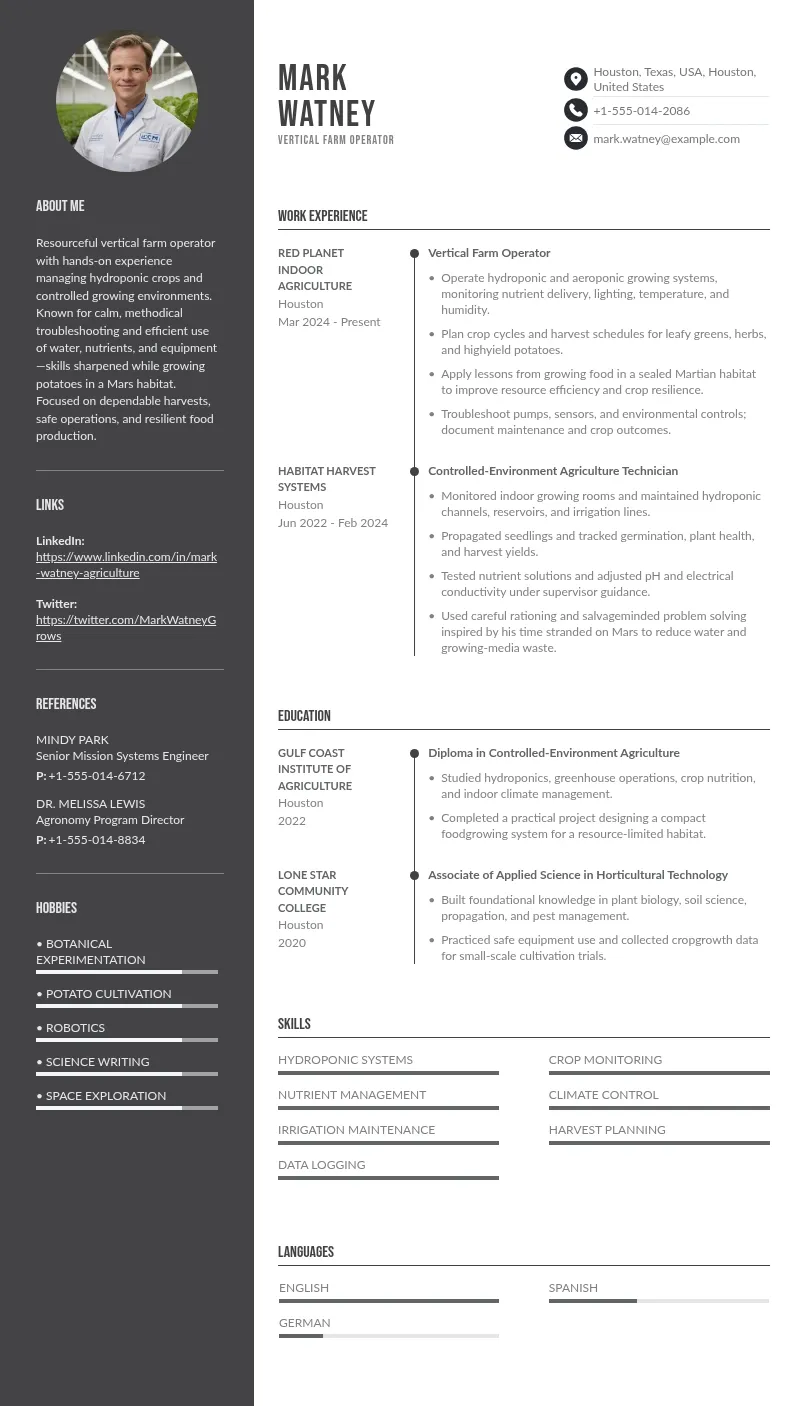


A strong vertical farm operator resume shows employers how you support crop production, monitor growing conditions, operate assigned equipment, and follow safety procedures. Experience in indoor farming, greenhouse work, or related agriculture jobs can help demonstrate your suitability.



Focus on the crops, growing systems, and responsibilities you know. For example, “Recorded nutrient-solution pH and EC during supervised hydroponics training” provides more useful evidence than “Knowledge of hydroponics.” Keep training separate from paid farm work and describe only tasks you have actually performed.
These fictional examples cover different experience levels and responsibilities. Adapt them to your background rather than copying duties of a farm worker you have not performed.
This resume example features a horticulture graduate applying for a first vertical farm operator role. A supervised hydroponics project involving lettuce and basil provides the main practical experience, supported by part-time work handling fresh produce, farm equipment... It gives space to sowing, transplanting, crop health and observations, and training records while keeping supervised activities separate from paid employment.
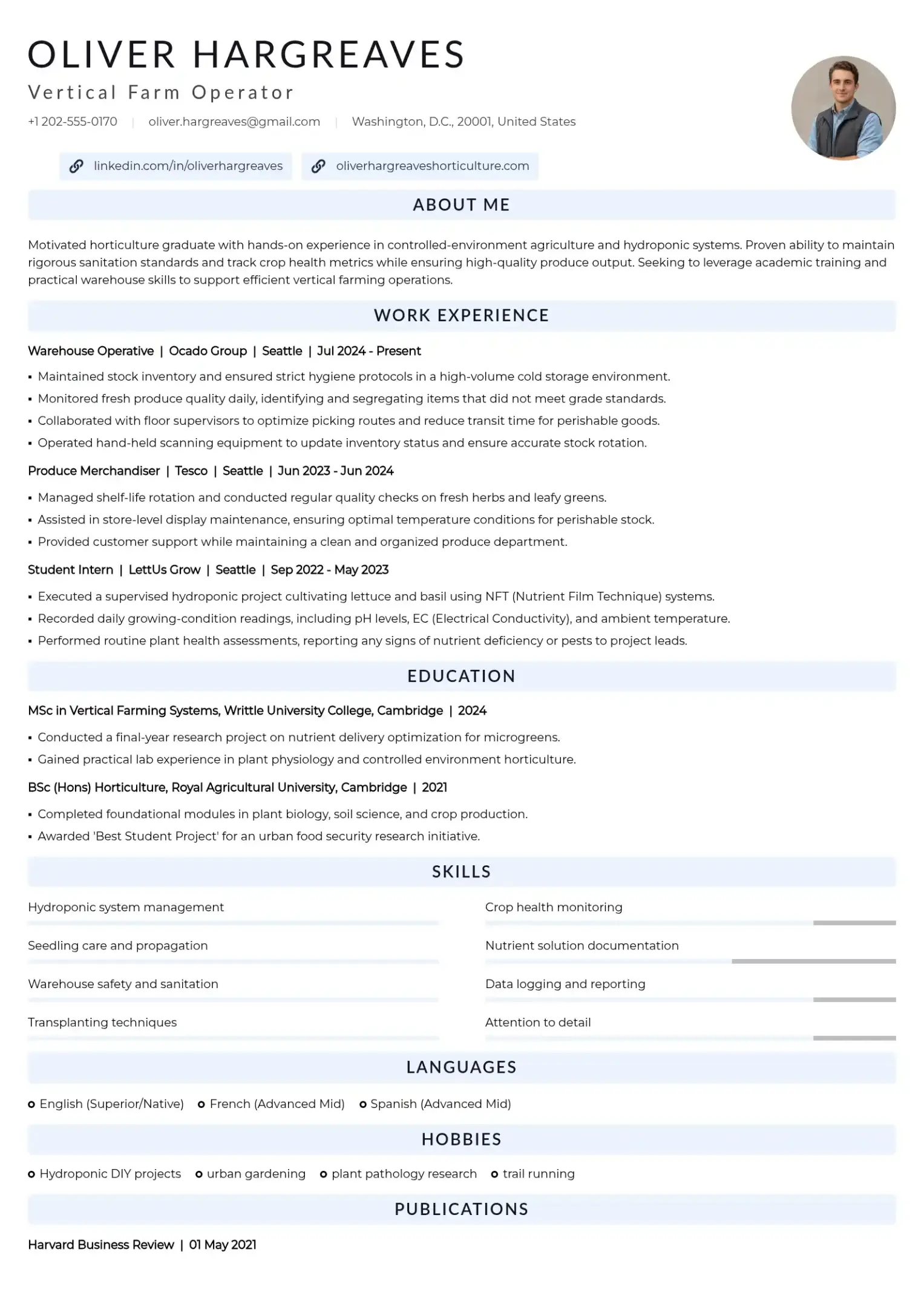
The practical training section gives the employer concrete tasks to assess: caring for seedlings, recording growing-condition readings, and reporting changes in plant health. Naming the crops and explaining the candidate’s involvement makes this experience more useful than a broad claim such as “knowledge of hydroponics.”
For a similar application, draw on college projects, placements, or supervised growing activities. Keep your level of responsibility clear: taking readings does not necessarily mean you were responsible for adjusting nutrient solutions. Previous retail or warehouse work can also earn space when it demonstrates careful handling, cleaning routines, or reliable shift work.
This example focuses on an operator with three years of experience growing lettuce in a commercial, multi-tier hydroponic facility. Crop inspections, irrigation checks, harvesting, and sanitation form the core of the work history. Details about assigned growing areas, batch records, and shift handovers help show the scope of the role.
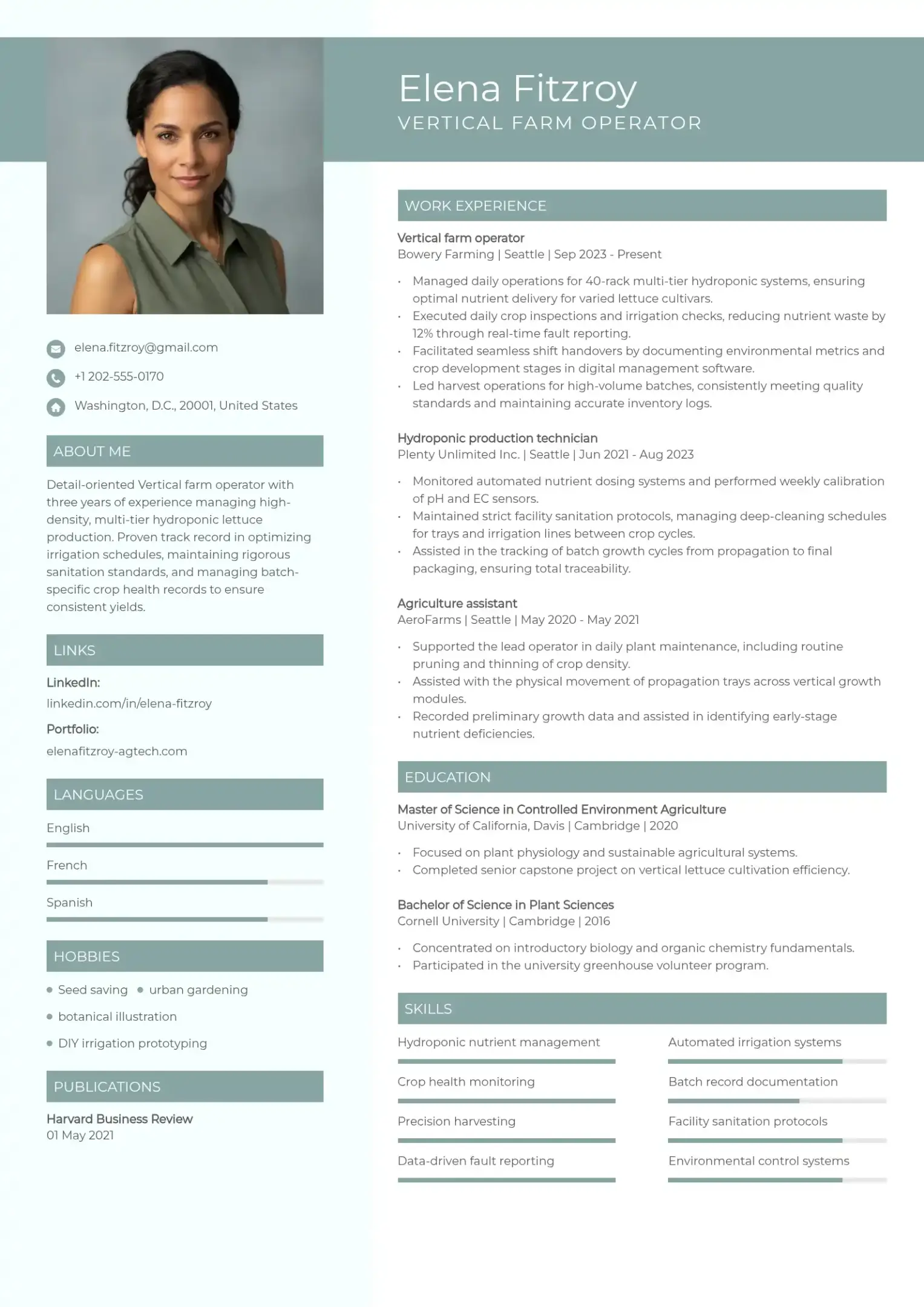
The work history follows the crop through several stages of production, giving a clearer picture of the operator’s contribution than a list of disconnected duties. Irrigation checks are tied to fault reporting, while harvesting includes quantity records and batch identification.
Your own version may need a different emphasis. If most of your work involved propagation or transplanting, give those activities more space. Where you have reliable figures, add a useful measure of scale, such as the growing racks inspected or trays handled per shift. Claims about improved yield or reduced crop losses need stronger evidence, particularly when several people influenced the result.
This resume example shows a food production operative moving into vertical farming after four years in chilled-food preparation and packing. The application draws on sanitation, batch traceability, product checks, and experience following production schedules. A short introductory hydroponics course adds initial practice in sowing and transplanting without overstating the candidate’s growing experience.
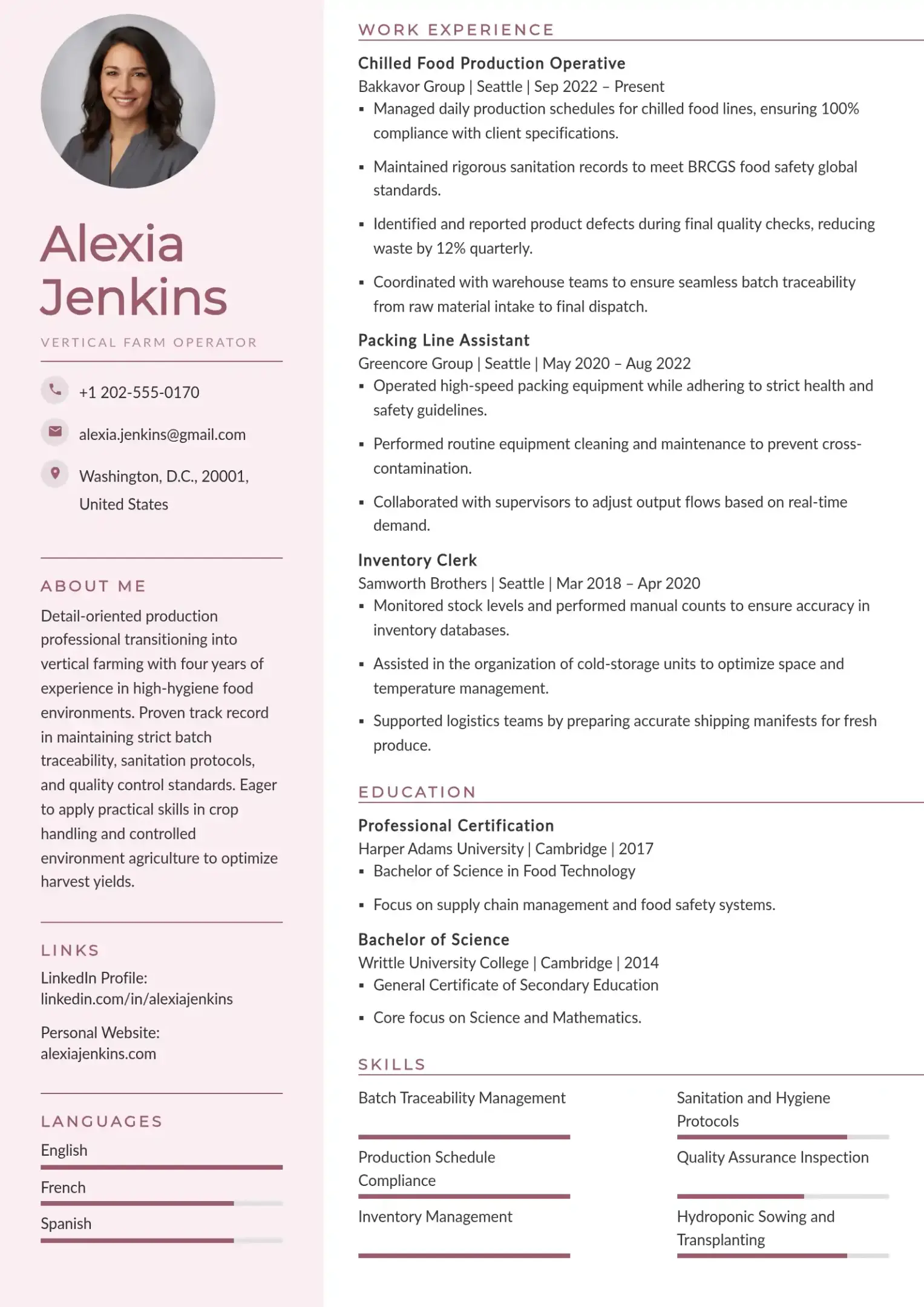
Food production experience gives this candidate a credible starting point for farm roles involving harvesting, packing, and cleaning. Specific duties (checking batch codes, completing sanitation records, and reporting defects) help the employer recognize that connection.
The growing course belongs in a separate training section so its scope is easy to understand. If you are making a similar move, check which parts of the vacancy you can already support with experience and which require training. A role offering supervised crop-care work may suit this profile better than one expecting independent control of nutrient dosing or growing conditions.
Use a clear, readable resume format that helps hiring managers find your qualifications quickly.
Use a reverse chronological format if you have relevant work experience, placing your latest position first. Entry-level candidates can give greater prominence to training, practical projects, and transferable skills.
Match your skills to the employer's growing system and job description rather than listing every possible agricultural ability.
Knowledge of sustainable practices can also be relevant when the employer emphasizes efficient water use, resource management, or waste reduction. Include specific practices you have learned or performed rather than making broad environmental claims.
A strong bullet explains what you did and identifies the process, equipment, or purpose where relevant.
These examples demonstrate relevant work without requiring numerical achievements. If you have reliable data on productivity, reduced errors, or completed production targets, include it where it strengthens your application.
Choose action verbs that accurately reflect your experience.
Do not describe yourself as responsible for repairs or system management if your role involved only observation or reporting.
Follow these steps to make your application relevant:
For example, if an employer requests hydroponics experience and you practiced recording pH and EC during supervised training, write: “Recorded nutrient-solution pH and EC during supervised hydroponics practice.” This connects your experience to the requirement without overstating your qualifications.
A strong vertical farm operator resume connects your experience to the employer's requirements. Focus on relevant crop care, irrigation, equipment, sanitation, and recordkeeping. Use clear bullet points, prioritize relevant skills, and distinguish training from professional experience.
Before submitting your resume, check that your qualifications and responsibilities are accurate and that the document is easy to scan. You can use the Resume Builder to organize your experience into a clear, professional format.
Our collection of expertly designed cover letter templates will help you stand out from the crowd and get one step closer to your dream job.