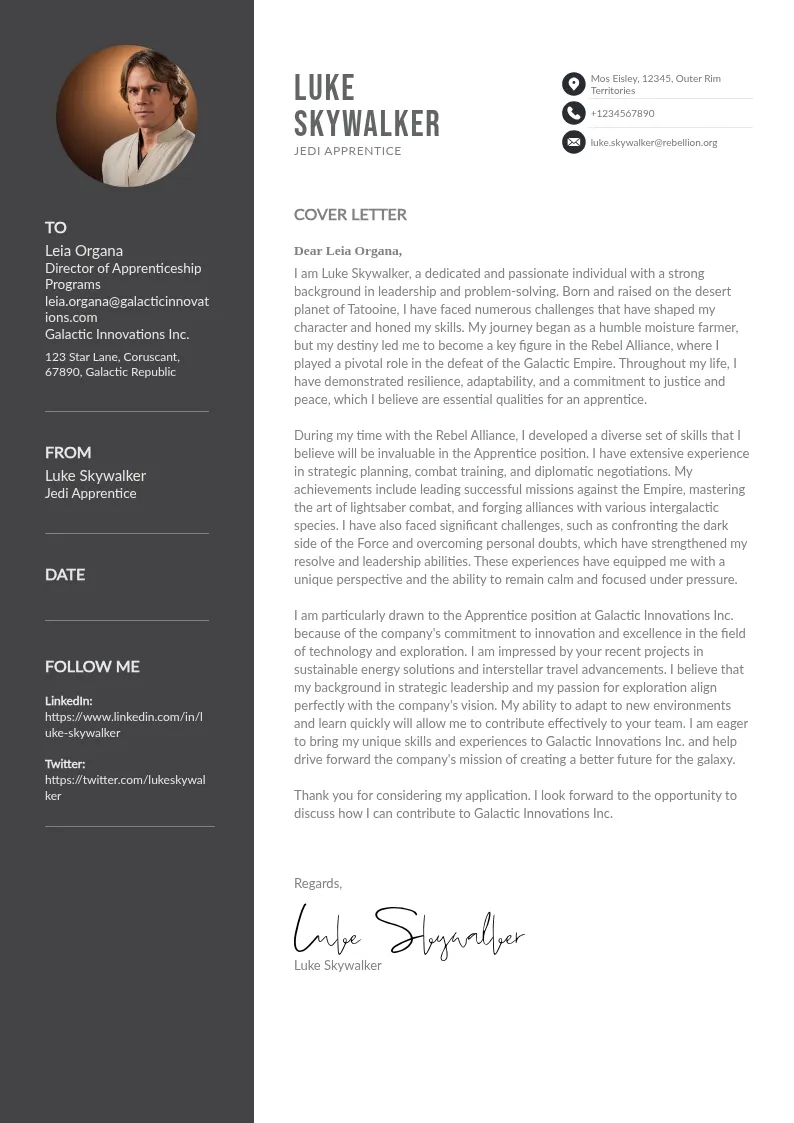
We’ve created this comprehensive guide to writing a French le modèle cover letter with plenty of examples tailored to different professions.
The article also includes:
- French cover letter styling guide to impress the native hiring managers.
- A step-by-step guide to writing each section of the cover letter.
- Pro tips to make your cover letter better than 95% of the other applications.
Here’s the good news. Our resume builder is capable of creating your French cover letter in less than 10 minutes – starting with a modern cover letter template that you could tailor to your requirement.
Meantime, let’s dive into writing the best version of your lettre de motivation.

How to Write a French Cover Letter
Writing a cover letter for a French hiring manager would have significant differences in the style and the content of the letter. French hiring managers always prefer well-structured formal letters.
As in any other region, a cover letter in France should demonstrate the applicant’s academic and professional background and their ability to meet the roles and responsibilities of the job.
Here’re some general guidelines for writing your cover letter:
- Keep your cover letter to a single page
- Avoid using too complicated words and long sentences
- Avoid being too salesy and self-promoting
- Keep your content to 3-4 short paragraphs
- Use conventional fonts such as Arial or Times
French cover letter structure
The content on a French cover letter is quite different from an American cover letter – especially the order in which the content is written.
Here’s the structure we recommend for a French-style cover letter:
- Header
- Subject
- Opening greeting
- First Paragraph: Introduction
- Second Paragraph: key skills and experience
- Third Paragraph: why you’re interested in the job/ company
- Fourth Paragraph: Call to Action (CTA)
- Complimentary close
Now, let’s break down how to write your cover letter step by step.
Start with the Header
French recruiters consider your cover letter as a formal letter – therefore, start your header with the information of the sender (the applicant) and the receiver (the hiring manager) – the same way you start any formal letter.
Sender Information
Start with your name followed by the position you’re applying for. Put your contact information including your personal e-mail address, telephone number, and the physical address (only if applicable). Put the date on which you’re writing the letter.
Receiver Information
Put the name of the hiring manager or the person who reads your application – their position – company name – and the address.
You won’t find out details about the recruiters on some occasions – then, use the company name and the address.
However, if the company has posted the job advertisement on LinkedIn, you’ll probably be able to find the hiring manager’s information. Addressing the hiring manager by their name is a great way to show that you have done your research.
Put the Letter’s Subject
As in any formal letter, you should write the subject of your cover letter. In this case, the subject should be the job and the position you’re applying for.
 Examples
Lettre de motivation pour le poste de responsable de l'ingénierie
Lettre de motivation pour le poste d'assistant administratif
Lettre de motivation pour le poste de comptable financier
Opening Greeting
We recommend using a formal French greeting in your letter. Address the reader with Madame or Monsieur without mentioning their name again. When you are unsure of the gender of the person you address, use both.
ExampleRefer to this article for more greeting styles and important French resume phrases.
Paragraph 01: Start by Introducing Yourself
In American-style cover letters, the first paragraph is often a sales pitch to the hiring manager explaining the key achievements and accomplishments of the candidate.
French recruitment practices are a little different – the job market is academic-focused, whereas your degree has more value than your achievements in a previous job. If your degree matches the job requirements set by the employer, you’ll have a great chance of getting an interview.
Therefore, highlight the relevant educational background in the first paragraph itself – give a brief introduction to your academic and professional experience – show that you have the basic qualifications listed on the job description.
See the following example first paragraph for a store manager position.
CORRECTRichtiges Beispiel
Nach meinem Bachelor-Abschluss in Marketing an der University of Massachusetts in Boston, den ich mit Auszeichnung bestanden habe, absolvierte ich einen Zertifikatskurs für fortgeschrittene Einzelhandelsoperationen an der Eastern Finland University, der es mir ermöglichte, bei Carrefour in Paris als Filialleiter zu arbeiten.
 INCORRECT
Falsches Beispiel
Ich habe 2015 meinen Bachelor-Abschluss in Marketing gemacht und 2019 meinen Master abgeschlossen. Danach habe ich bei der Supermarktkette Carrefour als Betriebsleiter in einer ihrer Filialen angefangen.
Be specific about your academic qualifications – state the name of the degree, the year you graduated, and the university or institution name.
If you possess a couple of key technical skills required to perform the job duties, you could mention them in the first paragraph.
Paragraph 02: Key Experience that Makes You the Best
Demonstrate your key experience and skills relevant to the job in the second paragraph. In this, you do not have to limit yourself to your most recent work experience – instead, pick the right information from your career and compose them into a couple of sentences.
Always focus on putting the most demanding skills for the job. Read the job posting and find out the objectives of the employer in making this hire – address those issues and show them how your expertise could help solve those problems.
Use this space to showcase one or two of your greatest and most relevant achievements – add numbers to demonstrate the impact of your decisions on key business metrics such as profit, sales, annual target, employee turnover, customer satisfaction, etc.
light your skills and expertise without overdoing it. French hiring managers hate to see job candidates trying to oversell them on their cover letters. In fact, they expect raw facts on the cover letter instead of boasting about the brilliance of the candidate.
CORRECTRichtiges Beispiel
Bei meiner früheren Tätigkeit bei Carrefour in Paris war ich an der Durchführung von Marketing- und Werbekampagnen in den einzelnen Filialen beteiligt, habe Kundenanfragen und Beschwerden bearbeitet und Strategien zur Steigerung der Produktivität der Mitarbeiter entwickelt. Meine Vorschläge zum bestehenden Ladenplan haben dem Geschäft geholfen, seinen Umsatz im Jahr 2021 um 6 % zu steigern.
INCORRECTFalsches Beispiel
Bei Carrefour habe ich vor allem Erfahrungen in der Kundenbetreuung und im Einzelhandel gesammelt. Ich war auch an der Planung von Marketingkampagnen für besondere Anlässe beteiligt.
Paragraph 03: Express Your Interest in Joining the Firm
Though you’re sending your CV to multiple employers, you can’t send your cover letter to two different vacancies – the cover letter addresses the particular employer, the job, and the industry.
One of the main objectives of your cover letter is to convey your interest in the firm and the position – this is especially important for the candidates who are applying for their first jobs and for those who are in career transitions.
Research about the industry, the company, and the job you’re applying for, and establish what makes you interested in applying for the position. Employers love to hire candidates who have a genuine passion for the job.
Talk about the company’s mission, vision, purpose, or the strategies they used and align them with your personal career objectives.
CORRECTRichtiges Beispiel
Als leidenschaftlicher Einzelhandelskaufmann und Logistiker möchte ich mein Interesse bekunden, das Carrefour-Team bei seiner Mission zu unterstützen, ein großartiges Kundenerlebnis zu schaffen.
INCORRECTFalsches Beispiel
Ich möchte mich dem Carrefour-Team anschließen, um meine Karriere im Einzelhandel in einer gut bezahlten Position als Leiter eines etablierten Geschäfts in Paris auszubauen.
Paragraph 04: Finish with a Call to Action (CTA)
In your last paragraph, you should tell the hiring manager what to do next – the Call to Action.
This does not mean that your hiring manager doesn't know what to do next – but, you should know what to expect. In most cases, there will be a couple of interviews in the hiring process. French recruiters often call the shortlisted candidates for formal interviews instead of informal chats or meetings.
By stating your CTA, you should manifest your interest and readiness to meet them and talk about the specifics.
CORRECTRichtiges Beispiel
Es wird mir ein Vergnügen sein, mit Ihnen über meine Rolle als Filialleiter in Ihrer neuen Filiale zu sprechen und Ihnen zu zeigen, wie meine bisherigen Erfahrungen problemlos in Ihr Projekt einfließen können, um einen größeren Erfolg zu erzielen.
INCORRECTFalsches Beispiel
Ich freue mich darauf, bald von Ihnen zu hören
The French Cover Letter Closing
End your cover letter with a salutation. Be respectful and use a standard closing statement as in a formal letter.

How to Finish Your Letter?
Consider using the following closing sentences based on the situation.
- Yours faithfully: Veuillez agréer mes l'expression de mes salutations distinguées
- Yours sincerely: Salutations distinguées
- Respectfully yours: Veuillez agréer l'expression de mes sentiments respectueux
All above salutations are used in formal conditions while “Yours Faithfully” is used when the recipient's name is not known.
INCORRECTTips to Improve Your Cover Letter in French
Take your French cover letter to the next level using these tips:
- Get your French cover letter proofread by a native French speaker.
- Find out who reads your cover letter so that you can personalize it with their name.
- Identify the most troubling questions your potential employer faces and address them in your cover letter.
- Keep the French cover letter formal all the time.
- Consider using a modern cover letter template to make your application stand out.
- For consistency, use the same or similar template for the CV and the cover letter.
Key Points: Writing a Perfect French Cover Letter
- Follow the time-tested cover letter structure we recommended.
- Avoid casual and informal language – maintain a formal and respectful tone throughout.
- Tailor your cover letter to the firm, job, and the industry you’re applying for.
- Use 3 to 4 short paragraphs with clear objectives.
- Include a CTA.
- Showcase your excitement for the job throughout the letter.
Complement Your Cover Letter with the Right Resume
A French resume is a one or two page comprehensive document highlighting the candidate’s education, previous experience, and skills.
The resume is a part of every job application. You can send your resume without a cover letter, but not the other way around.
The resume draws an overall picture of the candidate while the cover letter addresses a specific job or an employer.