You've pulled off flawless corporate conferences, dreamy weddings, and charity galas that had guests talking for weeks. But right now, the hardest event you're planning is your own career move. If your resume isn't doing your experience justice, that stops here.


SARAH MITCHELL
Senior Event Manager
London, UK | sarah.mitchell@email.com | +44 7700 900 142 | linkedin.com/in/sarahmitchell | sarahmitchell-events.com
Professional Summary
Results-driven Event Manager with 8+ years of experience delivering high-profile corporate conferences, luxury private events, and large-scale charity galas across the UK and Europe. Proven track record managing budgets up to £300,000, leading cross-functional teams of 20+, and consistently achieving client satisfaction scores above 90%. Recognised for creative event concepts, rigorous logistics management, and the ability to stay calm — and keep teams calm — when things don't go to plan.
Portfolio
View selected event photography, client testimonials, budget summaries, and creative concepts at: sarahmitchell-events.com/portfolio
Professional Experience
Senior Event Manager | Pinnacle Events Agency, London | Mar 2019 – Present
Event Manager | Bright Occasions, Manchester | Jun 2016 – Feb 2019
Junior Event Coordinator | The Events Collective, Birmingham | Sep 2014 – May 2016
Key Skills
Event planning & end-to-end execution | Budget management & cost control | Vendor negotiation & supplier coordination | Logistics & on-site operations | Venue sourcing & selection | Stakeholder & client management | Team leadership & mentoring | Event technology (Cvent, Eventbrite, Asana, Trello) | Creative concept development | Post-event reporting & analysis
Certifications
Education
BA (Hons) Events Management — Manchester Metropolitan University | 2011–2014
This guide skips the generic formatting advice. Instead, you'll get real-world examples, action-packed bullet points, and proven strategies to write an event manager resume that gets interviews.
Whether you're chasing your first event manager role or moving up to a senior position, this is your playbook.
Your resume is your first “event”. In the event management universe, first impressions really matter. Recruiters don’t just want to know you’ve planned events. They need to see what kind of events, for how many people, how complex they were, and what measurable impact you delivered.
Whether you’ve coordinated a 5,000‑guest corporate gala, a multi‑day conference, or an intimate luxury wedding, your summary has to capture that scope, creativity, and execution skill, very fast. A generic opener won’t cut it.
 Don't do this:
 Do this instead:
See the difference? The second version is specific, metric-driven, and immediately positions you as someone who delivers.
Quick tips for your summary:
This is where most event manager resumes fall flat… and where yours can pull ahead. Your experience section is where you show you actually deliver, not just list what your job was supposed to be. Most Event Manager CVs read like recycled job descriptions: “Managed events, coordinated vendors, supervised staff.” and so on. Every other candidate says the same.
But there’s no mystery: just skip the generic duty list, as this is where your achievements live. Focus on what changed because of your work: smoother logistics, bigger attendance, happier clients, tighter budgets, or creative solutions that wowed stakeholders.
Here's a strong example:
Event Manager | ABC Events, New York, USA | Jan 2020 – Present
The formula behind every great bullet point:
Think your resume lands on a human desk first? Not quite. In today’s hiring process, the ATS is your first audience, and it’s looking for proof that you can run events, manage vendors, and deliver results.
Why is this especially important for event planning roles? Because event management is multi-dimensional. One day you’re juggling budgets, the next coordinating vendors, the next leading teams on-site. ATS software doesn’t know context: it only sees keywords that match the job posting.
That means your resume needs to speak the language of both machines and humans. Highlight the full spectrum of your event skills: project management, vendor negotiation, budget control, logistics, client communications… but tailor it to the role you’re applying for. Miss the keywords, and your perfectly executed $250K gala never gets seen.
Here’s what to make your resume get past the robots and lands in front of real eyes:
Hard skills to include:
Soft skills that matter:
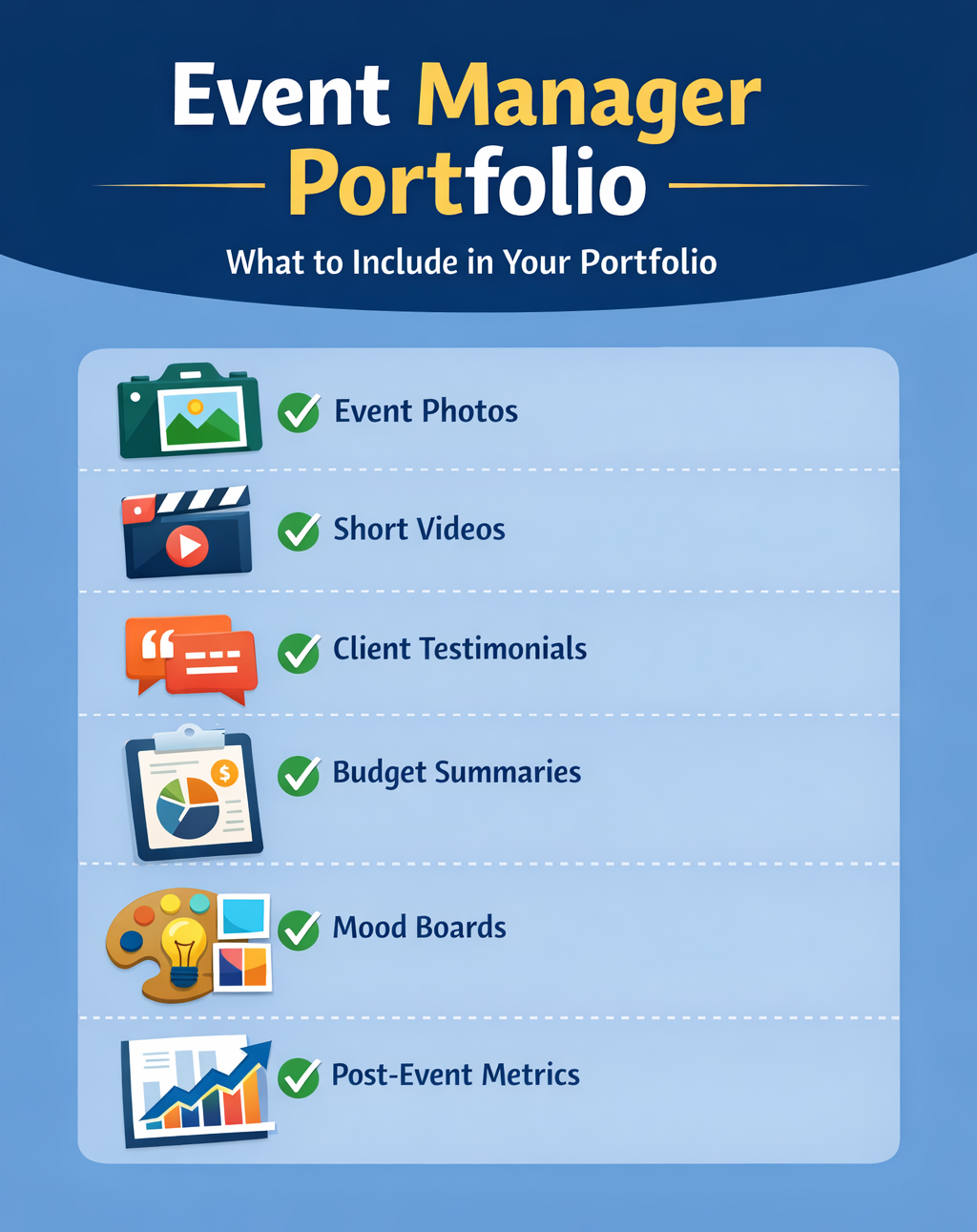
In most industries, a resume alone can carry your application. In event management, it rarely tells the full story. Your work is visual, experiential, and deeply contextual… a bullet point saying you "coordinated a gala for 500 guests" lands very differently when a hiring manager can actually see the room you transformed, the layout you designed, or the post-event feedback scores you earned.
A portfolio bridges that gap. It gives recruiters and clients tangible proof of your creative vision, your organisational capability, and your ability to deliver under pressure. Yet the majority of event managers skip this step entirely. Don't be one of them.
The event management industry has become highly professionalized. Today, certifications aren’t optional, as they prove you understand industry standards, best practices, and strategic event delivery, not just logistics.
For senior or management roles in particular, recognized credentials can be the tiebreaker between equally experienced candidates, while also signaling your commitment to the craft and ongoing professional growth.
Worth highlighting:
Even if you're mid-career, a recent course shows you're actively developing your skills.
Writing strong bullet points from scratch is one of the hardest parts of building any resume. And for event managers, it's especially tricky because the work looks so different depending on the type of events you run. The tone, scale, and priorities of a corporate conference are worlds apart from a charity gala or a luxury wedding, even if the underlying skills are the same.
The examples below are designed to give you a solid starting point for each context. Treat them as a framework: plug in your real numbers, swap in your specific achievements, and make them yours.
Corporate Events:
Weddings & Private Events:
Community & Charity Events:
A strong event background won't save a weak resume. Some of the most experienced event managers get passed over simply because their CV undersells them. Not because of what they've done, but because of how they've presented it.
These mistakes are more common than you'd think, and they tend to cluster around the same patterns: too much description, not enough proof, and a one-size-fits-all approach to every application. Fortunately, they're all fixable once you know what to look for.
Your resume deserves rigour. This checklist covers every element that makes the difference between a CV that gets filed away and one that gets you in the room:
Our collection of expertly designed cover letter templates will help you stand out from the crowd and get one step closer to your dream job.