Tips for Writing an Effective CMM Programmer Resume: Examples Included
cta

Tips for Writing an Effective CMM Programmer Resume: Examples Included

If you know how to program precision measurement equipment, interpret complex GD&T drawings, analyse part data, and verify manufacturing quality to the micron, it’s time to show those skills off on paper. A well-crafted CMM programmer resume can open doors to aerospace plants, automotive production lines, medical-device manufacturers, and top-tier engineering firms.

In this article, we’ll show you how to write a CMM programmer resume that gets noticed. You’ll learn the best format, how to highlight your technical and inspection skills, and how to make your experience stand out. Real examples are included for inspiration.

Last update:
6/1/2026

Best Resume Examples in This Guide

No items found.
Resume 1
Resume 1
Resume 2
Resume 3
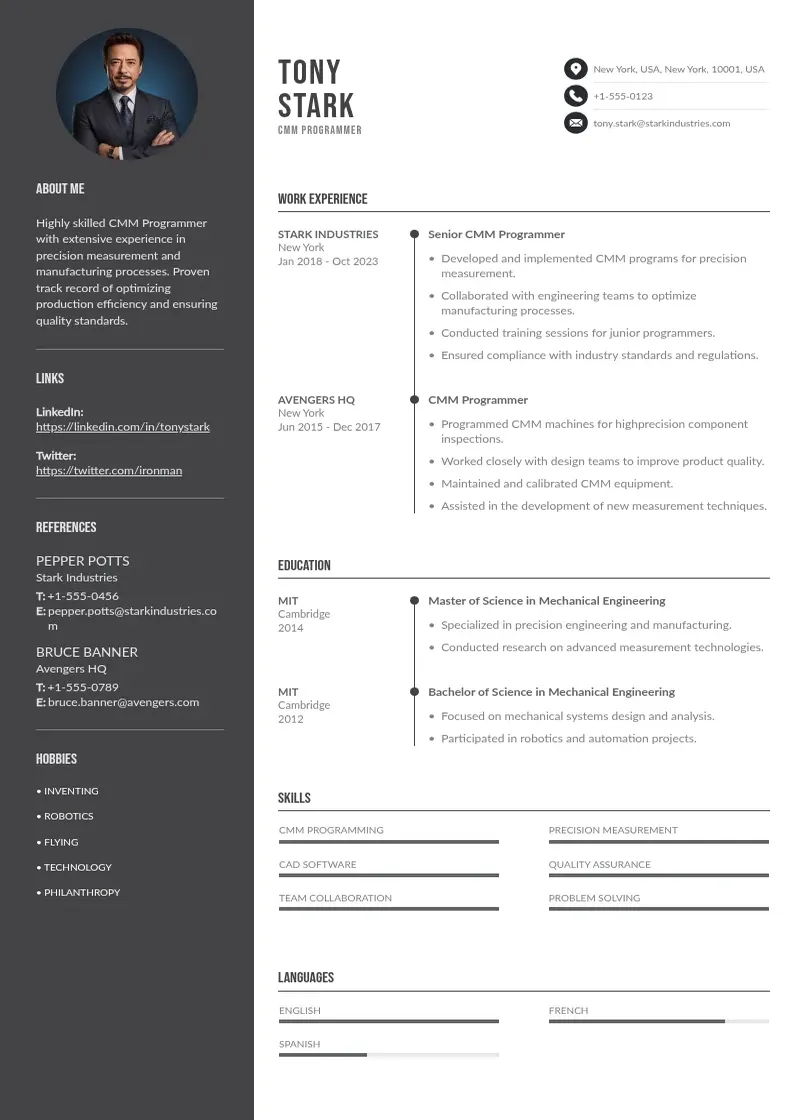
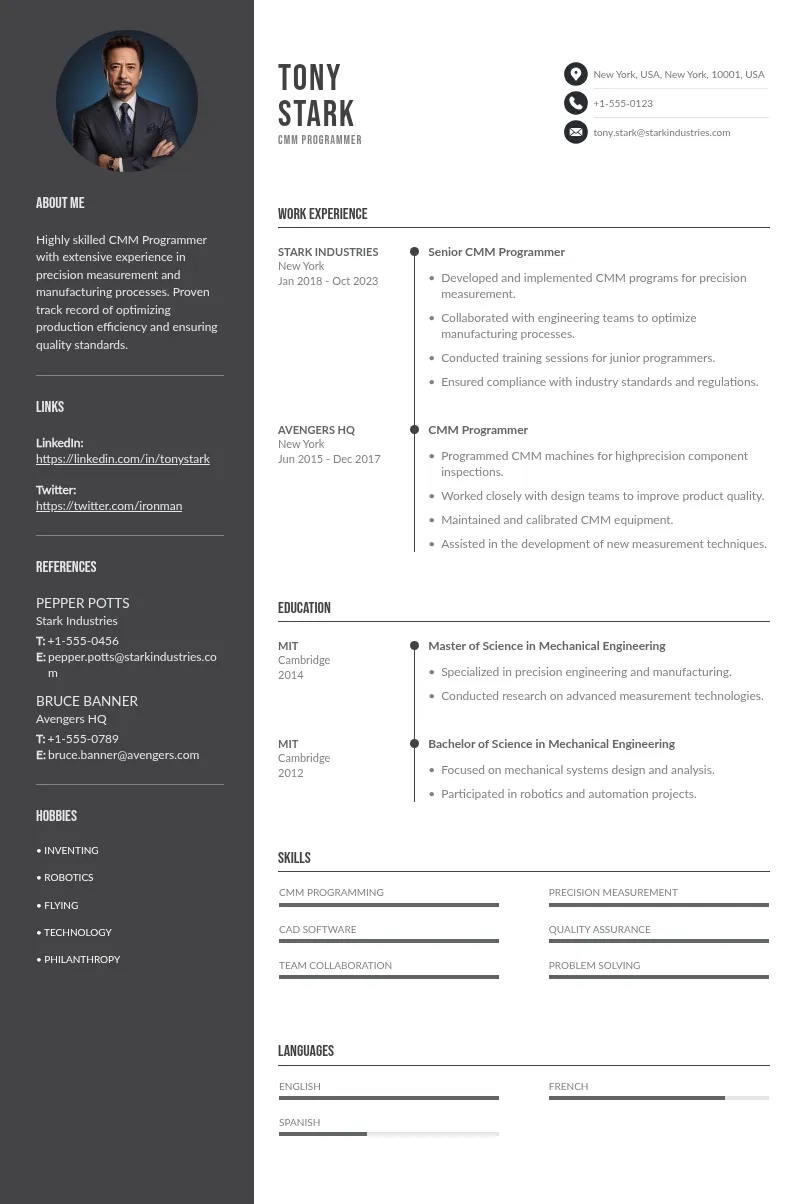
two column cmm-programmer-resume resume example
Budapest
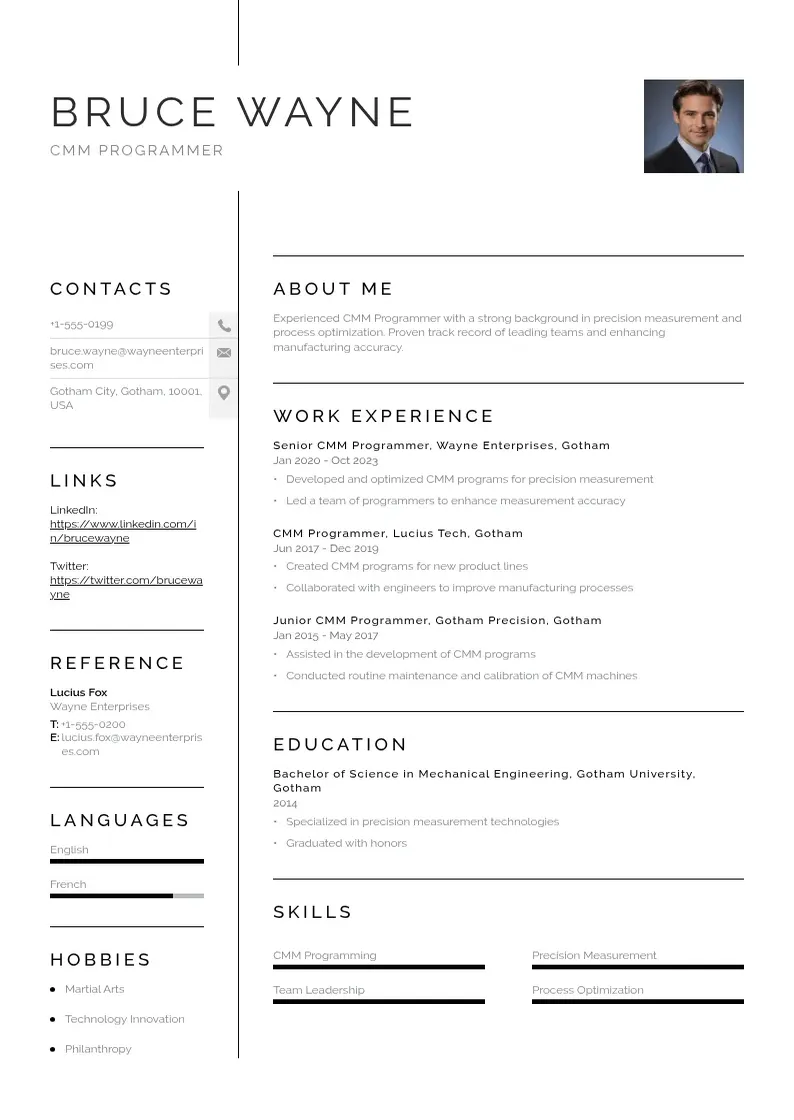
professional Cmm programmer resume resume template
Perth
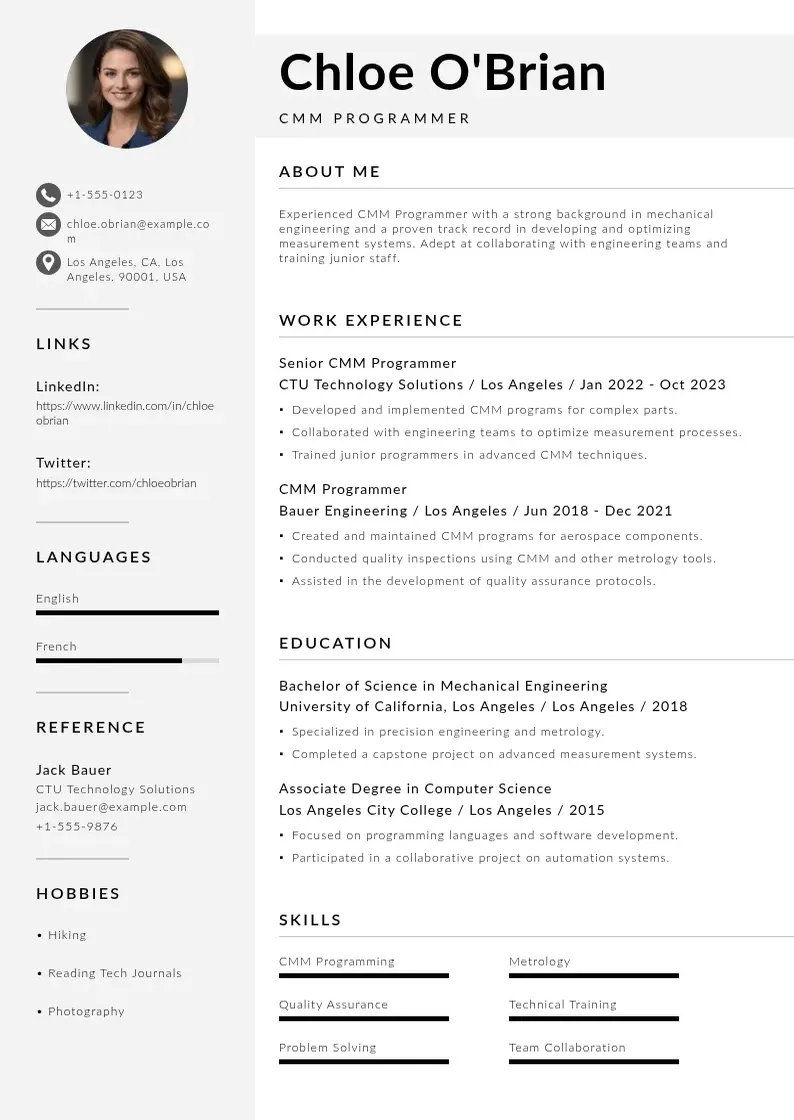
modern Cmm programmer resume resume template
Rotterdam
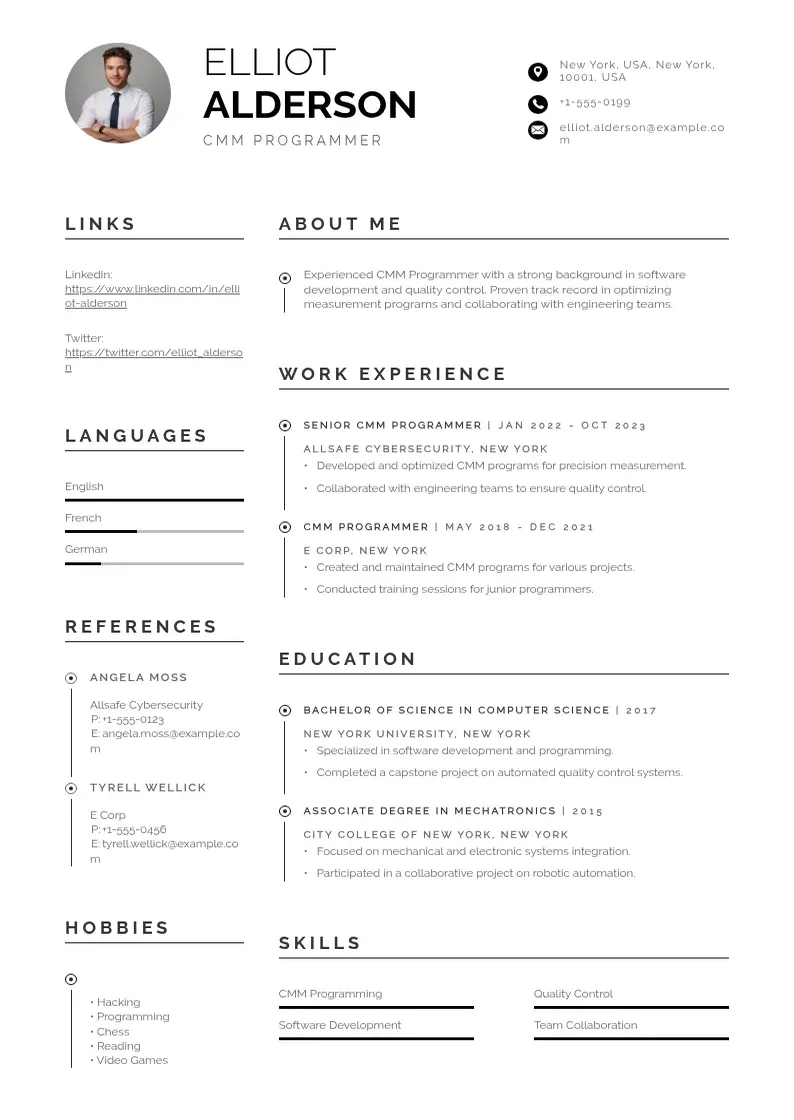
simple Cmm programmer resume resume example
Chicago

Resume Guide
Content Score
of your resume
Get My Resume Score

Tips for Writing a Standout CMM Programmer Resume


When writing your resume, the goal is to combine technical precision with clear storytelling. Here are practical, real-world tips to help you craft a resume that makes an impact:


1. Start With a Strong Professional Summary

Your CV summary is the first thing hiring managers see, and it needs to really pack a punch. In 3 to 4 sentences, describe your years of experience, your areas of technical expertise, and the measurable results you’ve achieved.

Example Summary:
“Detail-oriented CMM Programmer with 6 years of experience in aerospace and precision manufacturing environments. Skilled in PC-DMIS and Calypso programming, fixture design, and complex GD&T interpretation. Known for reducing inspection cycle time by 25% through optimised measurement routines and data automation.”

Tip: Avoid vague traits like “team player” or “hard worker.” Instead, focus on measurable results and specific technologies you’ve mastered.

2. Highlight Your Technical and Inspection Experience

List your roles in reverse-chronological order, including your job title, employer, location, and dates of employment.

Under each position, use bullet points to describe your technical contributions and measurable results. And remember to always show what impact your work had.

Example:
  • Developed and validated CMM programs in PC-DMIS and Calypso for complex aerospace components, reducing inspection time per part by 18%.
  • Created and maintained CAD-based inspection routines to ensure first-article quality verification and ISO 9001 compliance.
  • Collaborated with manufacturing engineers to optimise tolerance stacks, improving first-pass yield by 12%.

Tip: Start bullet points with strong action verbs like programmed, validated, inspected, optimised, analysed, and calibrated.

3. Include a Detailed Education and Certification Section

Even if you’ve been programming for years, your formal qualifications still matter. Start with your highest degree, then add relevant certifications, courses, or manufacturer-specific training.

Example:
  • Associate Degree in Mechanical Engineering Technology – Central Technical College, 2016
  • Certified CMM Programmer – Hexagon Manufacturing Intelligence, 2018
  • PC-DMIS Advanced Programming Certificate – Hexagon, 2021
  • GD&T Professional Certification (ASME Y14.5) – Issued 2022

Tip: Include training or certifications in CAD, quality systems, or metrology. Employers love seeing continuous learning in this field.

4. Add a Section for Project or Process Improvement Experience

Many top CMM programmers stand out because they contribute to larger process improvements — not just inspection results. Create a short “Project Experience” or “Process Optimisation” section to highlight these contributions.

Example Project Entry:
  • Led the implementation of automated CMM inspection for turbine blade geometry, cutting manual verification time by 40%.
  • Developed a standardised inspection template used across three production lines, improving reporting consistency.
  • Collaborated with the Quality Engineering team to integrate SPC data collection into PC-DMIS reports, enhancing traceability.

Tip: Use numbers whenever possible. Quantify the results such as time saved, error reduction percentages, yield improvements, or throughput increases.

5. List Your Technical and Soft Skills Clearly

Your “Skills” section helps recruiters instantly recognise your core competencies. Divide them into Technical Skills and Interpersonal or Operational Skills for clarity.

Technical Skills:

  • CMM Programming (PC-DMIS, Calypso, MODUS, MCOSMOS)
  • GD&T Interpretation (ASME Y14.5)
  • CAD Model Integration (CATIA, SolidWorks, NX)
  • Metrology Equipment Calibration
  • Fixture Design & Validation
  • Statistical Process Control (SPC) & Minitab
  • ISO 9001 / AS9100 Quality Standards
  • Measurement System Analysis (MSA, Gage R&R)
  • Interpreting engineering drawings

Interpersonal/Operational Skills:

  • Cross-functional collaboration between teams
  • Root cause analysis and problem-solving
  • Continuous process improvement
  • Training and mentoring junior inspectors
  • Documentation accuracy
Tip: Keep skills relevant. Don’t clutter the section with general computer abilities. Rather, focus on what truly defines you as a metrology expert.

Applying for programmer jobs and want your CV to stand out? Use our free Resume Builder to create a polished, professional CV that lands interviews faster.

6. Use a Professional and Easy-to-Read Resume Format

Use a clean, readable font like Calibri or Arial (size 10–12). Keep consistent headings and bullet formatting.

Avoid using text boxes, images, or graphics. Applicant Tracking Systems (ATS) can’t interpret them properly. Stick to a simple, structured layout with clear spacing.

A two-page resume is acceptable for experienced programmers, as long as every section adds value. Entry-level professionals should aim for one concise page.

Tip: Save your resume as a PDF to maintain formatting when sending to employers or uploading to job portals.

7. Add Optional Sections to Show Growth to Hiring Managers

Optional sections can help you stand out, especially if they show a commitment to precision engineering or innovation.

Professional Development:

  • Attended Hexagon Live 2024 Conference: Sessions on “Smart Factory Integration” and “Digital Metrology Solutions.”
  • Completed internal training on “Advanced GD&T Applications for Aerospace Components,” 2023.

Awards & Recognition:

  • “Quality Excellence Award,” Precision Components Inc., 2022.
  • Recognised for “Zero NCRs in Aerospace Inspection Audits,” 2021.

Professional Memberships:

  • Member, Coordinate Metrology Society (CMS)
  • Member, American Society for Quality (ASQ)
Tip: Keep these sections brief and professional. They should strengthen your technical profile, not overwhelm it.

8. Tailor Your Resume for Each Job Application

Every CMM programmer role is different. Some focus on aerospace precision parts, others on automotive mass production or medical-device prototyping.

Before sending your resume, scan the job description for keywords like “PC-DMIS,” “Zeiss Calypso,” “AS9100,” “GD&T,” or “FARO Arm.” Then naturally integrate those terms into your summary, skills, and experience sections.

Tip: You don’t need to rewrite everything for each job. Just adjust the emphasis to match what the employer values most.

CMM Programmer Resume Examples


Example 1: Senior CMM Programmer in Aerospace Manufacturing

Copy

Name: James Bennett

Phone: (555) 123-4567

Email: james.bennett.cmm@example.com

Location: Wichita, KS

Professional Summary:

CMM Programmer with 9 years of experience in aerospace component inspection and dimensional analysis. Expert in PC-DMIS, Calypso, and CATIA integration. Proven track record of reducing inspection time by 22% by implementing standardised routines and automated report generation.

Professional Experience:

Senior CMM Programmer – AeroTech Precision Manufacturing | Wichita, KS | 2018–Present

  • Developed and maintained more than 250 CMM programs for aerospace parts within AS9100 quality frameworks.
  • Validated fixture designs and optimised probe paths, reducing measurement errors by 15%.
  • Collaborated with engineering and production teams to correct tolerance stack-ups, improving part conformance rates.
  • Trained five CMM operators and implemented best practices for manufacturing processes, calibration and verification.

CMM Operation Programmer – Delta Components | Tulsa, OK | 2015–2018

  • Programmed and executed measurement routines using Zeiss Calypso and Faro Arm systems.
  • Designed automated inspection templates that reduced operator setup time by 30%.
  • Performed GR&R studies and contributed to PPAP documentation.

Education:

Associate Degree in Mechanical Engineering Technology – Tulsa Tech, 2015

Certified CMM Programmer – Hexagon, 2017

ASQ Certified Quality Technician (CQT), 2019

Skills:

PC-DMIS | Calypso | GD&T | CAD Model Interpretation | SPC | AS9100 | Fixture Design | MSA | Training & Mentorship | Organizational skills


Example 2: Entry-Level CMM Programmer with Manufacturing Focus

Copy

Name: Ana Martinez

Phone: (555) 987-6543

Email: ana.martinez.cmm@example.com

Location: Detroit, MI

Summary:

Recent graduate in Mechanical Engineering Technology with 1 year of experience as a junior quality technician. Skilled in PC-DMIS, GD&T interpretation, and dimensional inspection of machined and cast components. Passionate about precision manufacturing and data-driven quality control processes.

Experience:

Junior Quality Technician – Precision Machining Solutions | Detroit, MI | 2023–Present

  • Assisted in CMM software setup, fixture alignment, and inspection of prototype parts.
  • Conducted basic dimensional analysis and reported deviations to the quality engineer.
  • Supported PPAP submission with detailed measurement reports.

Externship – Automotive Quality Lab | Detroit, MI | 2022–2023

  • Shadowed senior CMM programmer during routine calibration and verification tasks.
  • Helped validate new CMM equipment and routines against CAD models using PC-DMIS.

Education:

Associate Degree in Mechanical Engineering Technology – Detroit Technical College, 2022

Introductory GD&T Course – ASME, 2023

Skills:

PC-DMIS | GD&T | Dimensional Analysis | Data Reporting | Calibration Support | Team Collaboration


CMM Programming Resume Strategies by Career Stage


CMM programming is a career that grows with experience, and so should your resume. The focus for a new graduate will look very different from that of a seasoned quality engineer. Here’s how to tailor your resume to reflect your professional stage and make the strongest impression possible.


1. Entry-Level

Highlight training, externships, and supervised projects. Focus on your ability to interpret blueprints, understand tolerances, and perform accurate measurements under supervision.

2. Mid-Career

Emphasise productivity gains, programming efficiency, and your role in process improvements. Include metrics that show how your work improved inspection accuracy or reduced downtime.

3. Senior Roles

Show leadership, mentorship, and collaboration across departments. Highlight how you’ve implemented new technologies, managed inspection teams, or supported ISO/AS9100 audits.

Sector-by-Sector CMM Programmer Resume Differences


Not all CMM programming roles are created equal. Each industry values slightly different skills and priorities; and your resume should reflect that.

  • Aerospace: Emphasise AS9100 standards, tight tolerances, and advanced GD&T interpretation. Highlight experience with first article inspections and traceability documentation.
  • Automotive: Focus on PPAP processes, SPC analysis, and efficiency in high-volume inspections. Employers value speed, consistency, and process optimisation.
  • Medical Devices: Showcase work under ISO 13485, micro-precision measurement, and regulatory compliance. Stress accuracy, validation, and documentation.

Tailoring your resume to each sector shows precision which is exactly what employers want.

Keywords to Include for ATS Optimization


Most manufacturers use Applicant Tracking Systems (ATS) to screen resumes before they reach a hiring manager. Including relevant keywords increases your visibility.

Recommended Keywords:

  • CMM Programming
  • PC-DMIS / Calypso / MODUS / MCOSMOS
  • GD&T / ASME Y14.5
  • Operating CMM machines
  • Dimensional Inspection
  • Coordinate measuring machines
  • First Article Inspection (FAI)
  • ISO 9001 / AS9100
  • Measurement System Analysis (MSA)
  • PPAP / SPC / GR&R

Other Tips for ATS Optimization

  • Use exact terms from the job description.
  • Avoid fancy formatting, graphics, or tables.
  • Repeat top keywords naturally in your summary, skills, and experience sections.
  • Stick to standard headings like “Experience,” “Education,” and “Certifications.”

Common Mistakes to Avoid


Even experienced CMM programmers can lose interviews because of a few simple resume slip-ups. The good news? They’re easy to fix once you know what to look for. Here are the most common mistakes; and how to correct them fast:

  • Mistake 1: Listing every skill ever used
    Fix: Only include up-to-date, job-relevant tools like PC-DMIS, Calypso, or MODUS. Keep it focused and current.
  • Mistake 2: No measurable results
    Fix: Quantify your impact. For example, “Cut inspection time by 18% through probe path optimisation.”
  • Mistake 3: Poor ATS formatting
    Fix: Avoid tables, images, or columns. Use a clean, text-only layout so Applicant Tracking Systems can read your resume easily.
  • Mistake 4: Ignoring industry terminology
    Fix: Include relevant metrology keywords like GD&T, FAI, and AS9100 to ensure your resume passes ATS keyword filters.
Ready to turn your CMM programmer career goals into reality? Build a customised, recruiter-approved CV in minutes with our easy Resume Builder.

Final Thoughts


A strong CMM programmer resume showcases both precision and progress. It tells the story of how your programming expertise, analytical thinking, and process knowledge contribute to quality manufacturing.

Keep it clean, results-focused, and rich with relevant keywords. Tailor it for each role, back up your skills with achievements, and make every line prove your value. A polished, well-structured resume can be your best tool for landing that next precision-driven role.

Frequently Asked Questions About Writing a CMM Programmer Resume

Do I need to list every CMM machine or software I’ve used?

No. Only list those that are relevant to the position or in which you have significant hands-on experience. Focus on the systems mentioned in the job description, like PC-DMIS, Calypso, or MODUS.

How can I show impact as a CMM programmer?

Quantify your results. Mention inspection time reductions, accuracy improvements, or process efficiencies. For example: “Reduced inspection cycle time by 18% through probe-path optimisation.”

Should I include my machining or engineering background?

Yes. If you have experience in machining, CAD, or metrology, it adds depth to your technical credibility. Just keep it brief and focused on how it supports your measurement expertise.

Create your resume with the best templates

Resume Guide
Use this example
Content Score
of your resume
Get My Resume Score

Create your resume in 15 minutes

Our collection of expertly designed cover letter templates will help you stand out from the crowd and get one step closer to your dream job.

Create my resume