Business Resume: The Complete Guide With Examples (2026)
The U.S. Bureau of Labor Statistics projects over 960,000 new job openings per year in business and financial occupations through 2033. But competition for the most coveted roles has never been fiercer. A Business Development Manager position at a mid-size company routinely attracts 200+ applicants. A Corporate Strategy role at a Fortune 500 firm can pull in 500. In that environment, hiring managers spend a few seconds on an initial resume scan, and most resumes don't even reach 10 seconds. They're filtered out upstream by ATS software that scores candidates against the job description before a human ever gets involved.
San Francisco, CA · m.ellison@email.com · +1 (415) 882-0394 · linkedin.com/in/marcusellison
Profile
Management Consultant with 6 years of experience advising mid-market and enterprise SaaS companies on go-to-market strategy, operational efficiency, and organizational design. Delivered $34M in cumulative client value across 18 engagements with an average ROI of 3.8x. Known for translating complex data into board-ready recommendations and driving adoption of change across product, sales, and ops teams. All engagements delivered on time and within budget.
Experience
Senior Consultant — Veritas Advisory Group San Francisco, CA · Mar 2021 – Present
Led a GTM restructuring engagement for a $120M ARR cloud security SaaS, realigning sales territories and ICP targeting. Contributed to a 31% increase in net new ARR within two quarters post-implementation
Diagnosed a $2.4M annual customer success cost overrun for a Series C HR-tech platform; redesigned CS segmentation model and reduced cost-to-serve by 22% ($530K annually) without impacting NPS
Facilitated a 12-week pricing strategy engagement for a B2B analytics vendor; introduced usage-based pricing tiers that drove a 17% uplift in expansion revenue in the first full fiscal year
Managed a 4-person project team across two concurrent engagements; introduced a weekly risk-flagging cadence that eliminated end-of-project surprises and kept both deliverables on schedule
Consultant — Meridian Strategy Partners New York, NY · Aug 2018 – Feb 2021
Supported a full operational audit for a 400-person SaaS company pre-Series D; identified $1.8M in redundant tooling and process overlap across engineering and finance — recommendations fully adopted by the CFO within 60 days
Built a competitive landscape model covering 22 vendors for a PE-backed EdTech platform seeking acquisition targets; analysis directly informed a $47M acquisition decision
Designed and rolled out an OKR framework for a 3-product SaaS portfolio company; adoption reached 87% of teams within one quarter, improving cross-functional alignment scores by 28 points (internal survey)
Co-authored client-facing strategy decks presented to C-suite and board stakeholders across 9 engagements; received an average stakeholder satisfaction score of 4.7 / 5.0
Analyst — Meridian Strategy Partners New York, NY · Jul 2017 – Jul 2018
Conducted primary and secondary market research for 6 SaaS verticals; delivered research packages averaging 40-page competitive analyses used in board-level strategy reviews
Built financial models (3-statement, scenario, DCF) for two M&A due diligence mandates totaling $90M in assessed enterprise value
Skills
Strategy & analysis: GTM strategy · Competitive analysis · Business case modeling · Pricing strategy · M&A due diligence
Operations & process: Process redesign · OKR frameworks · Org design · Change management · KPI development
Business roles come with an additional layer of pressure: the resume itself is treated as a work sample. Hiring managers for sales directors positions aren't just reading your credentials, they're assessing some strengths: communication, argumentation, persuasive presentation... A vague, generic resume signals exactly the opposite of what business employers are looking for.
This guide gives you the concrete framework to build a business resume that passes ATS filters, holds a recruiter's attention, and makes the case for your hire — with before/after examples, a full skills list, action verbs, and profile-specific guidance for the most common business roles.
Examples by types of Business Resumes
The business world covers dozens of roles with very different expectations. Before writing your resume, identify the exact position you're targeting so you can tailor your tone, keywords, and highlighted skills accordingly.
Here are the main profiles covered in this guide:
Business Developer / Business Development Manager — focused on acquisition, partnerships, and revenue growth
Business Analyst — focused on data, processes, and decision support
Business Operations Manager — focused on operational efficiency and cross-functional management
Business Executive / COO — focused on leadership, strategy, and P&L ownership
Business Consultant — focused on diagnosis, recommendations, and change management
Corporate Strategy Manager — focused on long-term growth and competitive analysis
Project Manager — focused on deliverables, timelines, and budgets
Small Business Owner — focused on versatility, profitability, and customer relationships
Each profile shares a common foundation: quantified results, business-oriented language, and a clean structure… but requires specific adjustments.
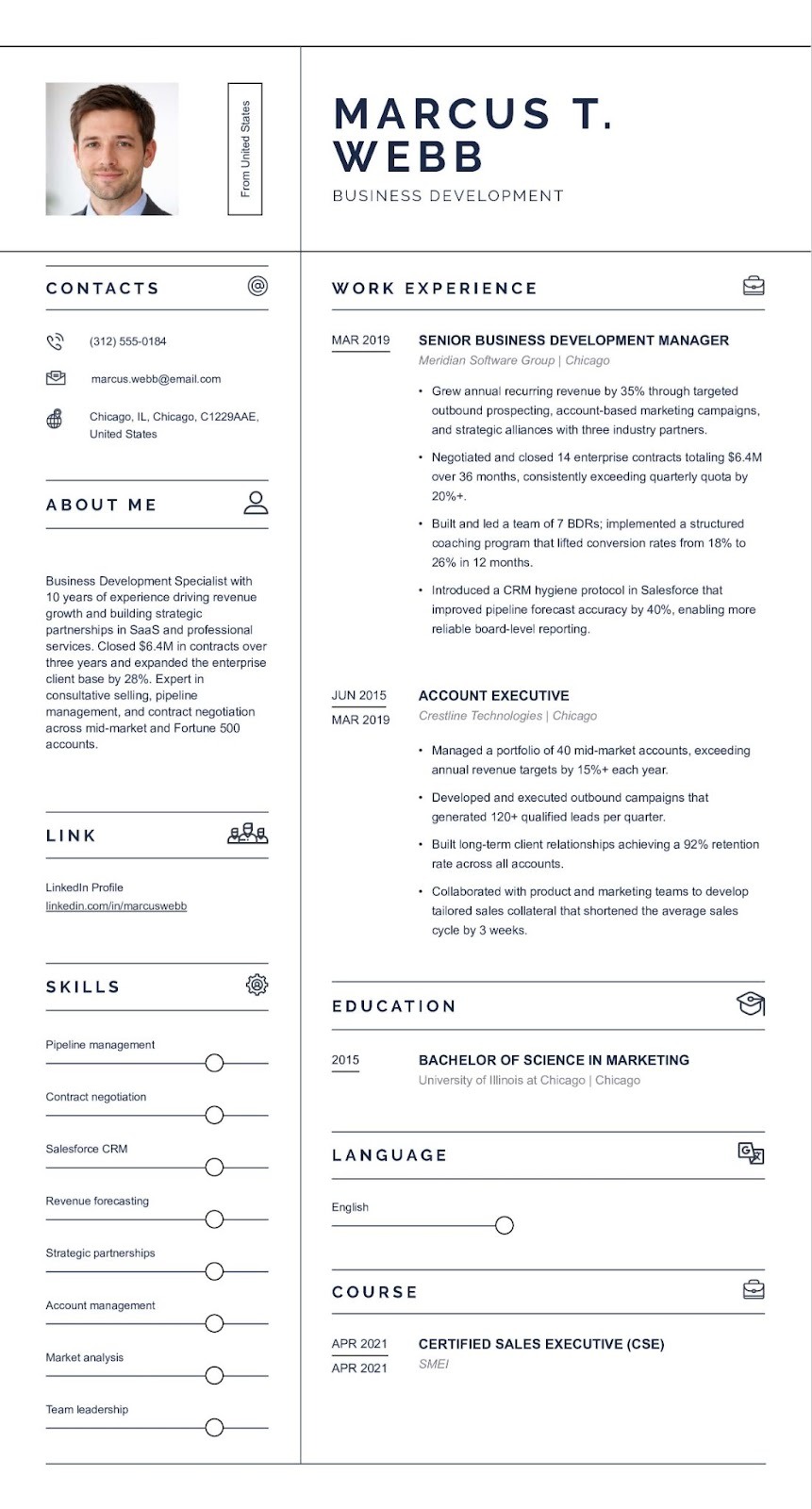
Every bullet that only describes activity without a revenue outcome is a missed opportunity: anchor at least 3 of your 4 bullets to a dollar figure or a growth percentage.
"SaaS and professional services" and "$6.4M in contracts" signal industry fit and deal scale instantly. Generic phrases like "B2B sales experience" force the recruiter to guess.
Retention rate (92%) is as compelling as acquisition numbers: it tells hiring managers you build relationships that last, not just deals that close.
The CRM hygiene bullet shows strategic thinking beyond quota: you improved how the whole team operates, which is what separates a BDM from a future sales leader.
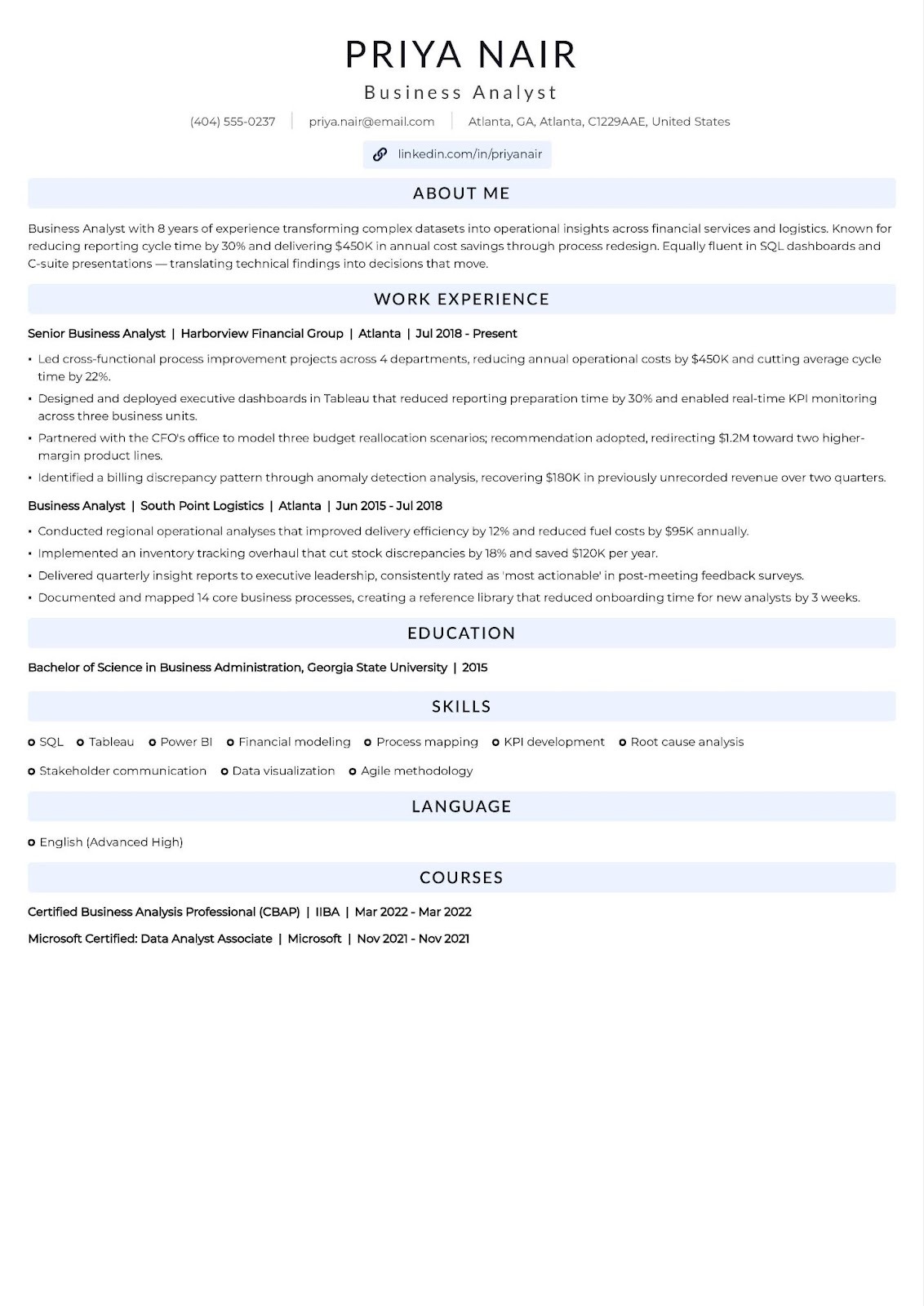
Every analysis bullet completes the sentence — "built a dashboard" stops at activity, "built a dashboard that enabled a $1.2M reallocation" shows what the work was actually worth.
The profile line "equally fluent in SQL and C-suite presentations" addresses the BA's core value proposition directly: bridging technical work and executive decision-making.
The billing discrepancy recovery bullet stands out because it shows analytical thoroughness and financial impact in a single line — if you have a similar story, include it.
The CBAP appears in many senior BA job postings as a preferred qualification — list it prominently, never buried below education.
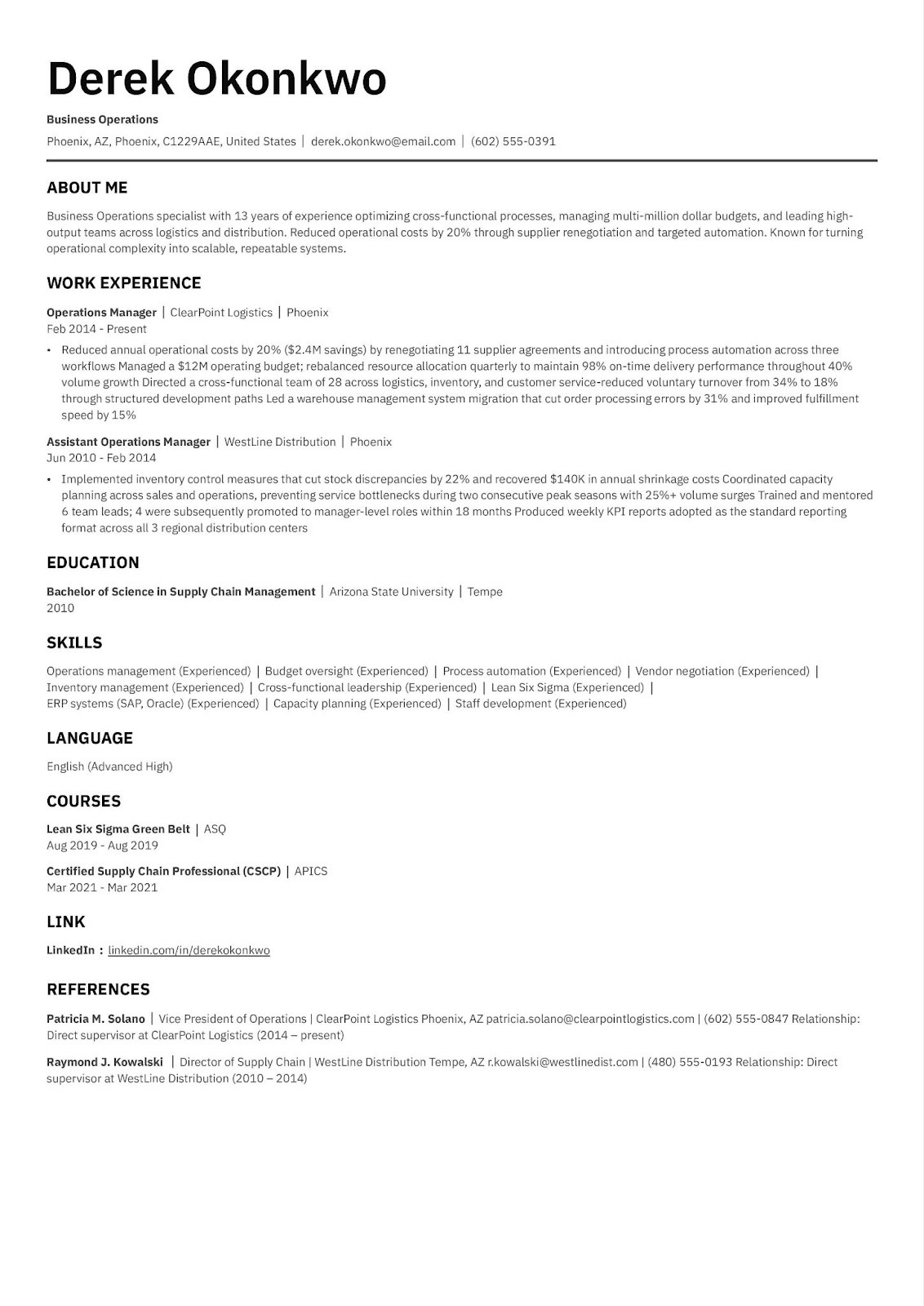
Always add a dollar value next to a percentage — "reduced costs by 20% ($2.4M)" tells the recruiter whether you managed a $500K budget or a $12M one, and scale is everything in operations.
Reducing voluntary turnover from 34% to 18% is one of the most cost-impactful achievements an ops manager can show — most never think to include it.
Maintaining 98% on-time delivery through 40% volume growth signals that your systems hold under pressure, not just in steady state.
Listing "ERP systems (SAP, Oracle)" rather than just "ERP systems" satisfies both the ATS keyword match and the recruiter's need for specificity.
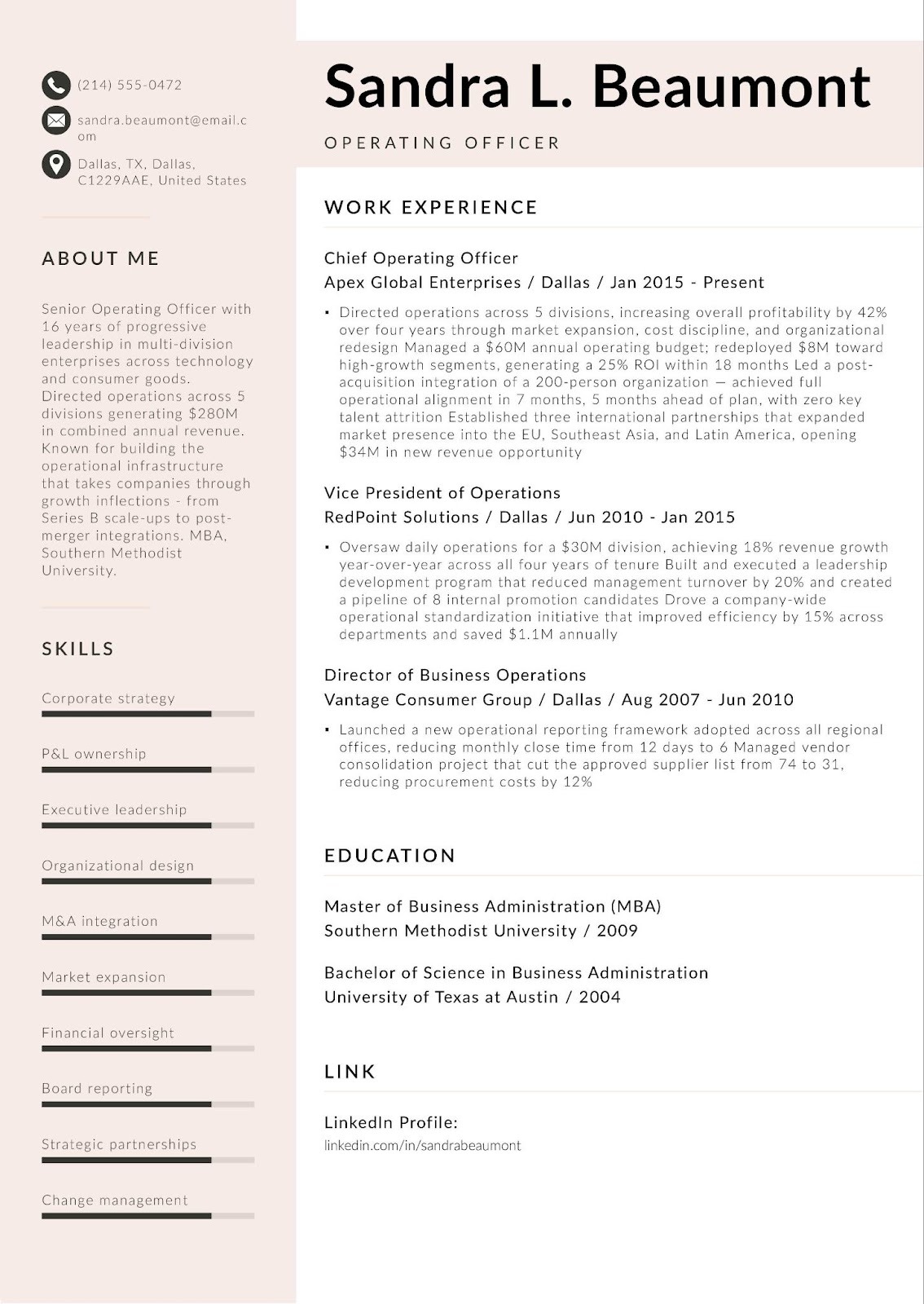
"$280M in combined annual revenue" in the first two lines is a deliberate scale signal — for executive roles, budget and revenue scope is the first filter, so surface it immediately.
The post-acquisition integration bullet is the strongest on the page because it shows the ability to lead through complexity: 7 months instead of 12, zero key attrition.
Three roles over 16 years is the right depth — the earliest is kept to two bullets to maintain momentum without padding, since recency and impact matter more than comprehensive coverage at this level.
Repeating the MBA in the profile (not just in education) ensures it's seen in the 7-second scan, which is all many executive resumes get at the first pass.
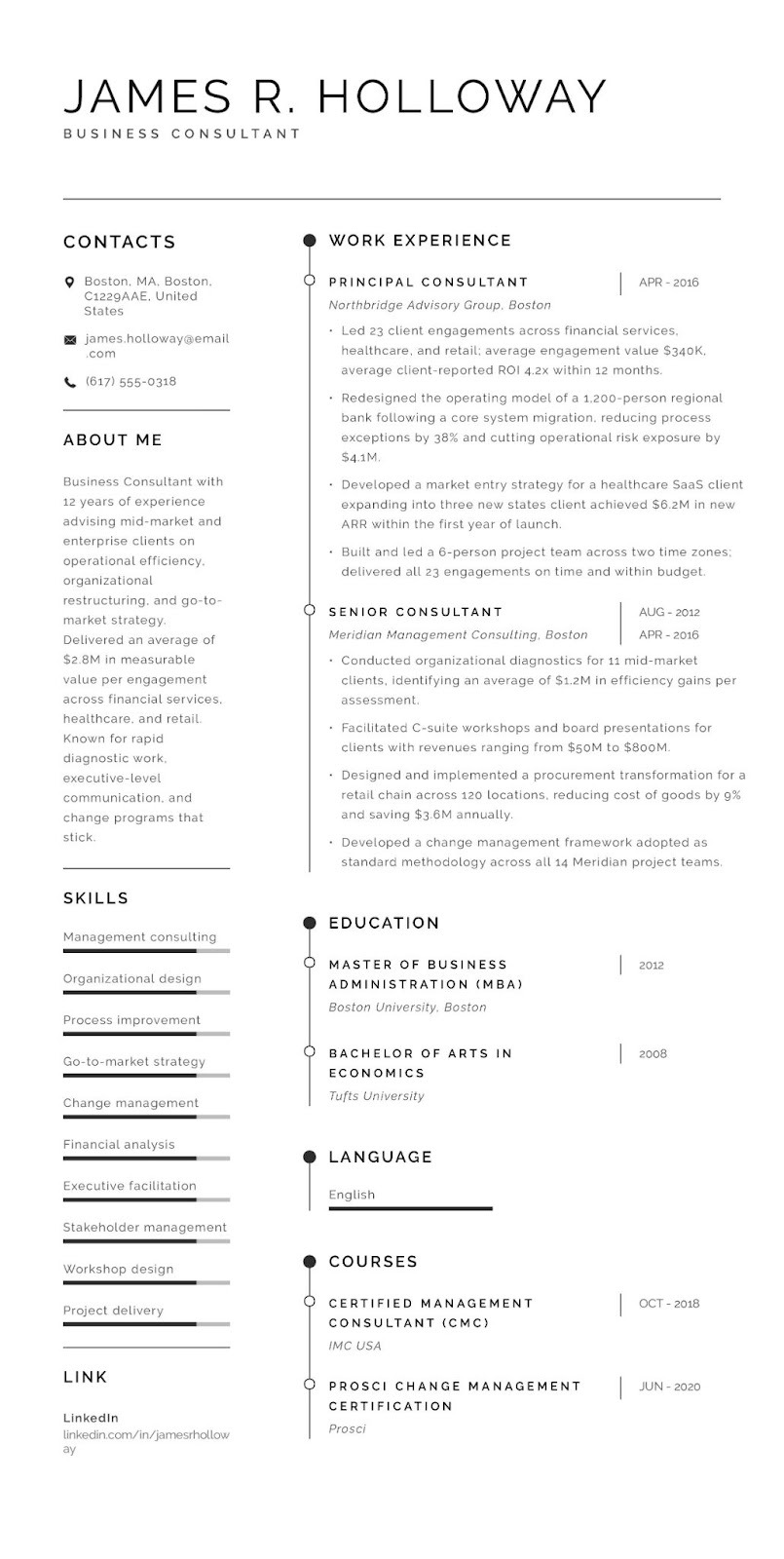
What sets this apart from a generic consulting resume
"Average engagement value $340K, average ROI 4.2x" quantifies both what you cost and what you delivered — most consultants only show one side of that equation.
Naming three specific industries (financial services, healthcare, retail) tells the recruiter immediately whether your client experience matches their practice area.
"Delivered all 23 engagements on time and within budget" directly addresses the two things clients care about most, and almost no consultant thinks to include it.
The change management framework adopted across 14 teams signals that your work outlasts the engagement — you changed how the organization operates, not just what it reported.
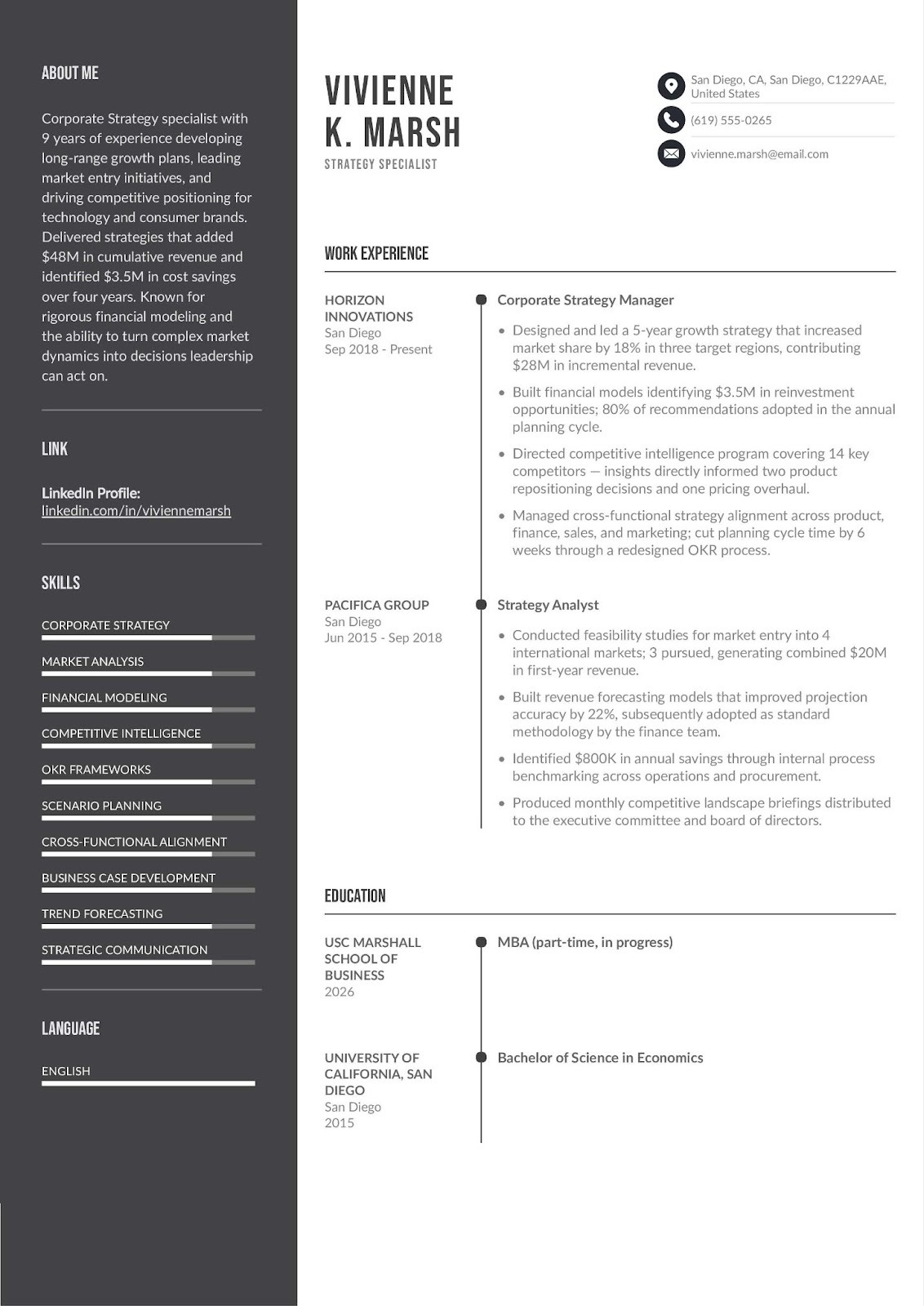
"Delivered strategies that added $48M in cumulative revenue" in the profile turns what could look like advisory work into a measurable business contribution.
"80% of recommendations adopted" is a signal of executive trust that most strategy candidates never think to quantify — and it immediately differentiates this resume.
An in-progress MBA from a recognized school still belongs on the resume — note the expected graduation date clearly and it becomes a credential, not a caveat.
Managing a competitive intelligence program covering 14 competitors and directly influencing pricing decisions shows strategic depth that "market analysis" in a skills list never could.
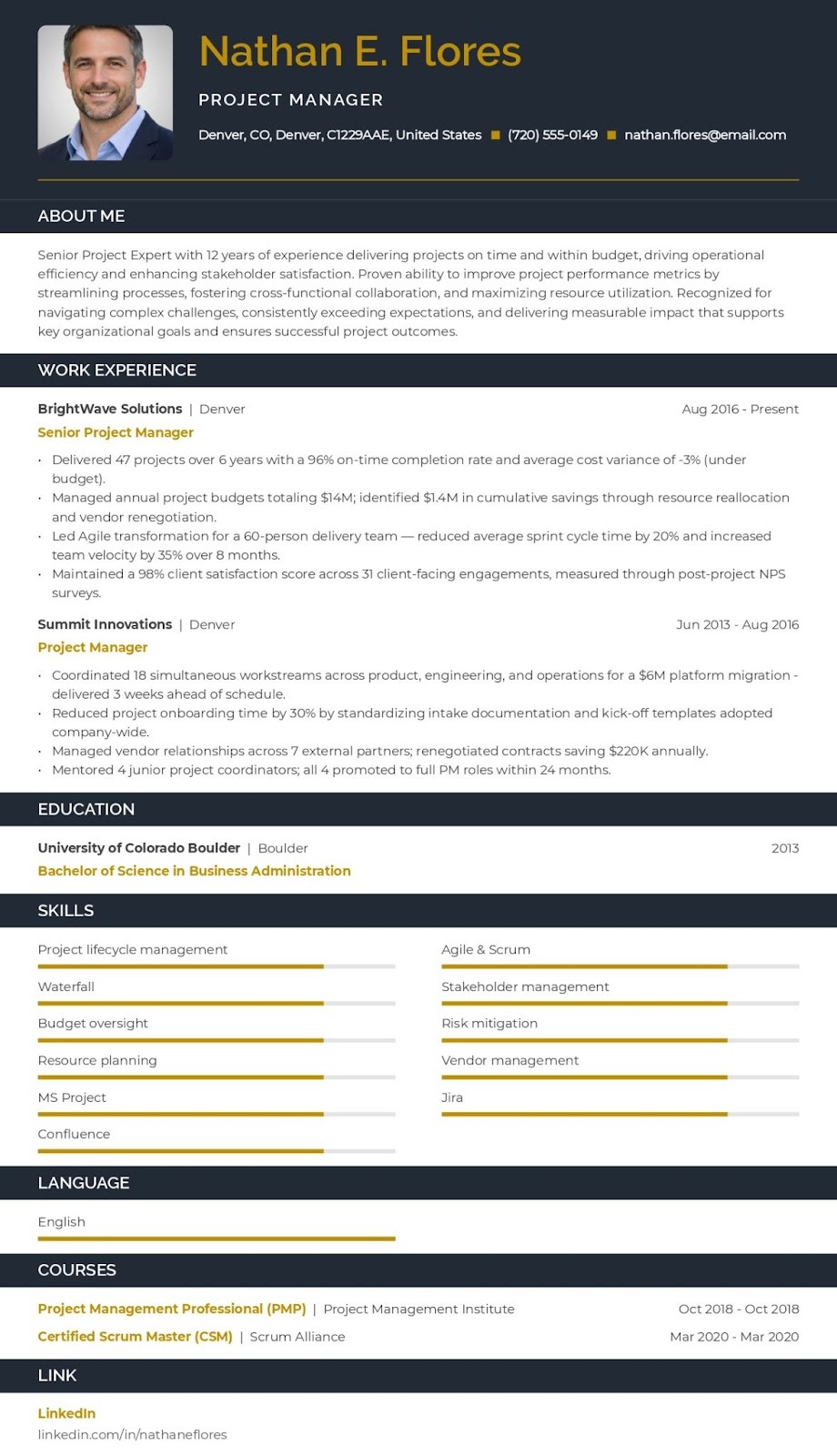
"96% on-time, −3% cost variance" in the profile does more work than any methodology mention — these are the two numbers hiring managers scan for first, so surface them immediately.
The Agile transformation bullet proves methodology depth: leading a 60-person team to a 35% velocity improvement shows you implement frameworks, not just follow them.
A 98% client NPS score across 31 engagements is highly specific and verifiable — if you have access to client satisfaction data, always find a way to quantify it.
Four coordinators promoted to PM roles under your watch signals leadership readiness, which is exactly what separates a senior PM candidate from a mid-level one.
Resume for Small Business Owner (transitioning to corporate)
How to frame an entrepreneurial background for corporate recruiters
Stating "now transitioning to a corporate operations or business development role" directly in the profile removes ambiguity and turns a potential fit concern into a deliberate, confident narrative.
Full P&L ownership with a 22% net margin is a senior-level credential — many mid-level corporate managers have never had it, so frame it accordingly rather than underselling it.
"E-commerce channel now 45% of total revenue" shows you built a real digital business, not just a side store — highly relevant when digital transformation is a boardroom priority.
The loyalty program bullet is a business development story in disguise: repeat rate from 28% to 51%, $180K incremental revenue — lead with the outcome, not the feature.
Choosing the right business resume format
Reverse chronological: the gold standard
For the vast majority of business profiles, the reverse chronological format is the most effective. Your most recent experience appears first, allowing the recruiter to immediately assess your current level.
This is also the format best handled by ATS software and most expected by hiring managers.
Combination format: for career changers
If you're switching industries or returning to the market after a break, the combination format (skills section first, followed by chronological experience) lets you highlight your transferable strengths before diving into your work history.
Formatting rules
Font: Arial, Calibri, Garamond, or Georgia — clean, readable, professional
Size: 10–12 pt for body text, 14–16 pt for your name
Margins: 0.6–0.8 inches on each side
Length: 1 page for under 10 years of experience, 2 pages maximum beyond that
File format: PDF to preserve layout; check whether the employer requests .docx
Writing a strong profile summary for business resume
The profile summary is the first thing a recruiter reads. You have 6 to 8 seconds to convince them to keep going. This is not the place to be generic.
Structure of a strong profile:
[Job title] with [X years of experience] in [2–3 key specializations]. Known for [distinctive accomplishment]. Skilled in [technical skill], [soft skill], and [industry-relevant expertise].
Keep it to 3 lines maximum. Every word should earn its place.
Strong example — Business Analyst
Copy
Business Analyst with 8 years of experience transforming data into actionable insights across finance and retail sectors. Known for reducing reporting time by 30% and improving forecast accuracy through predictive modeling. Skilled in stakeholder communication, process improvement, and cross-functional collaboration.
Weak example — Business Analyst
I am a Business Analyst with several years of experience. I work with data, generate reports, and help businesses make decisions. I am a team player and work well with others.
Strong example — Business Development Manager
Copy
Business Development Manager with 10 years of experience driving revenue growth and building strategic partnerships in the SaaS and professional services sectors. Closed $6M+ in contracts over three years and grew client retention to 92%. Known for turning cold pipelines into long-term accounts.
Weak example — Business Development Manager
Experienced business development professional with a strong track record of success. Good at building relationships and finding new opportunities. Looking for a challenging role in a dynamic company.
Optimizing the business resume Experience section
This section is where most business resumes lose the competition. The difference between a resume that gets an interview and one that doesn't often comes down to a single question: did you describe what you did, or what you achieved?
Every bullet point should follow this logic:
Action verb + what you did + measurable result
Before/after examples
Business Development Manager
"Responsible for finding new clients and building relationships with partners."
Copy
"Expanded client base by 40% in 12 months through targeted outreach and strategic partnerships, generating $1.2M in new annual revenue."
Business Operations Manager
"Helped improve internal processes and worked with different teams."
Copy
"Redesigned cross-functional workflows across 4 departments, cutting average process cycle time by 22% and freeing up $320K in annual overhead."
Business Analyst
"Created reports and presentations for senior management."
Copy
"Built executive dashboards that reduced decision-making time by 30% across three business units, directly supporting a $4.5M budget reallocation."
Small Business Owner
"Managed day-to-day operations and handled customer service."
Copy
"Scaled annual revenue from $150K to $780K over 5 years by introducing two new product lines, renegotiating supplier contracts (−15% cost), and launching a loyalty program that increased repeat purchases by 18%."
Common mistakes to avoid
Listing job duties instead of accomplishments. The job description already tells the recruiter what a Business Analyst does. What they want to know is how well you did it.
Mixing multiple experience categories. One "Professional Experience" section is cleaner and more readable than splitting into "Relevant Experience," "Additional Experience," and "Other Roles."
Vague quantifiers. "Significantly improved" or "greatly increased" means nothing. If you can't remember the exact figure, use a conservative estimate and note it as approximate.
Omitting context. "Grew revenue by 30%" reads differently depending on whether the baseline was $50K or $50M. Give the reader enough to understand the scale.
Education & Certifications: the good writing in business resume
Degrees
A bachelor's degree in business administration, economics, finance, or a related field is the baseline for most roles. An MBA adds significant weight for senior positions, particularly in strategy, consulting, and executive roles. That said, employers consistently rank relevant experience and demonstrated results above academic credentials.
List your education in reverse chronological order. Include: degree, institution, location, and graduation year. You can omit the year if you graduated more than 15 years ago to avoid potential age bias.
Example:
Copy
Master of Business Administration (MBA) University of Michigan — Ann Arbor, MI | May 2017
Bachelor of Science in Business Administration Ohio State University — Columbus, OH | May 2014
Certifications that carry weight in business roles
Certifications signal commitment to your field and often appear directly in job postings as preferred qualifications. Here are the most recognized ones by role type:
General business & management:
Project Management Professional (PMP) — Project Management Institute
Certified Management Consultant (CMC) — IMC USA
Chartered Manager (CMgr) — Chartered Management Institute
Certified Associate in Project Management (CAPM)
Business analysis:
Certified Business Analysis Professional (CBAP) — IIBA
PMI Professional in Business Analysis (PMI-PBA)
Operations & process improvement:
Lean Six Sigma Green Belt or Black Belt — ASQ
Certified Supply Chain Professional (CSCP) — APICS
Strategy & finance:
Certified Strategic Planning Professional (CSPP)
Financial Risk Manager (FRM) — GARP
Chartered Financial Analyst (CFA)
Digital & marketing:
Google Analytics Individual Qualification (GAIQ)
HubSpot Inbound Marketing Certification
Digital Marketing Certified Associate (DMCA)
Key skills to showcase in Business Resumes
The skills section serves two purposes: it signals your competency to the human reader, and it feeds keywords to the ATS. A well-built skills section is neither too short (a missed opportunity) nor a wall of buzzwords (which looks padded and reads poorly).
Aim for 10–16 skills, grouped by category when space allows.
Hard skills
Strategy & Analysis
Operations
Sales & Business Dev
Financial modeling
Process optimization
Revenue growth strategy
Competitive analysis
Budget management
Contract negotiation
Market research
Vendor management
CRM platforms (Salesforce, HubSpot)
KPI development
Resource allocation
Client acquisition
Business forecasting
Supply chain management
Partnership development
Data visualization
Risk management
Pipeline management
P&L management
Change management
Account management
Soft skills (with context)
Don't just list soft skills — they need a concrete anchor in your bullet points to be credible. These are the ones that appear most consistently in business job postings:
Strategic thinking — ability to connect day-to-day decisions to long-term business goals
Cross-functional collaboration — experience working across sales, finance, ops, and product teams
Stakeholder communication — translating complex data or strategy into clear executive-level messaging
Leadership & team development — building, managing, and mentoring high-performing teams
Problem-solving under pressure — making sound decisions with incomplete information or tight deadlines
Adaptability — thriving in fast-changing environments, pivoting strategy when market conditions shift
Action verbs to use in a resume for a business role
Opening every bullet with a strong action verb is one of the simplest ways to make your experience section more impactful. Passive phrases like "was responsible for" or "helped with" bury your contributions. The verbs below are organized by the type of achievement they describe.
Applicant Tracking Systems are now standard practice across most mid-size to large companies. Before your resume reaches a recruiter, it's scored against the job description — and if the match rate is too low, it's filtered out automatically.
How ATS scoring works
ATS software scans your resume for keywords that match the job posting. It looks for: job titles, skill names, certifications, tools, and industry terminology. A resume with strong qualifications but poor keyword alignment can score lower than a weaker candidate who mirrored the job description more closely.
Practical ATS checklist
Mirror the job title. If the posting says "Business Development Manager," use that exact phrase in your profile summary and experience section — not "BDM" or "Sales Growth Manager."
Pull keywords directly from the job description. If the posting mentions "competitive analysis," "cross-functional collaboration," and "Salesforce," those exact phrases should appear in your resume if they genuinely apply to your background.
Avoid tables, columns, and text boxes. Many ATS systems parse resumes linearly and can't read content inside multi-column layouts or text boxes. Use a single-column format for maximum compatibility.
Use standard section headings. "Work Experience," "Education," "Skills" — not "My Journey," "What I Bring," or "Expertise." Custom headings confuse parsers.
Submit as PDF or .docx depending on instructions. PDF is safer for preserving layout, but some older ATS systems parse .docx more reliably. When in doubt, check the job posting or application instructions.
Spell out acronyms once. Write "Applicant Tracking System (ATS)" before using "ATS" alone, so the system recognizes both forms.
Choosing the right business resume template
For business roles, the template is a signal in itself. A clean, professional layout communicates that you understand how business communication works. An overly decorative design suggests the opposite.
What to look for
Single-column or mild two-column layout — readable by ATS and easy to scan visually
Clear section hierarchy — your name and title at the top, experience prominent, no visual noise competing with your content
Sufficient white space — a dense, wall-of-text resume feels harder to read even when the content is strong
Consistent formatting — same font, same bullet style, same date format throughout
What to avoid
Heavy graphics, icons, profile photos (unless applying in a country where photos are standard)
Colored backgrounds or decorative borders that distract from content
Creative or infographic-style resumes for traditional corporate roles — save those for startups or design-adjacent positions
Fonts below 10pt or above 12pt for body text
Template choice by role type
Executive / C-Suite roles: conservative, traditional layout — gravitas over flair
Business Analyst / Strategy: clean modern layout with strong visual hierarchy for data-heavy content
Business Development / Sales: slightly bolder formatting is acceptable, as long as it stays professional
Consulting: crisp, minimal… as consulting firms value structure and clarity above everything
Notes about the Cover Letter for business roles
Many candidates treat the cover letter as an afterthought or a copy-paste of their resume summary. That's a missed opportunity. While some hiring managers skip cover letters, many use them as the deciding factor between two similarly qualified candidates — and in competitive business roles, that margin matters.
What a strong business cover letter does differently
It's addressed to a specific person. "Dear Hiring Manager" is a red flag. Spend 2 minutes finding the recruiter's name on LinkedIn.
It opens with a hook, not a statement of intent. Instead of "I am writing to apply for the Business Development Manager role," try: "In three years at NorthStar Solutions, I took a cold market segment from zero to $2M in annual revenue. That's the approach I'd bring to your team."
It connects your experience to their specific business challenge. Reference something real about the company — a recent market expansion, a product launch, a stated strategic priority — and explain how your background is directly relevant.
It adds information the resume doesn't contain. If your biggest achievement requires context to be understood, the cover letter is the place to give it.
It's concise. Three to four paragraphs, never more than one page.
Experience showcasing examples by profile type
Business Development Manager
Profile:
Business Development Manager with 10 years of experience driving revenue growth and building strategic partnerships in SaaS and professional services. Closed $6M+ in contracts over three years and grew client retention to 92%. Expert in pipeline management, contract negotiation, and CRM platforms.
Experience :
Increased annual revenue by 35% through targeted prospecting, customized pitches, and strategic alliances with three industry leaders
Negotiated and closed contracts totaling $6M over 36 months, expanding the company's enterprise client base by 28%
Led a team of 7 sales professionals; implemented a structured coaching program that improved conversion rates by 28%
Managed a portfolio of 40 corporate accounts, consistently exceeding quarterly targets by 15%+
Business Analyst
Profile:
Business Analyst with 8 years of experience transforming complex data into operational insights across finance and logistics. Known for cutting reporting cycle time by 30% and delivering cost savings of $450K annually through process redesign. Strong communicator at both technical and executive levels.
Experience bullet points:
Led cross-functional process improvement projects that reduced annual operational costs by $450K
Built custom dashboards that cut decision-making time by 30% across three business units
Conducted market and operational analyses that drove a 12% improvement in regional delivery efficiency
Delivered quarterly data presentations to C-suite, translating complex findings into prioritized action plans
Business Operations Manager
Profile:
Business Operations Manager with 13 years of experience improving efficiency, managing multi-million dollar budgets, and leading cross-departmental teams. Reduced operational costs by 20% through supplier renegotiation and process automation. Known for bridging strategy and execution.
Experience bullet points:
Reduced operational costs by 20% through renegotiated supplier agreements and targeted automation
Managed a $12M annual operating budget; reallocated resources to cut delivery times by 15%
Directed a cross-functional team of 25 across logistics, inventory, and customer service
Implemented inventory control measures that reduced stock discrepancies by 22% and cut waste
Small Business Owner (transitioning to corporate)
Profile:
Business Owner with 11 years of experience launching and scaling a profitable retail venture. Grew annual revenue from $220K to $1.1M through e-commerce expansion, supplier negotiation, and targeted local marketing. Now bringing entrepreneurial execution and P&L ownership to a corporate operations role.
Experience bullet points:
Grew annual revenue from $220K to $1.1M over 5 years by expanding product lines and launching a direct e-commerce channel
Negotiated vendor contracts that reduced supply costs by 18% while maintaining product quality standards
Built and led a team of 12; implemented performance-based incentives that boosted productivity by 22%
Developed local marketing partnerships that attracted an average of 120 new customers per month
FAQ
Do I need a cover letter for a business job application?
Not always. But they're almost always worth writing. For competitive business roles, a strong cover letter can be the difference between an interview and a pass. Treat it as mandatory unless the job posting explicitly says not to include one.
How do I write a business resume with no experience?
Lead with your education section and go deep on internships, academic projects, and extracurriculars that demonstrate business skills. Quantify what you can: even a student project that improved a club's budget allocation by 20% is more compelling than a vague list of responsibilities. Consider pursuing an entry-level certification (CAPM, CBAP associate, HubSpot) to strengthen your profile.
How do I explain employment gaps on a business resume?
Be straightforward. If you took time for family, health, or personal development, a brief honest mention in the cover letter is better than an awkward gap that raises questions. Freelance work, consulting, or courses completed during the gap can also be listed in the experience or education section.
What is the difference between a resume summary and an objective statement for business roles?
An objective statement focuses on what you want ("Looking for a challenging role..."). A profile summary focuses on what you bring ("Business Analyst with 8 years of experience..."). For experienced candidates, always use a profile summary. An objective statement is only appropriate for entry-level candidates with no professional experience.
How far back should a business resume go?
10 to 15 years is the standard for most business roles. Older experience can be listed briefly without bullet points (just title, company, and dates) or omitted entirely if it's no longer relevant.
What is the best format for a business resume?
Reverse chronological is the most effective format for the majority of business professionals. It puts your most recent and relevant experience front and center. Use a combination format only if you're making a significant career transition and need to lead with transferable skills before your work history.


 Strong example — Business Analyst
 Weak example — Business Analyst