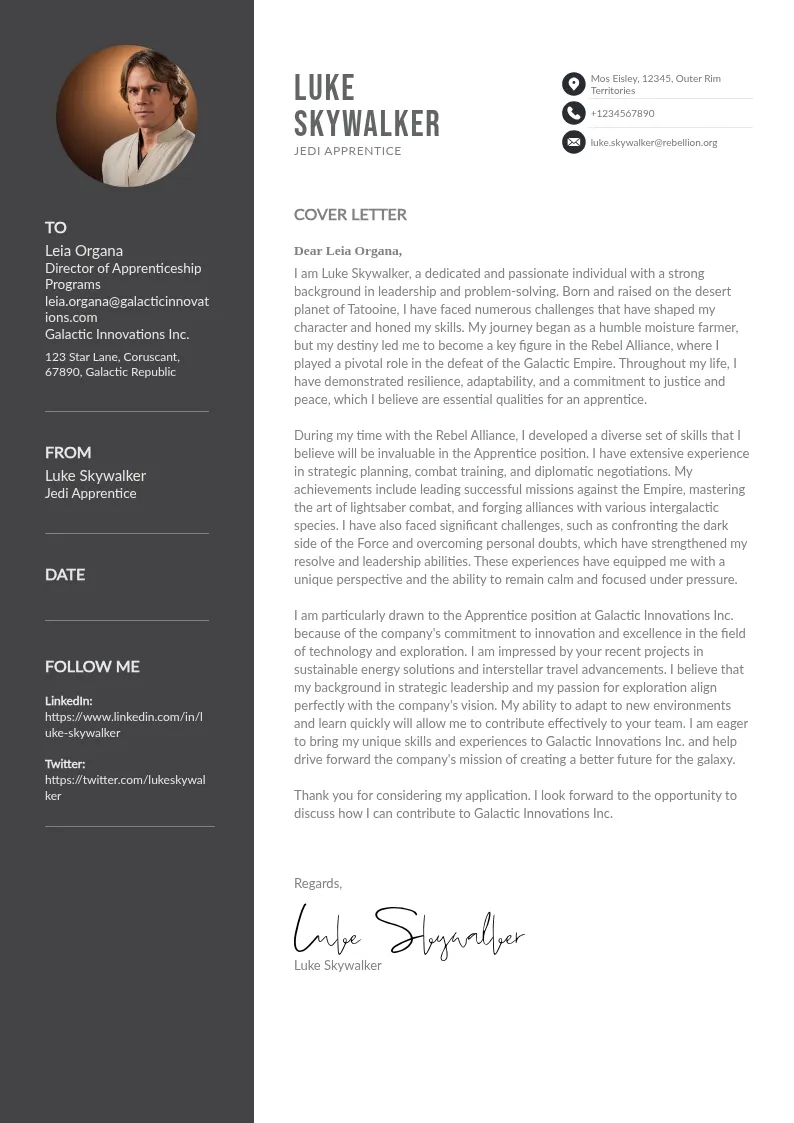
This guide covers every major application context in the Philippine job market: BPO and call center roles, government positions in Tagalog, corporate mid-level applications, career change, and OFW placements abroad. Each section follows the same logic — establish what the sector expects, explain why it differs from Western norms, and provide a ready-to-use template. The pre-submission checklist and FAQ at the end apply across all sectors.
Why Filipino cover letters are fundamentally different
Most rejections in the Philippine job market are not about qualifications. They happen because applicants treat Philippine professional culture as a variation of Western norms. Welle, it is not… The workplace here runs on a distinct set of values, and every hiring manager reads those values, or their absence, in the first paragraph of a cover letter.
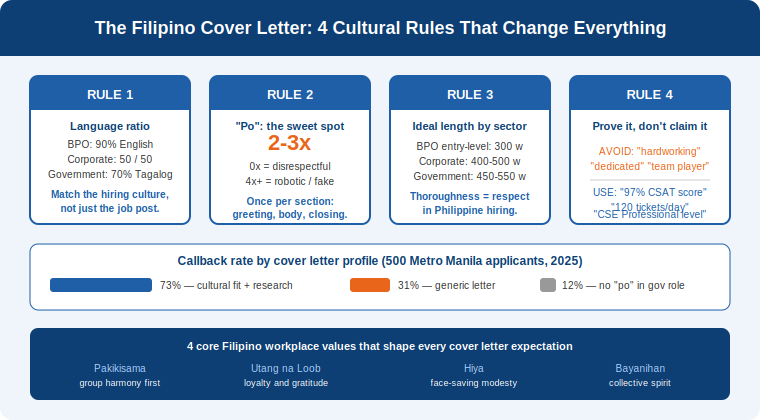
Four concepts shape how Filipino professionals relate to authority, colleagues, and opportunity.
These values explain the “po” question, which is one of the most misunderstood aspects of Filipino professional writing.
“Po” is not just a politeness particle. It is a cultural marker of social awareness. Two or three well-placed uses signal that the applicant understands the register. Five or six uses signal that the applicant copied a template without reading it. Zero uses in a government application signals cultural unawareness… The target is 2 to 3 times per letter: once in the greeting, once in the body when addressing the reader directly, and once in the closing.
This difference also explains why Philippine cover letters run longer than their Western equivalents.
A 250-word letter that might be considered tight and professional in the United States reads as low-effort in the Philippines. Hiring managers here typically read letters in full. Thoroughness is not verbosity: it is a sign of respect for the reader's time and the seriousness of the application.
English or Tagalog cover letter? How to choose
Language choice depends entirely on the target employer and sector. The most common mistake is choosing based on personal comfort rather than on what the hiring organization expects.
For government applications, writing in English when Tagalog is expected signals disconnection from the Filipino classroom or public service reality. On the other side, writing 100% Tagalog for a BPO role when English fluency is the core skill being evaluated defeats the purpose. The letter itself is the proof of concept.
What every strong Filipino cover letter looks like
Regardless of sector or career stage, the structure of an effective Philippine application letter follows the same logic: establish credibility quickly, prove it with numbers, demonstrate cultural fit, and close with appropriate respect.
Structure that works across all situations
- Header: full name, address, phone, email, date
- Recipient: full name, title, company, address — always research the name, never use 'Dear Sir/Madam'
- Paragraph 1: position applied for, one strong credential, and one specific reason for choosing this company
- Paragraph 2: 2 to 3 quantified achievements that directly address the role's requirements
- Paragraph 3: cultural and values alignment, with at least one specific detail about the organization
- Paragraph 4: respectful call to action, with 'po' where appropriate
- Signature: full name, LinkedIn URL, portfolio if relevant
The proof-over-adjectives rule
Roughly 80% of the application letters reviewed in Philippine HR circles contain phrases like 'hardworking', 'dedicated', and 'passionate for excellence'. These words carry no weight because every applicant uses them. The only version of these qualities that matters to a hiring manager is a number or a specific outcome. 'Maintained a 97% CSAT score across 120 daily interactions' says more than three paragraphs of self-description.
The same logic applies to government applications in Tagalog. 'Dedikado po ako sa aking trabaho' without any evidence of that dedication is the Tagalog equivalent of 'I am hardworking'. Always follow a claim with a concrete result.
The 7 mistakes that get Filipino cover letters rejected
These patterns surface consistently across HR conversations in Manila, Cebu, and Davao, and they affect applicants at every level, from fresh graduates to seasoned professionals.
1. 'Dear Sir/Madam' in 2026
That salutation signals the recruiter's name was never looked up. In a culture where personal relationships anchor professional trust, this reads as careless before a single qualification has been read. The fix takes five minutes: LinkedIn, the company website, or a quick call to HR.
2. Overusing 'po' (the authenticity trap)
“Maganda pong umaga. Nais ko pong mag-apply. Inaasahan ko pong matanggap…” Multiple HR managers across Metro Manila flagged in 2025 that letters with more than 4 uses of “po” are now treated as likely template copies. Over-reliance on 'po' does not read as respectful. It reads as performed, which is worse.
3. Claiming qualities without evidence
See the proof-over-adjectives rule above. 'Hardworking', 'dedicated', 'passionate' and 'team player' appear in the vast majority of Philippine cover letters. They are invisible to recruiters. One specific metric makes more of an impression than four paragraphs of self-praise.
4. Sending the same letter everywhere
A generic letter sent to ten employers reads like a letter written for no one. If Concentrix recently opened a site in Iloilo, that belongs in the letter. If Ayala published a sustainability roadmap the applicant genuinely finds compelling, citing it takes thirty seconds and doubles the likelihood of a callback. Company-specific research is not optional polish: it is the expected baseline for serious applicants.
5. Wrong length for the sector
A 250-word letter for a DepEd position signals that the applicant does not understand the civil service application culture. A 600-word letter for a BPO entry role signals poor communication skills. Length is information.
6. Mentioning salary expectations unprompted
Unless the posting explicitly requests it, compensation should never appear in the cover letter. The positioning shifts from 'what can be contributed' to 'what is being demanded', and that shift is noticed. Salary negotiation belongs in the interview stage.
7. Missing CSE eligibility in government applications
For any DepEd, DOLE, or LGU role, failing to state Civil Service Examination eligibility level (Professional or Sub-professional) in the cover letter is a common and avoidable rejection trigger. The DepEd hiring process guide covers the full document requirements in detail.
Adapting the letter to the sector and career stage
The core structure stays consistent. What changes between a fresh graduate applying to a call center and a mid-level professional targeting Ayala Group is the emphasis, the tone calibration, and the specific signals each sector looks for.
Fresh graduates and applicants with no prior experience
Around 700,000 graduates enter the Philippine labor market every year according to the Commission on Higher Education (CHED). Most carry no formal work experience. Philippine employers in BPO and government expect this. What they evaluate instead are cultural maturity, learning signals, and genuine interest in the specific role.
The mistake fresh graduates consistently make is apologizing for lack of experience either explicitly or through hedging language. The letter should not dwell on what is missing. It should surface what is present: academic performance, internship or volunteer work, relevant coursework, and the research done on the company.
BPO and call center roles
The BPO sector employs more than 1.57 million Filipinos (Philippine Statistics Authority, Q4 2025). Competition is high, but so is turnover, which means positions open frequently and hiring managers screen volume. A BPO cover letter has roughly 30 seconds to make an impression before a recruiter moves to the next file.
Three things matter most in this sector, and they should appear explicitly in the letter. First, written English fluency: the letter itself demonstrates this, so every sentence counts. Second, operational metrics: even from a university internship, any data around communication volume, satisfaction scores, or efficiency improvements makes an applicant stand out. Third, shift flexibility: many BPO accounts run overnight Philippine time (11 PM to 8 AM), and candidates who name this availability directly reduce one of the recruiter's primary screening concerns.
Familiarity with CRM platforms and support tools (Zendesk, Salesforce, Five9, Genesys Cloud) should be named if relevant, even if the exposure came through coursework rather than paid work.
Government positions: DepEd, DOLE, and LGUs
Government hiring in the Philippines follows institutional rules that bear little resemblance to private sector recruitment. The Civil Service Commission sets the framework, and applications that ignore it signal inexperience regardless of how strong the credentials are.
The first decision is language: 70% Tagalog with English for technical terms is the standard for most government roles. An English-only letter for a DepEd teaching position sends an immediate signal of cultural distance from the classroom and community the role serves.
Key Tagalog vocabulary worth knowing for government applications:
- Paglilingkod sa bayan: service to the nation. Strong and expected in the closing paragraph.
- Pagkakataon: opportunity. 'Umaasa pong mapagbigyan ng pagkakataon' is the standard closing phrase.
- Kaalaman at kasanayan: knowledge and skills. Replaces the generic 'skills and experience'.
- Plantilla position: permanent government post. Showing awareness of this framework signals familiarity with the civil service structure.
CSE eligibility (Professional or Sub-professional level) must appear in the letter, not just in the PDS. The applicable DepEd Order number should also be referenced where relevant, which signals the applicant has done the institutional homework rather than treating the application as a generic exercise.
For the complete DepEd application process, including document requirements under DepEd Order No. 45, s. 2024: DepEd hiring process guide.
Corporate mid-level roles: Ayala, SM, Jollibee Group, PLDT
At the mid-level in Philippine corporate settings, the cover letter does something different: it positions strategic intent. Hiring managers at this level are not evaluating potential, they are evaluating fit with a specific business challenge. The letter needs to name that challenge, reference the company's recent direction, and demonstrate how the applicant's track record connects to it.
Stakeholder management across organizational levels, cross-functional team leadership, measurable KPIs, ESG alignment, and regulatory compliance (SEC, BSP, or sector-specific) are the vocabulary of this space. Find more insights about opportunities at Ayala Group.
Career change applications
The most common mistake in career change letters is spending too much space explaining the departure from the previous field rather than making the case for the target one. The framing should be forward: not 'I am leaving teaching' but 'twelve years of classroom leadership translate directly into the training design skills this role requires'.
Concrete preparation steps matter here more than in any other profile. Completing a relevant certification, freelancing in the new field, or contributing to a relevant project before applying demonstrates that the transition is a decision, not a speculation. Name it explicitly.
OFW and overseas job applications
Every year, more than 2.5 million Filipinos leave for work abroad according to the Department of Migrant Workers. Most of them need a cover letter at some point in that process and most of them use the same generic template that gets ignored.
The core mistake is framing the application around the destination rather than the role. A letter that leads with eagerness to work in Dubai or Singapore reads as economic motivation, not professional fit. Employers abroad receive high volumes of Filipino applications precisely because the workforce is strong. What separates callbacks from silence is specificity: specific role knowledge, specific prior experience, specific cultural adaptability — not enthusiasm for leaving.
Three situations, three approaches
What the letter must answer before the recruiter asks
Overseas hiring managers have one underlying concern with Filipino applicants regardless of sector: will this person complete the contract? The cover letter should address this implicitly, not defensively. Mentioning a completed prior deployment, a positive end-of-contract reference, or OWWA membership signals stability without ever saying 'I am reliable' which proves nothing.
For TESDA-certified applicants (NC II, NC III, or international equivalents), the certification level should appear in the opening paragraph, not buried in the credentials section. In the Gulf caregiving and hospitality markets especially, that credential is often the first screen. More on relevant certifications: tesda.gov.ph.
A note for Balik-Manggagawa applicants specifically
Returning to the same employer or sector is a strategic advantage that most applicants undersell. The letter should open with the prior relationship, not restart from scratch.
For the full POEA and DMW application documentation requirements: dmw.gov.ph | For OWWA membership and OFW welfare services: owwa.gov.ph.
4 complete Filipino cover letter templates
Template 1: Entry-level BPO cover letter in English

[Full Name]
[Street Address, Barangay, City, Province]
[Phone] | [Email] | [LinkedIn]
[Date]
[Hiring Manager Full Name]
Talent Acquisition Manager
[Company Name], [Address]
Dear [Name],
I am writing to apply for the Customer Service Representative position at [Company]. As a [Course] graduate from [University], the communication skills developed through [specific coursework, internship, or relevant experience] translate directly to the demands of a high-volume BPO environment. Your recent [site expansion / account launch / specific development] is exactly the kind of growth context I want to be part of.
During my internship at [Previous Company], I handled an average of 85 customer interactions daily and maintained a 96% first-call resolution rate. In the first month, a process improvement I proposed reduced average handling time by 12% across the team.
I am fully available for rotating shifts, including overnight schedules from 11 PM to 8 AM Philippine time. I also have working familiarity with [Zendesk / Salesforce / relevant tool] from [coursework / internship / training].
I would welcome the opportunity to discuss how this background fits [Company]'s needs. Thank you for the consideration.
Respectfully,
[Full Name]
Template 2: Cover letter for a government position in Tagalog (with English integration)
[Buong Pangalan]
[Tirahan, Barangay, Lungsod, Lalawigan]
[Telepono] | [Email]
[Petsa]
[Buong Pangalan ng Tatanggap]
[Titulo at Posisyon]
[Pangalan ng Paaralan / Ahensya], [Tirahan]
Kagalang-galang na [Titulo at Apelyido],
Nais ko pong mag-apply para sa posisyon ng [Posisyon] sa inyong [Paaralan / Opisina]. Bilang isang nagtapos ng [Kurso] sa [Pamantasan] noong [Taon], at may [X] taon na karanasan sa [larangan], naniniwala po akong maiaambag ko ang aking kaalaman at kasanayan sa paglilingkod sa bayan sa pamamagitan ng inyong institusyon.
Sa aking nakaraang serbisyo bilang [Dating Posisyon] sa [Dating Employer], naituro ko ang [Asignatura] sa average na 45 mag-aaral bawat klase at napanatili ang 95% passing rate sa National Achievement Test. Isinagawa ko rin ang isang community reading program na nakinabangan ng 120 batang nasa elementarya sa loob ng isang taon.
Mayroon po akong Civil Service Eligibility (Professional Level), Career Service Examination Passer (2023), naaayon sa mga kinakailangan ng DepEd Order No. 45, s. 2024. Handa po akong iharap ang lahat ng kaukulang dokumento sa inyong opisina.
Umaasa po akong mapagbigyan ng pagkakataon na mapakita ang aking kakayahan. Maraming salamat po sa inyong atensiyon at pagtanggap ng aking sulat.
Taos-pusong gumagalang,
[Buong Pangalan] | [Telepono]
Template 3: Corporate mid-level Filipino cover letter in English
[Full Name]
[Address] | [Phone] | [Email] | [LinkedIn]
[Date]
[HR Manager Full Name]
Head of Human Resources, [Company Name]
Dear [Name],
I am applying for the [Position] role at [Company]. With [X] years in [industry], the work has consistently centered on [core competency relevant to role]. [Company]'s recent [specific initiative, press release, or strategic direction] maps directly to the challenges I find most meaningful, and the timing of this opening is well-aligned with where this career has been heading.
In the current role as [Position] at [Employer], I led a team of [X] through [specific challenge], resulting in [measurable outcome]: [metric] improved by [%] over [timeframe], and the client portfolio expanded from [X] to [Y] accounts within 18 months. Cross-functional coordination across [departments] was central to that result.
Stakeholder management across organizational levels, from C-suite to frontline teams, has been a consistent thread. That experience is particularly relevant to [Company's structure or regulatory context].
I would welcome the opportunity to discuss how this background addresses [Company]'s current priorities.
Respectfully,
[Full Name] | [LinkedIn URL]
Template 4: Career change Filipino cover letter in English
[Full Name]
[Address] | [Phone] | [Email] | [LinkedIn or Portfolio]
[Date]
[Hiring Manager Name]
[Title], [Company Name]
Dear [Name],
I am applying for the [Target Position] at [Company]. The background is in [Previous Industry], and this transition to [New Industry] is a deliberate move grounded in [specific reason: market insight, observed gap, sustained personal development].
The skills developed in [Previous Role] translate directly here: [Skill 1] maps to [needed capability 1], and [Skill 2] to [needed capability 2]. Concretely, [specific achievement from previous career] required exactly the kind of [core competency] this role demands.
To close the gap between sectors, [certification completed / project delivered / freelance work undertaken] over the past [timeframe]. This is not a pivot on paper. The transition has already started.
The learning curve of entering a new field is understood and welcomed. The commitment is to be contributing at full capacity within [X months].
Thank you for the consideration.
Respectfully,
[Full Name]
Sector-specific keywords that get noticed
Beyond structure and tone, the vocabulary of a letter signals sector fluency. Hiring managers in each field recognize their own language, and its absence is just as telling as its presence.
BPO sector (Concentrix, Teleperformance, TTEC, iQor)
- First-call resolution rate
- Average handling time (AHT)
- Customer satisfaction score (CSAT)
- 24/7 rotating shift availability, overnight schedules
- Omnichannel support: voice, chat, email, messaging
- Quality assurance metrics and scorecards
Government sector (DepEd, DOLE, LGU, CSC)
- Civil Service Eligibility: Professional or Sub-professional level
- Government Service Insurance System (GSIS) familiarity
- Reference to applicable DepEd Orders (e.g., DepEd Order No. 45, s. 2024): see deped.gov.ph for the current list.
- Plantilla position: demonstrating awareness of the permanent post structure
- Barangay-level community programs and local advocacy experience
- Transparency, accountability, and public service orientation (core CSC values)
Corporate sector (Ayala, SM, Jollibee, PLDT)
- Stakeholder management across all organizational levels
- Cross-functional team leadership
- KPIs and quantifiable business outcomes
- SEC, BSP, or industry-specific regulatory compliance
- ESG alignment and sustainability strategy (increasingly weighted post-2024)
Tech and startup sector (BGC, Ortigas, Cebu IT Park)
- Agile and Scrum methodology
- Product roadmap ownership or contribution
- Data-driven decision making
- Remote-first and hybrid workflow experience
- Platform proficiency: GitHub, Figma, Notion, Jira (specify which)
What the data shows
In a study of 500 Metro Manila applicants conducted by a Philippine HR consultancy in 2025, the following callback rates emerged across entry-level to mid-level positions:
The pattern is consistent: personalization and cultural intelligence, far more than grammatical polish, drive callback rates. A tailored letter with two well-placed 'po' uses and one company-specific reference outperforms a perfect letter addressed to nobody.
Results from Filipino job seekers
Pre-submission checklist
Before submitting, confirm each of the following:
- The hiring manager's name has been researched and used in the salutation
- A specific recent development at this company is mentioned, not generic praise
- At least 2 quantified achievements appear, with numbers, percentages, or timeframes
- The letter language matches the job posting: English or Tagalog
- 'Po' usage feels natural for the sector and the level of formality required
- 'Hardworking', 'dedicated', and 'team player' do not appear without concrete proof
- Letter length is appropriate for the sector (BPO: 300 to 400 words; others: 400 to 500)
- CSE Eligibility level is stated for any government position
- The letter has been proofread: a single typo can eliminate a strong application
- Contact details are current and a LinkedIn URL is included
- File is saved as PDF unless DOCX is specifically requested
Sources and references
- Philippine Statistics Authority (PSA) — Labour Force Survey Q4 2025: psa.gov.ph
- JobStreet Philippines — 2025 Annual Hiring Trends Report: ph.jobstreet.com
- DepEd Order No. 45, s. 2024 — Teaching Position Requirements: deped.gov.ph
- Civil Service Commission (CSC) Philippines — CSE Guidelines 2025: csc.gov.ph
- People Management Association of the Philippines (PMAP) — HR Best Practices Report 2025: pmap.org.ph
- Rappler Career Guide — 'How Filipino Hiring Culture Is Shifting' (2025): rappler.com/business
- GigaBPO — 'Understanding the Philippines Work Culture' (2026): gigabpo.com