You've polished your resume or CV, shortlisted the right jobs, and tailored each application. There's one step left: writing a cover letter that actually aligns with what's already in your application file. Not one that repeats it. Not one that contradicts it.
That distinction matters more than most job seekers realize. A cover letter that feels disconnected from your resume raises a red flag for recruiters. One that complements and reinforces it dramatically increases your chances of landing the interview.
This guide focuses on that specific challenge: how to craft a cover letter that works in harmony with your resume or CV, whether you're applying in the US, the UK, or anywhere else in the world.
Resume vs. CV: Does it change how you write a cover letter?
One of the most common sources of confusion for job seekers (especially those applying internationally) is the difference between a resume and a CV (curriculum vitae), and whether that difference affects the cover letter.
The short answer: the structure of your cover letter stays the same. But the tone and depth of alignment must match the document you're sending.
Regardless of which document you're submitting, the golden rule is the same: your cover letter must never repeat your resume or CV word for word, and must never contradict it either. It should extend it: providing context, personality, and motivation that a list of bullet points cannot.
What does “Compatible” actually mean?
A compatible cover letter is one that a recruiter can read alongside your resume and feel that both documents are telling the same coherent story. It means:
A mismatch like claiming "5 years of project management experience" in your cover letter while your resume only shows 3 years is one of the fastest ways to lose a recruiter's trust.
How to structure a cover letter that matches your resume
Here is the exact structure that creates alignment between your cover letter and your resume or CV, section by section.
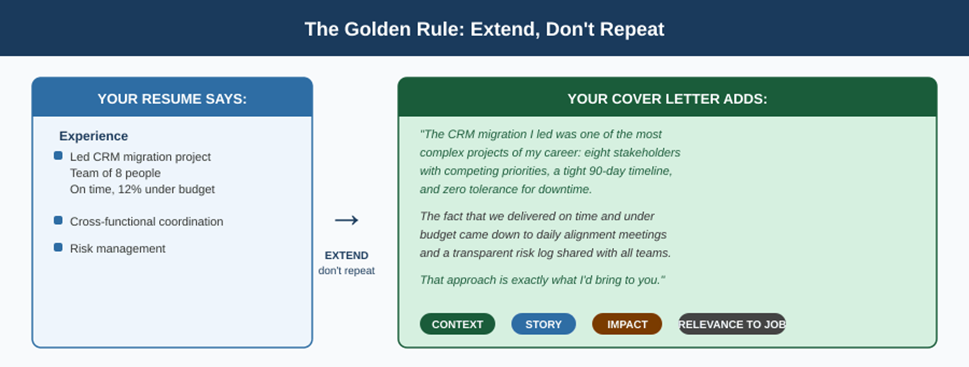
The “Extend, Don't Repeat” rule in practice
This is the most important principle for writing a cover letter that complements your resume. Here is what it looks like in practice:
Examples:
 Resume bullet point:
Managed a cross-functional team of 8 to deliver a CRM migration project on time and 12% under budget.
 Cover letter - WRONG (repetition):
In my previous role, I managed a cross-functional team of 8 to deliver a CRM migration project on time and 12% under budget.
Cover letter — RIGHT (extension):
The CRM migration I led at [Company] was one of the most complex projects of my career: eight stakeholders with competing priorities, a tight 90-day timeline, and zero tolerance for downtime. The fact that we delivered on time and under budget came down to one thing: daily alignment meetings and a transparent risk log shared with all teams. That approach to cross-functional coordination is exactly what I would bring to [Target Company].
Common cover letter / resume mismatches to avoid
Cover letter examples by profile
Here are three real-world examples of cover letter opening paragraphs that correctly align with a resume or CV, across different profiles.
Experienced Professional (Resume-based, US/Canada)
Example - Experienced candidate
Dear Ms. Peterson,After four years leading operations at Parkinson Enterprise (including a year where we reduced project delivery time by 30% while managing a team through a full office restructure), I'm drawn to the Director of Operations role at [Company Name] because of the scale of the challenge you're facing. I know how to keep teams steady under pressure, and I'd welcome the opportunity to discuss how that experience maps to your current priorities.Sincerely,Hannah Mitchell
Recent Graduate (CV-based, UK/Europe)
Example - Recent graduate
Dear Mr. Smith,My Master's in Human Resource Management from London University was never just an academic exercise. During my internship at JK Brothers & Company, I organized a 150-person staff event that received a 90% 'excellent' rating, and built a recruitment tracking system that cut time-to-shortlist by two weeks. I'm applying for the Recruitment Assistant role at [Company] because I want to keep building in an environment where HR is treated as a strategic function, not just an admin department.Best regards,Alexandra Williams
Career Changer (Transferable Skills, Any Market)
Example — Career change
Dear Ms. Roy,Ten years in marketing management taught me something that transfers directly to sales: the most effective way to close is to genuinely understand what the other person needs. My track record, including multiple Manager of the Year awards and a team I grew from 4 to 11, is built on exactly that. I'm applying for the Sales Manager role at Trident Corporation because I believe my commercial instincts and people management experience make me a stronger candidate than a traditional sales background alone.Sincerely,John Dave
Want a cover letter like these? Start from a template.
Our builder guides you section by section, so your cover letter always matches your resume.
Formatting: Make your cover letter look like it belongs with your resume
Visual alignment is often overlooked. But a recruiter who opens two documents that look completely different immediately senses a lack of coherence.
Not sure which format to use? See our guide on cover letter formats for detailed layout options.
8. Practical checklist before you send your cover letter
Run through this checklist every time before submitting a cover letter with your resume or CV: